Prep & Assembly
Swizzling Dhal
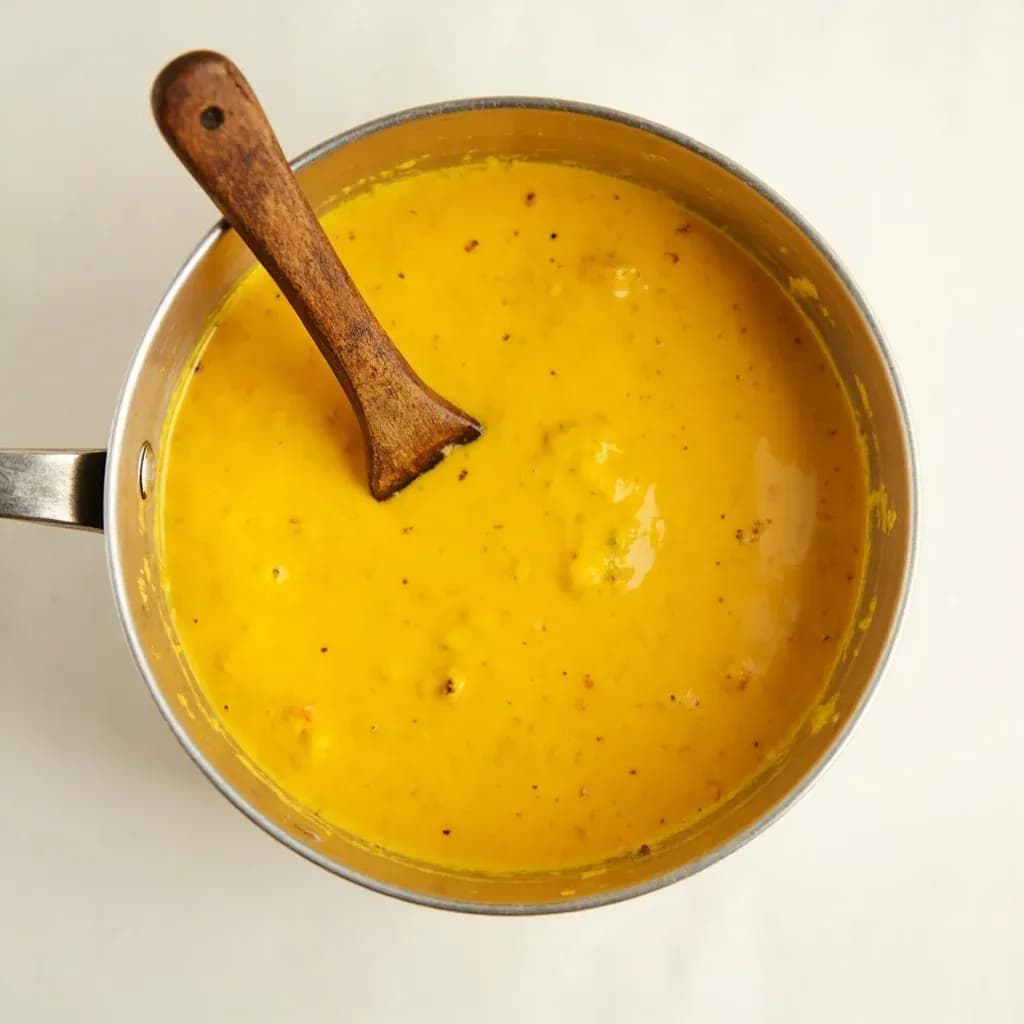
Beating cooked lentils with a churning stick to reach a smooth, creamy consistency.
Swizzling dhal is the South Asian and Caribbean practice of using a wooden churn or swizzle stick to vigorously beat simmered lentils until they break down into a smooth, homogeneous texture. The whisking action emulsifies the starches and blends the seasonings evenly through the pot. It is the step that turns boiled split peas into a velvety dhal.
Swizzling dhal is the traditional Indo-Caribbean and South Asian technique of puréeing fully cooked split pulses into a smooth, pourable consistency by beating them against the inside wall of a deep pot with a stout wooden stick. The motion is more a shearing, side-to-side churn than a stir: the stick is held nearly flat against the metal, and short, rapid strokes walk it around the pot while the cook's other hand braces the vessel. That friction does two jobs at once — it breaks the last intact lentil cotyledons and it whips starch and air into the liquid, producing the satiny body and pale, frothy top layer (called the "face" of the dhal in Trinidad and Guyana) that cooks treat as the mark of a properly made pot.
The technique matters because it works in places and on budgets where electric blenders aren't assumed, and because it produces a texture that isn't quite like a machine-pureed one: lighter, glossier, and slightly aerated, with a viscosity that holds spice oil and tempered aromatics in suspension. It also continues to develop the dish as you work — the dhal becomes more cohesive the longer you swizzle, as starch hydrates and aligns under sustained mechanical effort. In Trinidadian home kitchens the dedicated dhal stick is passed down the way a good chef's knife is elsewhere, and the sound of it ringing against the aluminium dhool is as much a part of dhal as the jeera and garlic.
- Difficulty
- Easy
Types & varieties
Hand-carved hardwood stick, often 25–30 cm, used against the inside wall of a tall aluminium dhool. Traditionally made from saman (monkey pod) or similar dense local wood.
Stout round stick (kaddu-mathu) used more for yogurt and butter than dhal, but applied to dhal in the same back-and-forth motion against the pot wall.
Kitchen-substitute shape: a thick dowel or the handle end of a heavy rolling pin used the same way against a pot wall.
How to do it
- 1
Cook the pulse to collapse
Simmer yellow split peas, toor dhal, or pigeon peas in plenty of water with aromatics until the grains are completely soft, splitting open and beginning to fall apart. The mixture should be loose — wetter than a finished dhal, drier than a soup.
- 2
Transfer to a tall vessel
Move the cooked dhal into a deep, narrow pot (a Trinidadian 'dhool' or a tall stockpot) leaving room at the top. Reserve the cooking liquid in a separate warm pot.
- 3
Set the swizzle stick
Hold the wooden implement in your dominant hand and brace the pot with the other. Lay the tip of the stick nearly flat against the inside wall of the pot, just under the surface of the dhal.
- 4
Swizzle in one direction
Drive the stick back and forth along the wall in rapid, short strokes, rotating around the pot as you go. Keep the strokes consistent and the stick in contact with the metal — the friction is what breaks the lentils.
- 5
Loosen with warm liquor
As the dhal thickens, ladle in small amounts of the reserved hot cooking water. Continue swizzling; the paste should stay fluid enough to ribbon off the stick.
- 6
Work until smooth and frothy
Keep going for 2–5 minutes. The dhal is ready when it is completely smooth, coats the stick evenly, and a pale foam has formed across the top.
- 7
Scrape, season, finish
Run a spoon along the bottom and sides to lift any unworked paste into the main body. Add salt, pepper, and any final seasoning now, give a few final swizzles to incorporate, and rest briefly before serving.
The physics of the swizzle
What looks like simple beating is actually three processes happening at once. The wooden stick, dragged fast across soft cooked lentils, shears the remaining intact cotyledon walls — essentially grating them against the pot wall the way you'd work a roux against a pan. At the same time, the back-and-forth motion entrains air into the starchy liquid, generating the fine pale foam that sits on top of finished dhal. And the sustained mechanical effort hydrates and aligns the freed starch granules, which is why the dhal thickens, glosses, and starts to ribbon off the stick as you work. A stick blender does only the first job; a metal whisk does the second but not the first or the third. The wooden swizzle is the only common tool that does all three at once.
- The wall does the cutting, not the stick — keep the tip in contact with the metal.
- Aeration is what gives the dhal its pale, satiny 'face.'
- Starch alignment is why swizzled dhal thickens as it rests; loosen with hot liquor, not cold.
Reading the dhal
Caribbean cooks judge progress by sight and sound as much as by feel. Early on, the dhal slaps and chunks against the pot; by the middle, it hisses softly and starts to coat the stick; at the end it should run off the swizzle in a continuous ribbon and leave a thin skin on the surface that settles into a glossy layer within a minute or two. If the surface stays flat and dull, the dhal is underworked; if it tightens into a thick paste that won't pour, it's been overworked or tightened with cold liquid.
- Underworked: surface is flat, lentils still visible against the pot wall.
- Ready: pale foam across the top, ribboning off the stick, soft hiss as you work.
- Overworked: heavy paste that clings to the stick and resists loosening — rescue with hot water, not more beating.
Common uses
Tips & pitfalls
- Cook the pulse until individual grains have lost their shape; under-cooked lentils stay grainy no matter how hard you swizzle.
- Hold the stick at a low angle, flat against the inside of the pot, and work the paste in one direction around the vessel rather than stirring in the middle.
- Add hot cooking water (not cold) a ladle at a time — cold water tightens starch and dulls the froth.
- Stop and scrape the underside of the pot every 30–40 strokes; a skin forms and will clump if ignored.
- Do not use a metal whisk or stick blender as a one-to-one replacement — you lose the aerated, satiny body the wooden stick produces.
- Season only after swizzling; salt added before beating tightens the texture and slows the breakdown.
- Rest the worked dhal 5 minutes before serving so the froth settles into a glossy layer on top.
- Common mistake: pressing the stick down into the dhal and 'stirring.' The work happens at the wall — lift, lay flat, and let friction do the cutting.
Good to know
- Also known as
- Dhal beating, dhal churning
- Primary tool
- Wooden swizzle stick / dhal implement or a heavy wooden spoon
- Origin
- South Asian; codified in Indo-Caribbean (especially Trinidadian and Guyanese) cookery
- Lentils most suited
- Yellow split peas (channa dhal), toor/arhar dhal, pigeon peas; any fully softened split pulse
- End texture
- Smooth, pourable purée with a pale, frothy top layer
- Time
- 2–5 minutes of continuous beating after the pulse is fully cooked
- Equipment
- Tall, narrow pot (a 'dhool' in Trinidad) or large deep bowl; wooden stick 20–30 cm long
- Difficulty
- Easy; physically vigorous but technically simple
Also called
Swizzling Dhal · Churning Dhal · Dhal Ghotni
Related

Whisk
Beat ingredients smooth and aerated with a looping wire motion

Sift
Pass dry ingredients through mesh to aerate and remove lumps

Strain
Pour through mesh to separate solids from liquid for a smooth result

Filter
Pass liquid through fine material to clarify out the smallest particles

Rice
Press cooked potatoes through small holes for fluffy, lump-free texture

Mash
Crush soft cooked food into a rustic, creamy purée

Grind
Crush food into a coarse to fine texture, from spices to meat

Grate
Shred food into fine bits against a sharp-toothed surface