Heat & Fire
Twice-Cooking (Hui Guo)
Boiling or steaming meat first, then stir-frying it for layered texture and rendered, crisp edges.
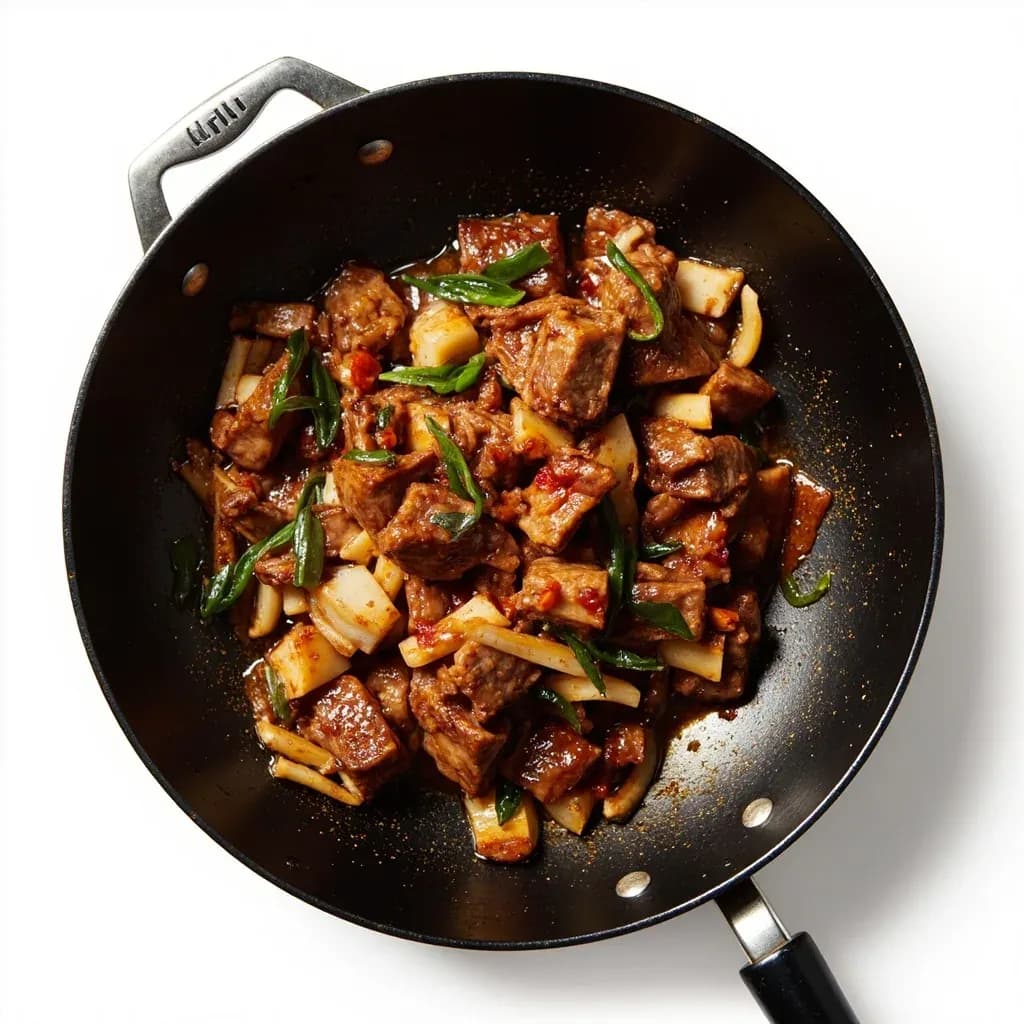
Twice-cooking simmers or steams a protein, most famously pork belly in hui guo rou, then slices it and returns it to a hot wok to stir-fry with aromatics and chili bean paste. The first cook renders fat and firms the meat for clean slicing, while the second cook crisps the edges and curls the slices into 'lamp-shade' shapes. It is a hallmark Sichuan technique that builds both texture and flavor depth.
Twice-cooking, known in Sichuan as hui guo (回鍋, literally "return to the wok"), is a structural technique in which a piece of meat is first gently simmered to set its texture, then rested, sliced, and finished in a smoking-hot wok with a bold, oil-based sauce. The first cook gives the cook total control over doneness and produces a firm, sliceable block; the second cook drives off surface moisture, renders the fat cap, and lets the slices drink in aromatics and fermented pastes without ever overcooking the protein. It is the engine behind Sichuan's most famous pork dish, hui guo rou, and it is fundamentally different from a simple stir-fry because the meat has already been cooked once.
The genius of the method is that it splits a problem into two manageable stages. A raw pork belly stir-fried directly would be chewy in the fat and rubbery at the lean edge, and the skin (if left on) would never behave. A boiled-and-then-fried belly, by contrast, slices cleanly, the fat renders into the wok on contact with heat, and the slices curl into the dish's signature "lantern" shape as the lean layer contracts faster than the fat. The same logic extends to any cut that benefits from controlled doneness and a final high-heat sear, which is why the technique travels far beyond its birthplace.
Outside Sichuan, the hui guo idea shows up wherever cooks have figured out that a pre-cook sets you up for a better sear: Japanese chashu finished in a hot pan, Thai-style crispy pork belly, even a Western pot-roast sliced and crisped before saucing. What makes the Sichuanese version distinct is the second-cook flavor base — Pixian doubanjiang bloomed in rendered pork fat — and the visual signal of correctly rendered slices curling at the edges like little oil lamps (dēng zhǎn wō, 燈盞窩).
- Difficulty
- Medium
Types & varieties
Pork belly stir-fried with garlic sprouts (garlic chives) — the textbook version
With green chili peppers for sharper heat, a slightly different regional style
With flowering chives (yongcai) for a more herbal, almost floral note
With napa cabbage, a humble home-style stretch variation
With lotus root for crunch and a nutty edge
Fish-fragrant sauces share the twice-cook structure (yu xiang rou si, yu xiang qie zi) but use ginger, garlic, scallion, and pickled chili rather than garlic sprouts
How to do it
- 1
Select and trim the pork
Use about 400–500 g of pork belly per dish, skin on or off. Trim any very loose external fat but keep the fat cap intact — the rendering is what gives the dish its body and the slices their curl.
- 2
First cook: simmer with aromatics
Place the pork in a pot and cover with cold water. Add smashed ginger, smashed scallion whites, and optionally a teaspoon of Sichuan peppercorns. Bring to a gentle simmer and cook 20–25 minutes for belly, or until a chopstick pierces with slight resistance (internal temperature around 70°C/160°F). Do not boil hard — an aggressive boil roughens the surface and squeezes out flavor.
- 3
Cool and dry the meat
Remove the pork and let it cool to room temperature, ideally resting in the cooking liquid so it does not dry out. Pat the surface dry before slicing; surface moisture will cause violent spattering in the hot wok.
- 4
Slice against the grain
Slice the pork about 3–4 mm thick, cutting across the grain. The slices should bend without snapping. If the meat resists slicing cleanly, chill it 15–20 minutes to firm up the fat.
- 5
Render in a hot, dry wok
Heat a wok over high heat until just smoking. Add the pork slices in a single layer — no oil. Press them flat with the spatula and leave them undisturbed for 20–30 seconds so they brown. Stir-fry until the slices have curled into lantern shapes and the fat has rendered down, about 2–3 minutes total. Spoon off excess fat if you prefer a lighter result; leave a few tablespoons in the wok.
- 6
Bloom the sauce base
Push the pork to the sides of the wok. Add 1–2 tablespoons of Pixian doubanjiang (chopped if coarse), 1 teaspoon of tianmianjiang if using, and a small pinch of sugar into the hot fat. Stir-fry 15–20 seconds until the paste turns glossy and the oil reddens — this is the flavor foundation.
- 7
Add harder vegetables and aromatics
Add sliced garlic, ginger, and any firmer vegetables (chili peppers, cabbage, lotus root). Toss for 30–60 seconds so they take on the chili oil.
- 8
Add soft vegetables and finish
Add garlic sprouts cut into 5–6 cm lengths (or leek whites and greens separately). Toss briskly for 20–30 seconds — the sprouts should stay bright and just wilted. Taste; adjust with a touch of soy or sugar. Plate immediately.
The lantern curl, and what it tells you
The dēng zhǎn wō shape is not decoration; it is a reading. When a slice of pork belly with a balanced fat-to-lean ratio hits a properly hot dry wok, the lean layer shrinks faster than the fat layer. The slice bows outward at the fat edge, and the whole piece curls into a shape that looks like a small oil lamp — a rounded well on the inside, crisp browned lip on the outside. If your slices lie flat, the pan was not hot enough or the cut was too lean. If they shrivel into tight tubes, the belly was either too thin or the simmer ran too long and the fat has lost its structure. Cooks in Chengdu treat the curl as the readiness signal that the wok is ready for the sauce.
- Look for the curl before adding doubanjiang — once you see it across the batch, the flavor base can go in immediately.
- A balanced belly (roughly 1:1 fat to lean, or slightly fattier) curls best; a lean shoulder stays flat and tastes dry.
- If the slices resist curling, the problem is almost always the cut, not the fire.
The principle beyond Sichuan
Hui guo is best understood as a template, not a single recipe. Anywhere a cook wants the clean slice of a pre-cooked piece of protein and the browned, sauced finish of a stir-fry, the same two-stage structure applies. The first cook can be a simmer, a steam, a poach, or even a low roast; the second cook is always high-heat, fast, and sauce-driven.
- Boiled pork shoulder sliced and crisped with scallions and soy is hui guo in spirit, even without doubanjiang.
- Chashu-style braised pork finished in a hot skillet with a glaze follows the same arc.
Common uses
Tips & pitfalls
- Choose pork belly with a balanced fat-to-lean ratio (about 1:1 or slightly more fat). Lean cuts will not render the signature curling and will taste dry.
- Do not fully cook the pork in the simmer — pull it when a chopstick slides in with a little resistance. Overcooking makes the slices fall apart in the wok and turns the lean layer mealy.
- Cool the meat fully before slicing. Resting in the cooking liquid prevents the surface from drying out; a quick chill in the refrigerator firms the fat for cleaner cuts.
- Render the meat in a dry, smoking-hot wok with no added oil. The pork supplies its own fat; oil at this stage makes the dish greasy and prevents proper browning.
- Press the slices flat against the wok with the spatula so they brown evenly and curl into the lantern shape rather than steaming in a pile.
- Add doubanjiang to the rendered fat, not to raw meat. Toasting the paste in hot oil blooms the chili and ferments the flavor; adding it to a cold wok yields a flat, raw taste.
- Garlic sprouts (or leeks) go in last and should stay crisp-tender. Overcooking them is the most common home mistake and turns the dish dull and heavy.
- Balance the doubanjiang's salt with a small pinch of sugar; tianmianjiang (sweet wheat paste) can be used instead for a rounder, less fiery profile.
Good to know
- Chinese name
- 回鍋 (huí guō), literally "return to the wok"
- Origin
- Sichuan, China; centered on Chengdu
- Signature dish
- Hui Guo Rou (回鍋肉), twice-cooked pork
- First-cook method
- Gentle simmer in water with ginger, scallion, optional Sichuan peppercorn
- Second-cook method
- Hot-wok stir-fry with aromatics and fermented bean pastes
- Key seasonings
- Pixian doubanjiang (fermented broad bean and chili paste), tianmianjiang (sweet wheat paste), garlic, ginger
- Defining visual cue
- Slices curl into a "lantern" shape (燈盞窩) as fat renders and edges brown
- Slice thickness
- About 3–4 mm (roughly 1/8 in)
- Equipment
- Wok, wok spatula, slotted spoon or spider, sharp slicing knife
Also called
Hui Guo Rou · Twice-Cooked Pork
Related

Sear
Blast the surface hot for a deep-browned, savory crust

Sauté
Cook quickly in a little fat over lively heat, tossing as you go

Stir-Fry
Toss bite-sized pieces over roaring heat for fast, smoky cooking

Pan-Fry
Crisp food in a shallow layer of hot fat, turning once or twice

Deep-Fry
Submerge in hot oil for an all-over crackling crust

Roast
Cook uncovered in dry oven heat for browned edges and tender centers

Bake
Cook with steady, surrounding oven heat — the soul of bread and pastry

Broil
Hit food from directly above with fierce overhead heat