Water & Steam
Water Temperature Control
Holding cooking or steeping water at a precise temperature for delicate results.
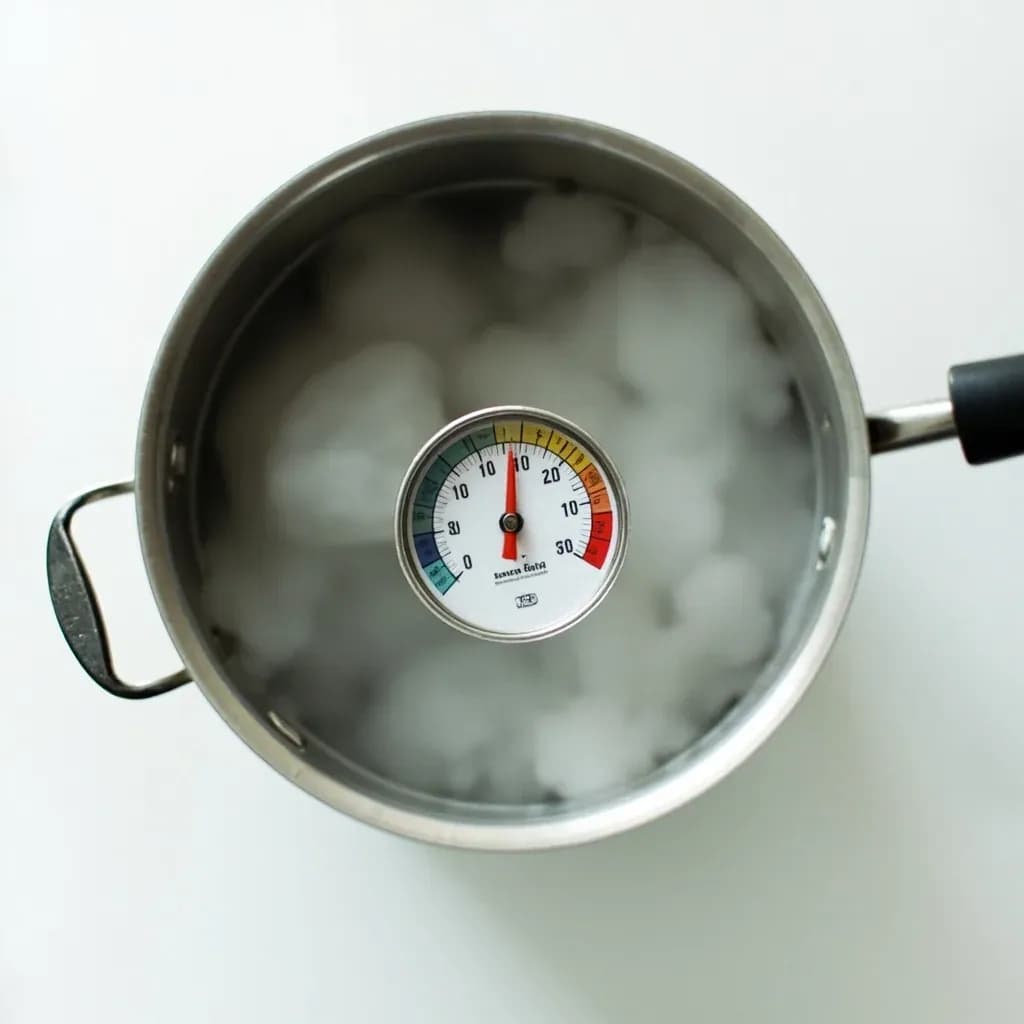
Water temperature control is the practice of heating water to and holding it at a specific temperature rather than a rolling boil. It matters for poaching eggs and fish, brewing green tea, blooming yeast, and any task where too-hot water would toughen, curdle, or scorch the ingredient. Cooks judge it by visual cues, simmer to gentle boil, or with a thermometer for precision.
Water temperature control is the practice of holding water — or a water bath — at a precise, steady temperature rather than letting it roll to a full boil or cool off the heat. Most overcooking in home kitchens traces back to ignoring this: a steak dropped into water that's five degrees too hot tightens its proteins past the point of tenderness, a custard goes from silken to scrambled in the gap between 175°F and 185°F, and chocolate blooms on the counter because it was never coaxed through its three tempering windows. The technique is less a single recipe than a cluster of methods — poaching, simmering, scalding, sous vide, tempering, bain-marie baking — united by one principle: heat behaves differently at 160°F than at 212°F, and the difference is the meal.
The temperature spectrum is wider than most cooks realize. A bare simmer sits around 185°F, a gentle poaching bath at 165°F, a rolling boil at 212°F at sea level. Between those bands live the real cooking decisions: where whites set but yolks stay liquid, where yeast wakes up but does not die, where milk denatures its whey proteins for a smoother dough, where egg yolks thicken without curdling. Water is the medium that makes those temperatures visible and controllable. A thermometer turns the stovetop from a guess into a dial.
The technique scales from a $15 probe thermometer and a heavy pot to a $150 immersion circulator that holds a bath within half a degree for twelve hours. A clip-on probe covers most home poaching, scalding, and held-simmer work. A double boiler or bain-marie is irreplaceable for gentle melting and custard baking. An immersion circulator unlocks the full sous vide library and stress-free custard work. From there, the same physics underlies sugar-cooking stages, chocolate tempering, and yeast proofing — water is just the visible carrier of the temperature that does the actual work.
- Difficulty
- Medium
Types & varieties
Pumps heated water around vacuum-sealed food for ±1°F precision across hours.
Indirect gentle heat from a bowl set over simmering water; classic for chocolate, custards, hollandaise.
Large hotel pan filled with water, held at setpoint; pastry workhorse for cheesecakes and terrines.
Manual control with a clip-on thermometer; relies on burner and lid adjustments to hold 180–200°F.
Kettles with presets for green, white, oolong, black, and French press; steeps tea at the correct leaf temperature.
Cooling molten chocolate with chopped callets or pistoles to induce stable beta crystals without a marble slab.
Sugar syrups measured by temperature: thread 230°F, soft ball 235°F, firm ball 245°F, hard ball 250°F, soft crack 270°F, hard crack 300°F, caramel 320–350°F.
Keeps finished food at 140–160°F (60–71°C) during service without overcooking.
How to do it
- 1
Choose your method
Decide whether you need precision (sous vide circulator, double boiler) or approximation (stovetop with a thermometer). For anything within ±2°F, use a circulator or bain-marie; for ±5–10°F work, a heavy pot and a clip-on probe suffice.
- 2
Calibrate your thermometer
Fill a glass with crushed ice, top with cold water, stir, and insert the probe — it should read 32°F (0°C). Then check a rolling boil — 212°F (100°C) at sea level. Adjust or replace the thermometer if it reads off by more than 2°F.
- 3
Bring the water up to target
Fill the pot, bath, or circulator vessel with water, set the heat or circulator to your target temperature, and cover partially to speed the climb without superheating the surface.
- 4
Confirm and stabilize
Wait until the thermometer reads your target and holds steady for at least 60 seconds before adding food. A circulator's 'ready' light usually means stable; stovetop water can overshoot — pull it off the heat and let it settle.
- 5
Add food at the right moment
Lower eggs, fish, bags, or bowls gently so you don't crack the surface tension (which roughens poached whites) or drop the bath temperature. Pre-warm cold items in warm water first when possible.
- 6
Monitor and adjust
Watch the thermometer, not the clock. Adjust burner, lid position, or circulator setting to hold within range. For long holds, top up with hot water and skim foam or scum as needed to keep the liquid clean.
- 7
Finish and rest
Remove food when it reaches its target internal temperature (or its bath-time finish for sous vide). Hold briefly off-heat, or ice-bath sous vide bags before searing, to lock in the exact doneness and prevent carryover overcooking.
The Temperature Ladder
Almost every kitchen task has a narrow band where it works and a wide zone where it fails. Learning the bands is more useful than memorizing recipes.
- 100–115°F (38–46°C) — yeast proofing, melting butter gently, blooming gelatin.
- 130–145°F (54–63°C) — sous vide for rare steak, beef brisket, fish; rare to medium-rare doneness.
- 150–165°F (66–74°C) — sous vide chicken and pork to juicy, food-safe internal temps; low scrambles in a double boiler.
- 160–180°F (71–82°C) — poaching eggs, fish, chicken; scalded milk; custard setting.
- 180–200°F (82–93°C) — bare simmer for stocks, braises, poaching tougher cuts, cooking dumplings without tearing wrappers.
- 200–212°F (93–100°C) — black and herbal tea steeping; blanching; hard-boiled eggs; pasta.
Choosing the Right Tool
Match the tool to the precision you actually need. Most home work falls into two camps:
- Clip-on probe thermometer + heavy pot: covers poaching, scalding, held simmers, blanching, candy stages to within a few degrees. Cheap, reliable, no learning curve.
- Instant-read thermometer: spot checks, not for holding; too slow to react in a circulating bath.
- Double boiler: gentle, indirect heat for chocolate, hollandaise, delicate sauces. Cap at about 180°F even with a hard boil underneath.
- Immersion circulator: ±0.5°C precision for hours. Worth it if you cook sous vide, bake custards in a water bath, or hold delicate sauces for a dinner party.
- Variable-temperature kettle: solves the tea problem cheaply; presets take the guesswork out of green, white, oolong, and black.
Common uses
Tips & pitfalls
- Calibrate any new thermometer in ice water (32°F / 0°C) and boiling water (212°F / 100°C at sea level) before trusting it — most are off out of the box.
- Use a clip-on probe thermometer when holding a pot for more than a few minutes; instant-reads are for spot checks only.
- Never trust 'medium-low' as a temperature. A thermometer turns guesswork into precision and is the single biggest upgrade a home cook can make.
- When scalding milk, pull it off the heat the moment it foams and steams — it climbs another 5–10°F from residual heat and will scorch if you wait.
- For sous vide, account for carryover and thickness: a thick ribeye at 130°F needs longer to equalize than a thin steak, even at the same bath temperature.
- Add salt to poaching water only after the eggs are in — salt on the surface can spread the whites before they set.
- Never let even a drop of water or steam contact melted chocolate — it seizes into a grainy, thick mass that needs cream to rescue.
- A heavy-bottomed pot holds temperature more steadily than thin stainless; better for held simmers, and easier on the cook.
- Replenish a poaching or simmering pot with hot water from a kettle, not cold, so the temperature does not plunge and stall the cook.
- For custards, pull them 5°F short of target — carryover finishes them on the bench and prevents the dreaded rubbery, weeping texture.
Good to know
- Key temperature bands
- Poach 160–180°F (71–82°C); simmer 180–200°F (82–93°C); rolling boil 212°F (100°C at sea level).
- Egg poaching sweet spot
- 160–170°F (71–77°C) — whites set, yolks stay liquid, no agitation needed.
- Yeast proofing
- Ideal 105–115°F (40–46°C); water above ~140°F (60°C) kills yeast outright.
- Milk scalding
- 180°F (82°C) — just below a simmer, used to deactivate whey proteins for baking and custards.
- Custard doneness
- Cooked to 170–180°F (76–82°C) to set eggs without curdling; pull 5°F short to let carryover finish.
- Tea steeping guide
- Green 160–180°F (71–82°C); white 170–180°F (77–82°C); oolong 180–200°F (82–93°C); black & herbal 200–212°F (93–100°C).
- Chocolate tempering (dark)
- Melt to 115–120°F (46–49°C), cool to 82–84°F (28–29°C), rewarm to 88–90°F (31–32°C).
- Altitude effect
- Boiling point drops roughly 1°F per 500 ft above sea level; adjust downward or extend cook times.
- Equipment
- Instant-read or probe thermometer, sous vide immersion circulator, double boiler, bain-marie, induction plate, thermal immersion heater.
Also called
Water Temperature Control · Temperature Control
Dishes that rely on it
Related

Boil
Cook in vigorously bubbling liquid at full rolling heat

Simmer
Hold liquid at a gentle shimmer for tender, unhurried cooking

Poach
Cook gently in barely-trembling liquid for silky, tender results

Steam
Cook in rising vapor to keep color, nutrients, and shape intact

Blanch
Plunge briefly in boiling water, then shock cold to lock color

Braise
Sear, then cook slow in a little liquid until fall-apart tender

Stew
Simmer bite-sized pieces fully submerged into a rich, unified pot

Sous-Vide
Seal and cook in precise warm water for edge-to-edge doneness