Prep & Assembly
Weighing Ingredients by Mass
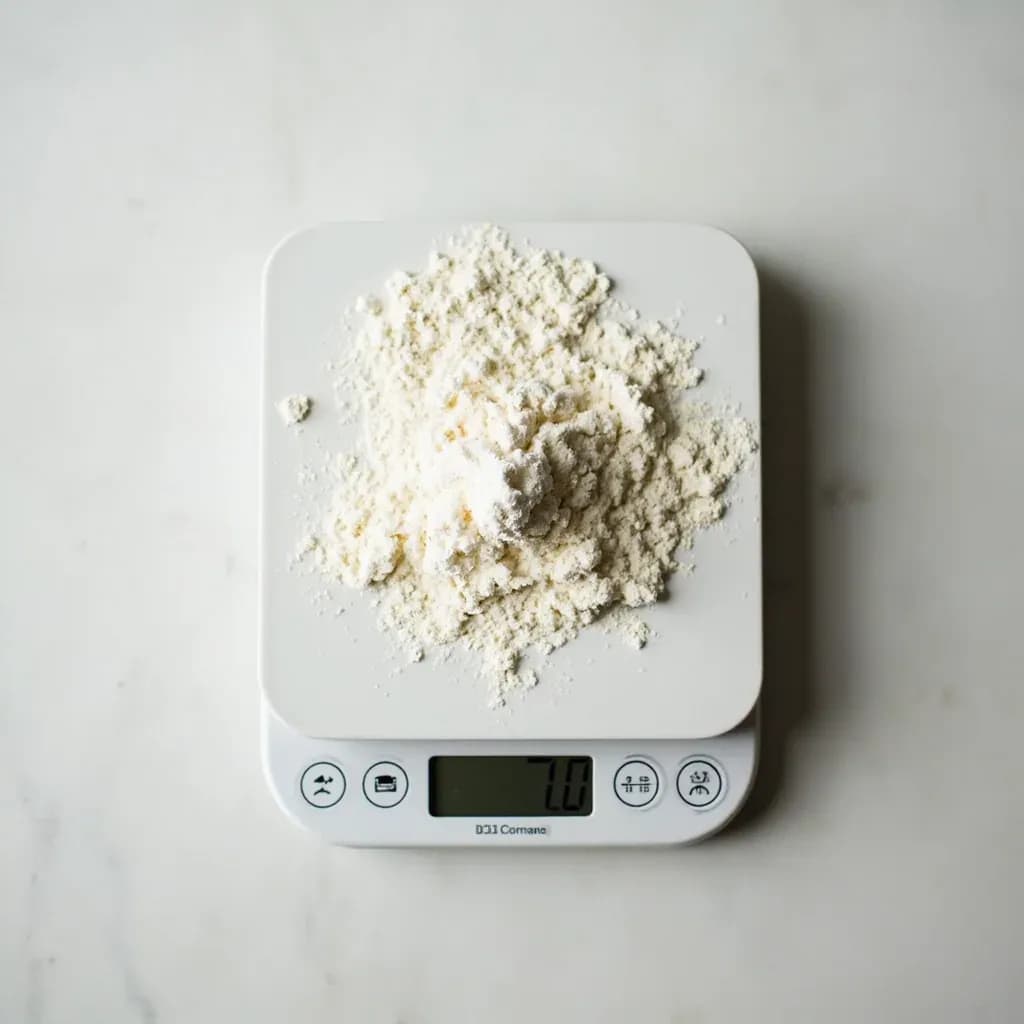
Measuring ingredients by weight on a scale for accuracy and repeatable, scalable recipes.
Weighing by mass uses a scale to portion ingredients precisely, avoiding the variability of volume measures like cups. It is essential in baking and pastry, where small ratio errors change the outcome, and underpins baker's percentages. Weighing also speeds batch scaling and makes recipes reproducible across kitchens and equipment.
Weighing by mass is the practice of measuring ingredients on a scale rather than in cups and spoons, and it is the default in professional pastry, bread baking, and food production. The reason is straightforward: a gram of flour is a gram of flour, but a "cup" of flour can be anywhere from 125 g to 160 g depending on humidity, how the bag was handled, and whether the cup was scooped, spooned, or shaken. The variability of volume measures is the single largest source of inconsistency in home baking, and switching to a scale is the most reliable way to make any recipe reproducible.
In practice, weighing collapses an entire mise en place into a single bowl. The cook tares the scale between ingredients, building the formula one component at a time without a forest of measuring cups, spoons, and a knife for leveling. The same workflow scales linearly: doubling the gram weights doubles the recipe exactly, while doubling volumetric flour can quietly throw off the ratio of flour to liquid, leavening, and fat.
Water and a handful of other ingredients are the exception. Liquids with a density near water, plus the conveniently pre-portioned American butter stick, are cases where volume and mass are interchangeable. For powders, chopped produce, brown sugar, oats, and anything aerated, they are not, and a scale is the only honest way to measure.
- Difficulty
- Easy
Types & varieties
The modern home and small-production standard. 0.1 g or 1 g resolution, tare function, battery- or USB-powered. Common brands include MyWeigh, Escali, OXO, and Breville.
Two-pan mechanical balance with sliding poises. Historically the bakery standard and still seen in teaching kitchens and some European patisseries. No batteries required.
Dial or vertical-pointer type. Less accurate, prone to drift over time, and generally not recommended for precise baking.
0.01 g resolution. Useful for very small quantities such as yeast, salt in brines, and spices, but limited to roughly 100–500 g capacity.
Larger-capacity (10–30 kg) industrial scale used in production kitchens, butcher shops, and food manufacturing.
How to do it
- 1
Set up the scale
Place a digital kitchen scale on a flat, stable surface away from drafts and vibrations. Turn it on and let it stabilize for a few seconds if it has been in a cold environment. Confirm it reads zero with nothing on it.
- 2
Place and tare the container
Set the mixing bowl (or any vessel) on the platform and press the tare button. The display should return to 0.0 g. If weighing into multiple vessels, tare each one separately.
- 3
Add the first ingredient to target mass
Add the ingredient gradually, pouring or spooning until the display shows the target weight. For powders like flour, pour from a low height to avoid losing material to the air, then use a spoon for the last few grams.
- 4
Tare between ingredients
Without removing the bowl, press tare again to reset the display to 0.0 g. Add the next ingredient to its target mass and repeat until every component is in the bowl. Taring between additions, rather than tracking a running total, is the step where most cooks slip up.
- 5
Verify total mass when needed
For formulas where the total weight matters, including many bread doughs, sausages, terrines, and layered dishes, clear the tare and read the combined weight of bowl and contents.
- 6
Handle liquids and sticky ingredients
Weigh liquids directly in the bowl; their density near 1 g/mL makes the reading exact. For honey, molasses, syrups, or nut butter, lightly oil the bowl first or pre-weigh the empty jar, dispense the sticky ingredient, and subtract the tare.
- 7
Read and record
Note the gram weight of every ingredient used, especially when developing or adapting a recipe. Replace volume measures with mass in the written version so the next attempt, and anyone else who cooks it, gets the same result.
Converting Volume to Mass
American home recipes still use cups, so a working knowledge of common ingredient weights is useful when a scale is at hand. The numbers below are reliable starting points for most home baking; treat them as references rather than absolutes, and adjust if a tested recipe is failing.
- Water, milk, and cream: 1 mL ≈ 1 g, so 1 US cup (about 237 mL) weighs about 237 g.
- Granulated sugar: 1 cup = 200 g; rarely deviates by more than a few grams.
- Brown sugar, firmly packed: 1 cup = 213 g for either light or dark.
- All-purpose flour, spooned and leveled: 1 cup = 125 g (USDA standard); scooped directly from the bag, it can reach 160 g.
- Unsalted butter: 1 stick = 113 g; 1 cup (2 sticks) = 227 g.
- Table salt: 1 cup ≈ 292 g; Morton kosher ≈ 245 g; Diamond Crystal kosher ≈ 220 g.
- Honey: 1 cup ≈ 340 g; maple syrup: 1 cup ≈ 320 g.
- Rolled oats: 1 cup ≈ 90 g.
Why a Scale Pays for Itself
A reliable digital scale costs roughly the same as a good set of measuring cups, takes up less drawer space, and produces more consistent results in less time. The arithmetic of baking rewards consistency: a 10% error in flour, applied across a 500 g recipe, is 50 g, the difference between a tender cake and a heavy one. Once a cook trusts the gram, recipes stop being mysteries and start being formulas.
- 0.1 g resolution covers almost all baking and most savory work.
- Taring between ingredients means one bowl, fewer dishes, and no leveling step.
- Portioning dough, meat, or individual servings to a target weight is faster than dividing by eye.
- Mass scales linearly when doubling or halving a recipe; volumetric flour does not.
- Legal food labeling and professional recipe costing both require mass, not volume.
Common uses
Tips & pitfalls
- Tare the scale with the empty bowl before each addition rather than tracking a running total; piling a running total is the most common source of silent compounding errors.
- Place the scale on a flat, hard, vibration-free surface; a wobbly counter, soft mat, or running dishwasher will degrade the reading.
- For sticky ingredients such as honey, molasses, and peanut butter, weigh into a lightly oiled bowl, or pre-weigh the wrapper and subtract, instead of scraping and guessing.
- Do not assume 1 cup = 240 g (or 237 g) for everything; flour, sugar, salt, oats, and cocoa each differ, and treating them as equal is a frequent cause of failure when converting an old recipe.
- Weigh flour after aerating it (fluffed, spooned loosely) and before compacting; tapping the cup or shaking the bowl can quietly add 10–20% mass and a tough crumb.
- Weigh brown sugar after packing it firmly into the bowl until it holds its shape; a loose 213 g will bake differently from a packed 213 g by volume, even at the same mass.
- Use 0.1 g resolution whenever salt, baking soda, baking powder, yeast, or spices are involved, where a 1 g error is meaningful.
- Check scale accuracy periodically with a calibration weight or a known reference; a new US nickel weighs 5.000 g.
Good to know
- Primary unit (metric)
- Grams (g), with kilograms (kg) for large batches and milligrams for very small amounts like yeast or salt.
- Primary unit (US)
- Ounces (oz) and pounds (lb); 1 lb = 453.6 g, 1 oz = 28.35 g.
- Standard reference for water
- 1 mL of water ≈ 1 g at room temperature, so liquids convert directly between volume and mass.
- All-purpose flour reference
- USDA standard is 125 g per US cup; the scoop-and-sweep method routinely yields 140–160 g, a 15–25% discrepancy.
- Salt variance
- 1 cup of table salt is about 292 g, Morton kosher about 245 g, and Diamond Crystal kosher about 220 g, a major reason volume salt measurements are unreliable.
- Brown sugar reference
- 1 firmly packed cup = 213 g for either light or dark; weight is more consistent than packed volume.
- Granulated sugar reference
- 1 cup = 200 g (USDA) and rarely deviates more than a few grams.
- Butter shortcut
- 1 stick = 113 g = 4 oz = ½ cup, one of the few ingredients where volume and mass are both exact.
- Accuracy advantage
- A digital scale at 0.1 g resolution is roughly 10–100× more accurate than a measuring cup or spoon.
- Equipment
- Digital load-cell kitchen scale, typically 0.1 g or 1 g resolution with a 5 kg capacity; balance and spring scales remain in limited professional use.
- Adoption in pro kitchens
- Universal in pastry and bread work since at least the early 20th century; standard in professional baking globally.
- Home adoption
- Accelerated by 2010s digital scale affordability and ratio-based cookbooks such as Michael Ruhlman's 'Ratio' (2009).
Also called
Weighing Portions · Food Weighing · Scaling · Gravimetric Measuring
Related

Whisk
Beat ingredients smooth and aerated with a looping wire motion

Sift
Pass dry ingredients through mesh to aerate and remove lumps

Strain
Pour through mesh to separate solids from liquid for a smooth result

Filter
Pass liquid through fine material to clarify out the smallest particles

Rice
Press cooked potatoes through small holes for fluffy, lump-free texture

Mash
Crush soft cooked food into a rustic, creamy purée

Grind
Crush food into a coarse to fine texture, from spices to meat

Grate
Shred food into fine bits against a sharp-toothed surface