East Asia
Chongqing Hot Pot
Also: 重庆火锅, Chongqing huoguo, Chongqing mala hot pot
Chongqing's fiercely red, tallow-based communal cauldron — the world's most intense and deeply flavored hot pot tradition, a city-defining ritual of communal eating.
Chongqing hot pot (重庆火锅) is a communal table-cooking tradition in which raw ingredients are cooked tableside by dipping them into a bubbling, scarlet broth built on beef tallow, dried chilies, Sichuan peppercorns, doubanjiang (fermented broad bean paste), and a proprietary blend of thirty or more dried spices. It is distinct from Sichuan hot pot in fundamental ways: Chongqing's broth is tallow-based (not oil-based), markedly more intensely spiced, and tied to a specific industrial city culture shaped by the Yangtze River dock-workers who invented it. The traditional dipping sauce is sesame oil with garlic — the fat coating protects the mouth from the extreme heat of the broth. Chongqing has been referred to as 'the hot pot capital of the world,' with the city hosting an estimated 30,000+ hot pot restaurants.
The flavour base
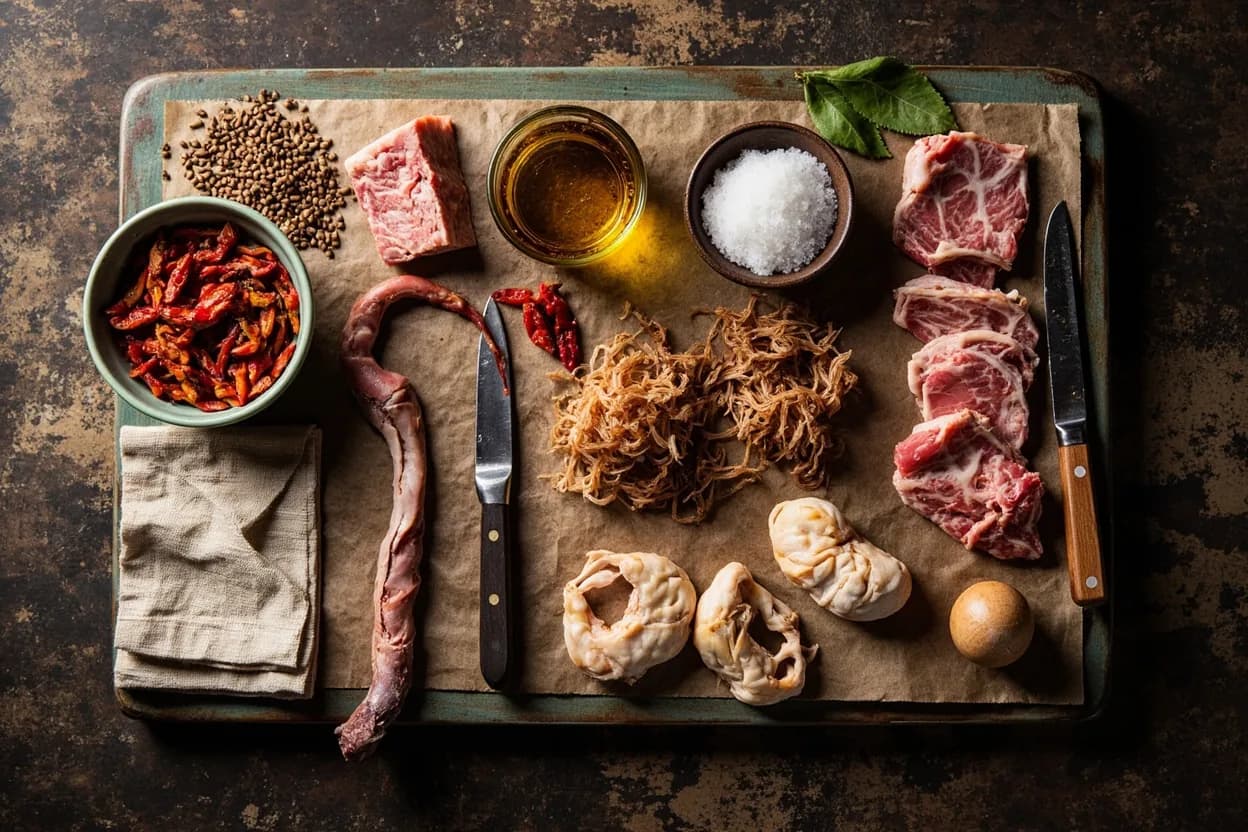
Beef tallow (牛油) is the fat base, giving the broth a rich, unctuous body distinct from oil-based broths. The foundational aromatics are doubanjiang (郫县豆瓣酱, Pixian fermented bean paste), dried Facing Heaven chilies (朝天椒), Sichuan peppercorn (花椒), black cardamom, star anise, cassia bark, fermented black beans, and ginger. The broth is boiled for hours, sometimes from a decades-old base kept perpetually alive (like a sourdough starter), before service.
Pantry staples
Key ingredients
Signature techniques
Signature dishes
Chongqing Hot Pot on the table

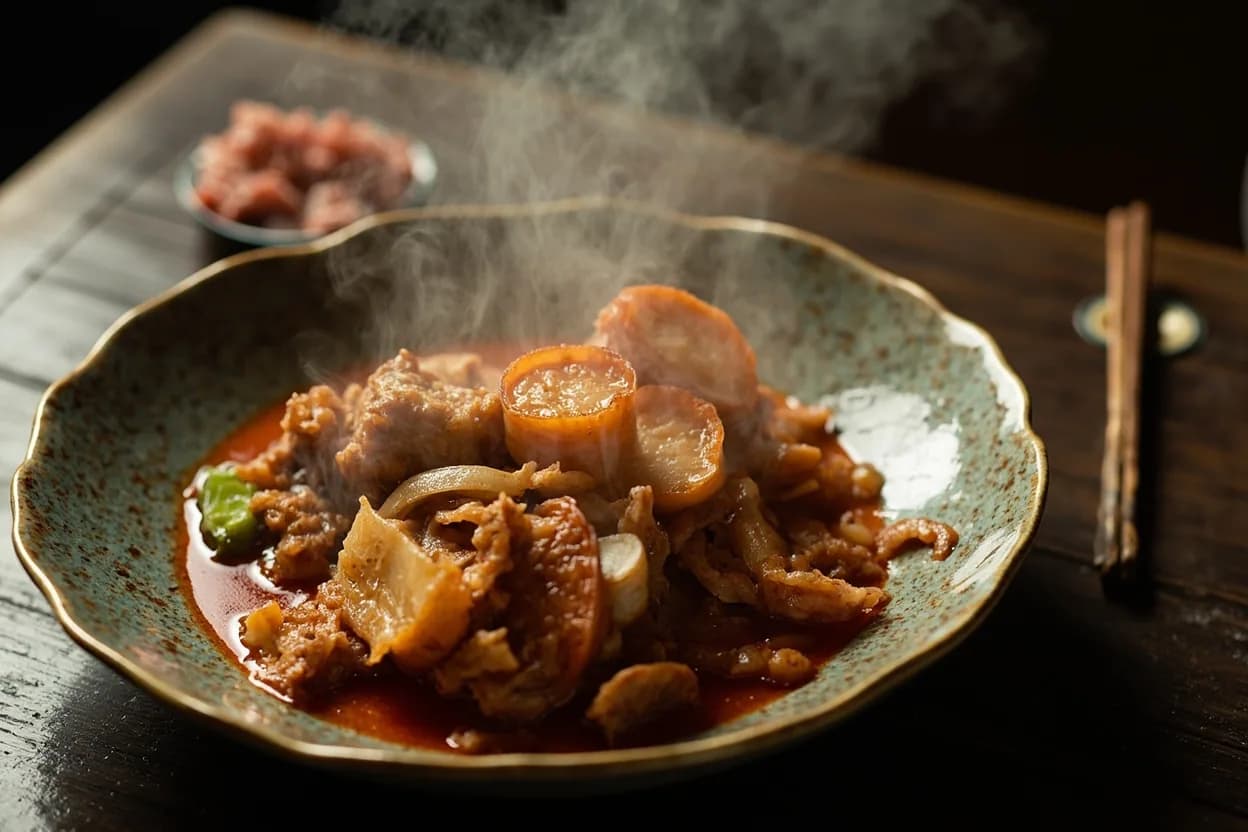
At the table
Hot pot is an immersive, extended communal meal of two to four hours, structured around successive rounds of ordering and cooking raw ingredients at the table. A typical table orders several rounds of meat (thinly sliced beef, offal, pork), vegetables (lotus root, leafy greens), tofu products, and noodles for the end. The meal is fundamentally social — conversation, shared cooking, and communal broth management are as central as eating. Chongqing locals often eat hot pot past midnight; 24-hour hot pot restaurants are common. The experience concludes with adding noodles to the enriched broth as a final course.
History & context
Chongqing hot pot is widely credited to the boat-trackers and dock workers of the Chaotianmen docks on the Yangtze and Jialing rivers in the late Qing dynasty (late 19th–early 20th century). These workers — who hauled boats upstream through treacherous gorges — subsisted on cheap cuts of beef offal discarded by slaughterhouses: tripe, intestines, liver, brain. They cooked these in large communal pots of boiling spiced water over riverbank fires. The beef tallow, doubanjiang, and chili base were a practical and economic choice: cheap, warming, antiseptic. As Chongqing industrialized through the Republican era and became a wartime capital (1937–1945), hot pot expanded from dockside subsistence to city-wide institution. The post-1978 reform era saw it commodify into restaurants, chains (Dezhuang, Little Sheep, Haidilao — the last now publicly traded), and eventually global franchise expansion. The Chongqing municipal government declared hot pot a municipal cultural symbol, and the city's hot pot restaurant density — estimated at one per 700 residents — is unmatched anywhere in the world.
Regional variations
- Old Chongqing style (老重庆火锅)
Strictly tallow-based, uses a perpetual base pot, more offal-forward, less sweet, extreme spice levels — considered the authentic heritage form
- Sichuan hot pot (Chengdu-style)
Often oil-based rather than tallow, slightly less aggressively spiced, more willing to use nut-oil broths; Chongqing locals consider this a diluted version
- Yin-yang pot
A divided pot serving both the scarlet mala broth and a mild clear or tomato broth for tables mixing heat tolerances; increasingly common in hot pot chains
Related cuisines
Both traditions share the mala flavor base from the Sichuan peppercorn-chili combination but represent wholly different dining occasions and formats
Chongqing was historically part of Sichuan province until 1997; the cuisines share key ingredients but Chongqing hot pot is fiercely locally identified
- Mongolian hot pot
The broader Chinese hot pot tradition traces some origins to Mongolian shabu-shabu-style cooking; Chongqing's version is the most divergent and distinctive regional evolution
Canonical recipes
The dishes that define Chongqing Hot Pot, documented in the Canon.
References
- 1.The Food of Sichuan — Fuchsia Dunlop (W.W. Norton, 2019)
- 2.Shark's Fin and Sichuan Pepper — Fuchsia Dunlop (W.W. Norton, 2008)
- 3.The Omnivore's Dilemma — Michael Pollan (Penguin, 2006) [background on chili economics]
Confidence: high
Notes
The tallow distinction
The use of beef tallow rather than vegetable or neutral oil is the single most important technical distinction between Chongqing and Sichuan hot pots. Tallow has a higher melting point and a complex fatty-acid profile that gives Chongqing broth its characteristic unctuous body, ability to carry aromatic compounds, and the thick, lipid-rich coating it leaves on every ingredient. Purists insist that the full depth of a Chongqing mala broth is simply inaccessible in an oil-based version.
The perpetual base
The most storied Chongqing hot pot establishments maintain a 老汤 (lǎo tāng, 'old broth') base that is never fully discarded — only replenished. Like a sourdough culture, this perpetual stock accumulates depth over months and years. Some restaurants claim bases going back decades. Whether this claim is literal or aspirational, the principle is real: yesterday's reduced, spice-saturated tallow is the foundation for today's pot.