Natural form
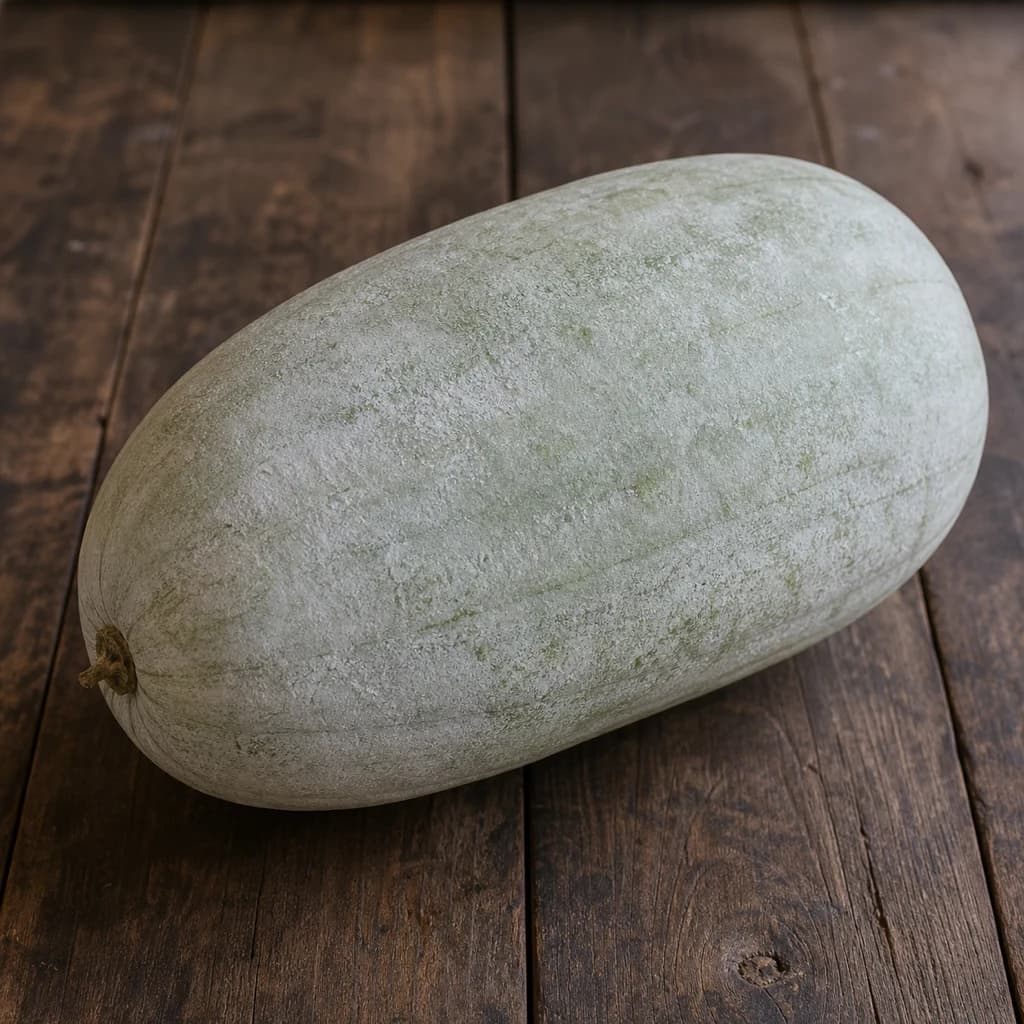
Whole ash gourd showing its distinctive pale green skin dusted with chalky white bloom.
Shows the reader the full size, shape, and identifying chalky-bloom exterior that makes ash gourd unmistakable at market.
Produce
Ash Gourd (Winter Melon)
Large pale gourd with mild flesh, simmered in curries, soups and candied sweets.
Ash gourd, also called winter melon, is a large pale-green gourd coated with a chalky white bloom and filled with mild, watery white flesh. It is widely used in Indian, Chinese, and Southeast Asian cooking for curries, dals, and clear winter melon soup, and is candied into sweets like petha. The flesh is nearly flavorless and readily absorbs the spices it is cooked with.
Ash gourd (Benincasa hispida) is a large, pale-skinned gourd prized across South Asia, East Asia, and Southeast Asia for its exceptionally mild, almost neutral flavor and high water content. The fruit can reach impressive sizes — from a few pounds to over 50 pounds — though the most common market specimens weigh 2–15 pounds. What distinguishes ash gourd from other gourds is its natural waxy bloom that develops on the skin as the fruit matures; this edible coating acts as a preservative, allowing whole fruits to be stored for months in cool, dry conditions. The flesh is firm and white when raw, turning translucent and silky when cooked, with a remarkable ability to absorb the flavors of whatever it is cooked with — broths, aromatics, spices, or sweeteners alike. This versatility, combined with its long shelf life, made it a valuable storage vegetable before refrigeration, earning it the name 'winter melon' in markets where it would be available through the cold months.
In Indian cuisine, ash gourd is known as safed petha or vellai poosanikai, while in Chinese markets it is sold as dong gua or simply winter melon. The names overlap considerably — ash gourd, winter melon, and wax gourd all refer to the same species, with regional naming conventions determining which term prevails. The fruit's pale color and cooling properties have long associated it with medicinal use; in Ayurveda, it is classified as having a cooling energy and is used in diuretic and digestive preparations. The texture behaves uniquely in cooking: it remains firmer longer than expected, then breaks down quickly once it begins to yield, so timing matters. Seeds from mature fruit are edible when toasted and are eaten as a snack in some regions, while the young leaves and tendrils are used as greens in Thai and Filipino cooking — parts often overlooked in Western markets but worth seeking out.
- Measured in
- g
- Storage
- Pantry
Types & varieties
Large, round to cylindrical, covered in pale waxy coating; the most common variety in global markets
Smaller plants producing 2–5 lb fruits; bred for home gardens and limited space
Various landraces with regional names; generally smaller with thinner skin, used in specific preparations
Selecting and Storing
Choose firm, heavy fruits with pale, even-colored skin and no soft spots or yellowing — discoloration indicates age or sun damage, and the flesh will be grainy. The waxy bloom is a sign of maturity and should not be washed off if storing the whole fruit. A ripe ash gourd feels heavy for its size, indicating high water content. Once cut, wrap pieces tightly and refrigerate; the cut surface will begin to dry if left uncovered.
- Avoid fruits with soft spots, cracks, or yellowed patches
- Store whole fruits in a cool, dry, well-ventilated spot — not the refrigerator
- Cut pieces keep refrigerated for 5–7 days; pat dry before cooking to remove surface moisture
Preparing Ash Gourd
The thick, waxy skin must be removed before cooking — use a heavy knife or vegetable peeler designed for hard squash. Halve the fruit lengthwise, scoop out the central cavity with its seeds using a spoon, then peel and cut into desired shapes. For preparations where you want to retain the gourd whole (stuffed or simmered in broth), score the skin deeply in a crosshatch pattern before cooking — the flesh expands as it heats and can split the skin violently. If preparing for a sweet dish like halwa, salt the diced gourd and let it drain for 15–20 minutes, then squeeze out excess water to achieve the dense, fudge-like consistency required.
- Peel before dicing; the skin becomes tender only after very long simmering in liquid
- Score deeply before cooking whole to prevent splitting
- Salt-drain and squeeze for sweet preparations to remove water
Common uses
Tips & pitfalls
- Score the skin deeply in a crosshatch pattern if cooking the gourd whole — the flesh expands significantly during cooking and will split the skin if not relieved
- Remove the seeds and spongy central cavity before dicing; the cavity can be slightly bitter and detracts from the clean flavor
- The waxy coating (bloom) on the skin is natural and edible — scrub gently rather than peel for whole preparations where you want the skin intact
- Cut pieces can be salted and left to drain 15–20 minutes to remove excess water before cooking, which prevents watery curries and soups
- For sweet preparations like halwa, squeeze out moisture after cooking to achieve the dense, fudge-like texture proper to the dish
- Do not overcook — flesh should remain slightly firm; it turns mushy quickly once it begins to break down
- When substituting ash gourd for denser squash varieties, reduce cooking time significantly as it cooks faster
- Avoid fruits with soft spots or yellowing skin — the flesh becomes grainy and unpleasant in texture
Nutrition
Energy
84 kJ · per 100 g
Where the calories come from
Protein
1.2g
2% DV
Carbs
4.4g
2% DV
Fat
0.2g
0% DV
Fiber
1.1g
4% DV
Sugars
2g
of which
Sodium
3mg
0% DV
Source · USDA FoodData Central · approx. Gourd, dishcloth (towelgourd), raw
View on FDC →In the shops
Matched grocery products
No matched grocery products for Ash Gourd (Winter Melon) yet.
Good to know
- Scientific name
- Benincasa hispida
- Origin
- Southeast Asia; cultivated in India and China for over 2,000 years
- Peak season
- Late summer through early winter; available year-round in tropical regions
- Typical weight
- 2–15 lbs (1–7 kg); can grow over 50 lbs (20+ kg)
- Flavor
- Mild, slightly sweet, neutral; watery flesh absorbs surrounding flavors
- Texture
- Firm white flesh when cooked; raw flesh is crisp and juicy
- Storage
- Whole fruit: 2–3 months in cool, dry place; cut pieces: 5–7 days refrigerated
- Edible yield
- Approximately 80% after peeling and seeding
Substitutes
- Zucchini or Yellow Squash — Similar mild flavor and cooking time; texture holds slightly firmer when cooked
- Bottle Gourd (Lagenaria) — Comparable mildness and watery character; interchangeable in curries and soups
- Pattypan or Crookneck Squash — Acceptable in stir-fries and soups; flavor is slightly more pronounced
- Cucumber (cooked) — Works in soups and stews where a more delicate texture is acceptable; flavor differs
- Chayote — Similar neutral flavor and firm texture; good for soups and braised dishes
Pairs with
Also called
Kumbalanga · Winter Melon · Wax Gourd
Appears in these dishes
Related

Tomato
Juicy, sun-sweet fruit for sauces, salads, and slow-cooked depth

Yellow Onion
The aromatic backbone of soups, sofritos, and braises

Garlic
Pungent cloves that perfume nearly every savory dish

Lemon
Bright, acidic citrus that wakes up almost any dish

Potato
Humble, hearty staple — roast, mash, fry, or boil

Carrot
Sweet, crunchy root — raw, roasted, or the base of a sofrito

Cucumber
Cool, crisp, and watery — for salads, pickles, and tzatziki

Lettuce
Crisp leaves for salads, wraps, and a fresh crunch