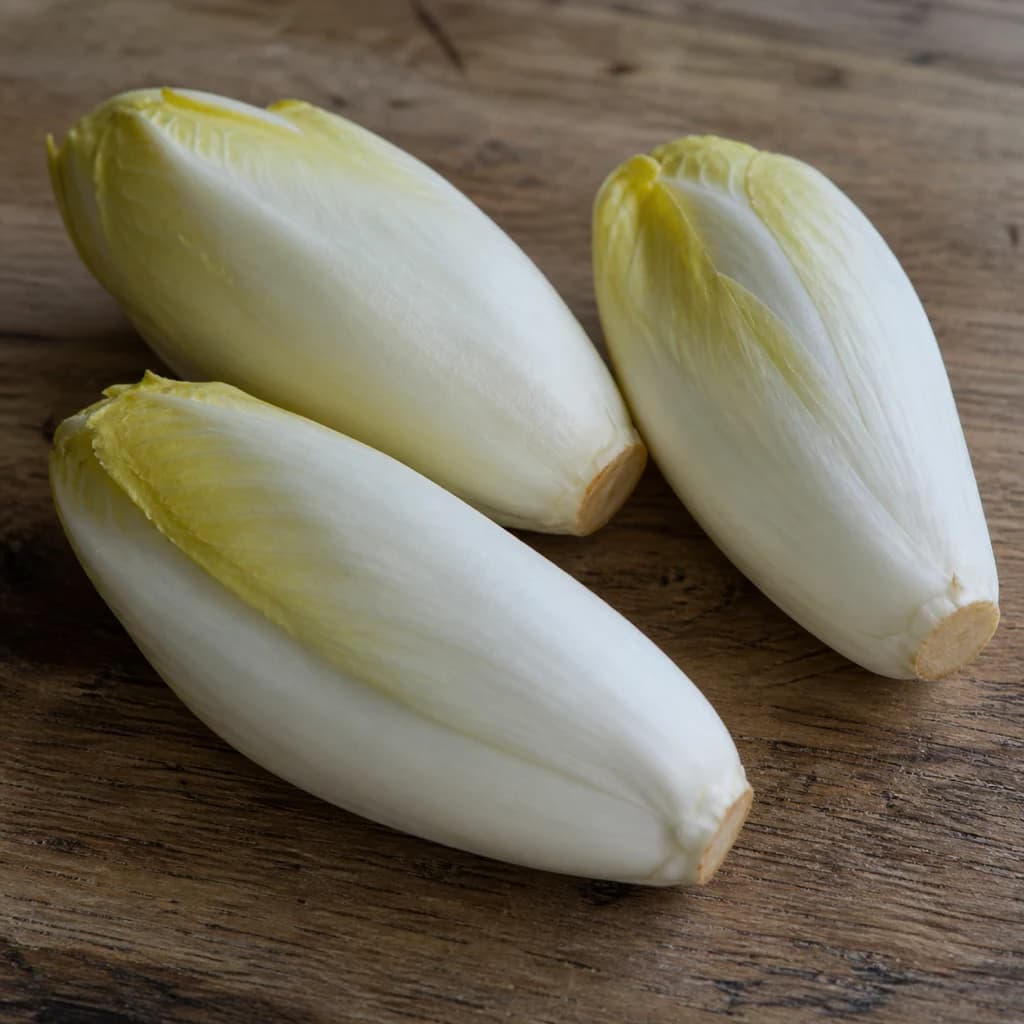
Natural form
Belgian endive heads whole: tight pale cylinders with yellow-white leaves and firm tips.
Shows the reader exactly what to look for when buying Belgian endive — the distinctive compact torpedo shape and color.
Produce
Belgian Endive
Pale, tightly furled chicory head with a crisp, pleasantly bitter bite.
Belgian endive is a small, tightly packed cylinder of pale yellow-white leaves grown in darkness to stay tender and mild. It has a crisp texture and gentle bitterness, eaten raw as boats for appetizers and in salads, or braised and roasted to bring out sweetness. It is a forced form of chicory.
Belgian endive (Cichorium intybus), called witloof in Belgium, is a forced vegetable grown entirely in darkness. Mature roots are harvested and replanted in warm, dark conditions, where they produce pale, tightly furled chicons without chlorophyll. This forcing process distinguishes Belgian endive from other chicories: it moderates the bitter compounds found in mature chicory roots, making the raw leaves pleasantly bitter rather than harsh, with a clean, crisp texture. When cooked, the bitterness softens into a nutty-sweet undertone that is deeply satisfying. The tight, conical shape of the head makes Belgian endive uniquely versatile—it holds together when halved or hollowed, making it ideal for stuffing, grilling whole, or presenting as a composed appetizer. The name "endive" is often used interchangeably with "chicory" in North America, but Belgian endive specifically refers to witloof; it is distinct from curly endive (frisée) and escarole, which are different vegetables entirely.
- Measured in
- piece
- Storage
- Fridge
Types & varieties
White, tight cylinder; the standard variety from Belgium
Some cultivars have burgundy or red outer leaves while remaining white inside
French variety known for large, well-formed heads
French variety with good disease resistance
Early-maturing forcing variety
Buying and storing
Select firm, compact heads with no visible green at the tips or margins. The tighter the curl at the top, the younger and more tender the endive. Avoid any heads that show yellowing, wilting, or spreading outer leaves. Once home, store unwashed in a plastic bag in the refrigerator's crisper drawer for up to two weeks. Light exposure causes greening and sharpens bitterness noticeably.
Preparing the head
The tight core at the base of Belgian endive is significantly more bitter than the leaves. For raw applications where the core would be noticeable, slice the head in half lengthwise and cut out the V-shaped core with a sharp knife before proceeding. For cooked preparations where you want the head to hold its shape, trim only the very base and halve or quarter downward so the leaves stay attached at the top.
Common uses
Tips & pitfalls
- Keep the head intact and trim only the very base when halving; cut downward so leaves stay attached
- Store away from light and ethylene-producing fruits to prevent greening and bitter off-notes
- Select firm, compact heads with no visible green; the tighter the curl, the younger and more tender
- To reduce bitterness, blanch briefly (2 minutes) in salted boiling water before cooking further
- When braising, cook covered over low heat; high heat turns the leaves mushy and dulls the flavor
- A squeeze of lemon or drizzle of aged balsamic just before serving brightens the bitter notes
- Common mistake: overcooking; Belgian endive should retain some resistance and structure
- Common mistake: skipping the removal of the bitter core when serving raw; the inner base is noticeably more bitter
Nutrition
Energy
71 kJ · per 100 g
Where the calories come from
Protein
1.3g
3% DV
Carbs
3.4g
1% DV
Fat
0.2g
0% DV
Fiber
3.1g
11% DV
Sugars
0.3g
of which
Sodium
22mg
1% DV
Source · USDA FoodData Central · Endive, raw
View on FDC →In the shops
Matched grocery products
No matched grocery products for Belgian Endive yet.
Good to know
- Origin
- Brussels region, Belgium, developed circa 1840s by farmer Bresiers
- Family
- Cichorium intybus (chicory family)
- Growing method
- Forced vegetable: roots harvested, replanted in dark, warm conditions to produce pale chicons without chlorophyll
- Peak season
- October through March; available September–April
- Flavor
- Pleasantly bitter raw; nutty-sweet undertone when cooked
- Typical size
- 4–6 inches long, 1.5–2 inches wide at base
- Shelf life
- 1–2 weeks refrigerated in plastic bag
- Storage note
- Keep away from light and ethylene-producing fruits to prevent greening and bitter off-notes
Substitutes
- Radicchio — Similar bitter-tangy flavor and crisp texture; more colorful; behaves similarly in cooking
- Frisée — Same family; has a more feathery, delicate texture; best raw rather than cooked
- Treviso — Italian radicchio variety; elongated, similar bitterness and uses
- Napa cabbage — Closest texture substitute for raw use; lacks the bitterness, so add a touch of chicory or endive to balance
Pairs with
Also called
Witloof · Chicon · Endive
Appears in these dishes
Related
Tomato
Juicy, sun-sweet fruit for sauces, salads, and slow-cooked depth
Yellow Onion
The aromatic backbone of soups, sofritos, and braises
Garlic
Pungent cloves that perfume nearly every savory dish
Lemon
Bright, acidic citrus that wakes up almost any dish
Potato
Humble, hearty staple — roast, mash, fry, or boil
Carrot
Sweet, crunchy root — raw, roasted, or the base of a sofrito
Cucumber
Cool, crisp, and watery — for salads, pickles, and tzatziki

Lettuce
Crisp leaves for salads, wraps, and a fresh crunch