Spices
Black Mustard Seed (Rai)
Tiny, hottest mustard seed, central to South Indian tempering. Pop in hot oil until they crackle and turn grey to release nutty heat over dals, curries, and pickles.
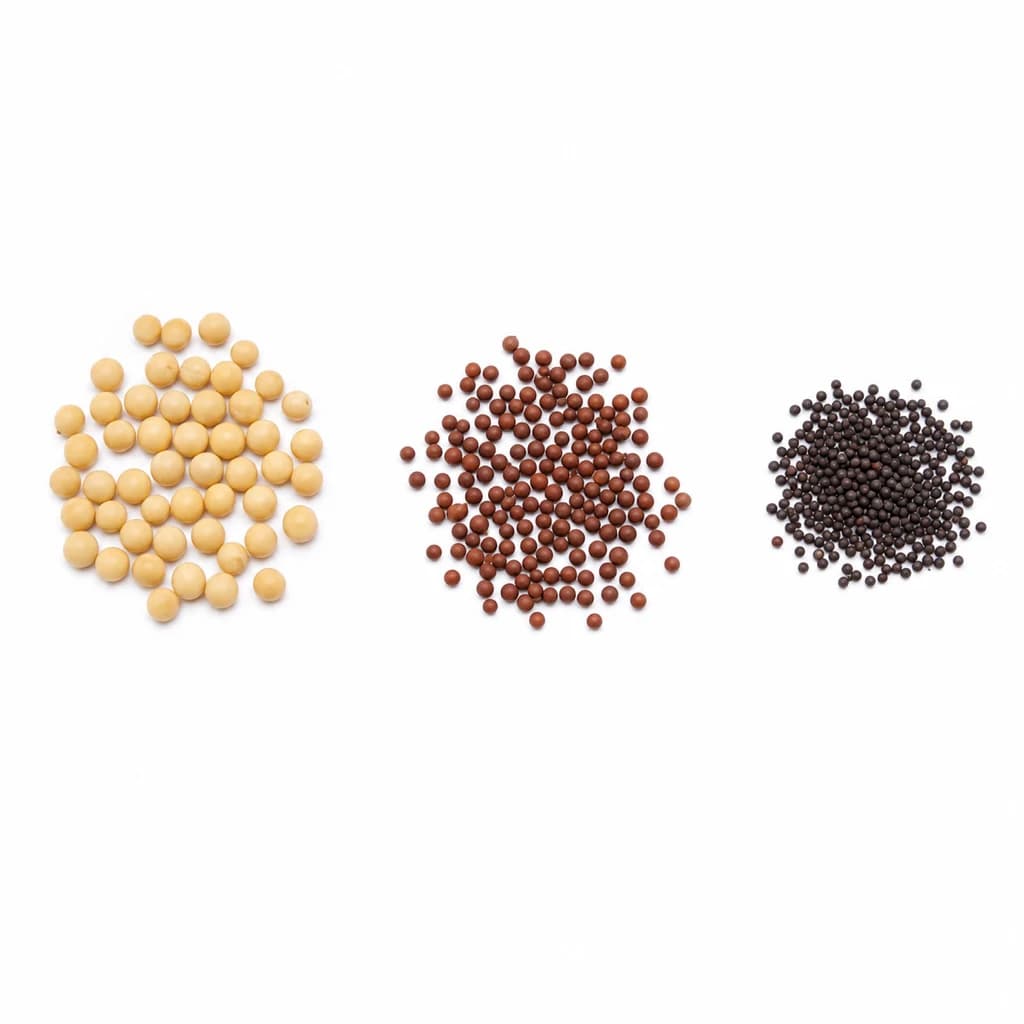
Black mustard seed — rai in Hindi and Bengali, kadugu in Tamil, sasive in Kannada — refers in Indian markets to the small, dark brown to near-black seeds of Brassica juncea, the same plant that gives us mustard greens and most commercial mustard oil. Despite the name, true Brassica nigra is rare today; what cooks call 'rai' is essentially the Indian mustard seed, smaller and rounder than yellow mustard and noticeably more pungent. The seed's heat comes from glucosinolates, primarily sinigrin, that convert to allyl isothiocyanate the moment the seed is crushed or dropped into hot oil. That volatile compound is what hits the sinuses and gives a fresh tadka its sharp, sinus-clearing lift.
The seed's defining move in the kitchen is the tempering, or tadka (also chaunk, baghaar, or phoran depending on region). When whole seeds hit hot fat, they leap and crackle, shed their dull outer coat, and release a nutty, almost toasted aroma within seconds. That pop is both a flavor release and a visual cue: it tells the cook the oil is ready and the aromatics — curry leaves, dried chillies, garlic, hing — should follow immediately. A good tadka is added at the very end of cooking in South Indian dals and sambar, where it layers sharp top notes over a mellow, slow-cooked base.
Outside the tempering, the seed anchors Bengali fish cookery, where it is soaked and ground into a coarse paste (shorshe bata) that wraps around ilish, rohu, and pabda; it seasons Maharashtrian and Punjabi pickles; it flavors cold-pressed mustard oil in eastern India; and it appears in spice rubs for tandoor cooking. Whole seeds keep their potency far longer than ground mustard, which is why nearly every Indian recipe that calls for mustard means the whole seed, bloomed in oil.
- Measured in
- tsp
- Storage
- Store Whole In An Airtight Container Away From Light & Heat
Find it in
Suits
Types & varieties
The standard 'black' seed in Indian markets; dark brown, sharp and nutty when popped.
Historically the European black mustard; smaller, intensely pungent, now mostly Ethiopian and Mediterranean.
Tiny, very dark Brassica juncea preferred for the wet pastes of Bengali fish cookery.
Slightly larger, reddish-brown; the principal source of commercial cold-pressed mustard oil.
Also Brassica juncea but yellow-brown, used for mustard pastes and pickling brines.
A different, milder species — not a true substitute for rai in a tadka.
Reading the Pop
The single most important moment in any recipe built on rai is the second the seeds hit the oil. Aim for the point where the oil first shimmers, just below smoking. A single test seed should snap and jump within 5 to 10 seconds — that audible pop is your signal that the oil is hot enough to bloom the rest of the batch and that the volatile aromatics are about to release. From there, work quickly: add the remaining seeds, and as soon as the popping slows, follow immediately with curry leaves, dried red chillies, hing, or sliced garlic. Letting the seeds go past the pop into silence is the most common home-cooking failure — burnt mustard turns acrid and bitter, and that bitterness carries through the whole dish.
- Oil that is too cold: seeds sit and steam, never pop, and turn rubbery and dull.
- Oil that is too hot: seeds scorch in 2–3 seconds, going black and bitter before aromatics can join.
- A heavy-bottomed kadhai or skillet buffers against scorching; thin steel pans are the usual culprit behind burned tadkas.
- Once popping slows, the window is roughly 10–15 seconds before the seeds over-toast — add aromatics in that window, not after.
Storage and Freshness
Mustard seeds are roughly 30% oil, which is exactly what makes them so aromatic and exactly what makes them go rancid faster than most other whole spices. Stored in a paper bag on a warm shelf, rai will lose its snap in a few months. In an airtight jar in a cool, dark cupboard, whole seeds stay lively for 1–2 years; refrigerated, even longer. A quick freshness test: drop a few seeds in hot oil. If they jump and crackle within seconds, the batch is good. If they sit and darken quietly, it's time to replace them. Pre-ground mustard powder is far more fragile — the volatile isothiocyanates evaporate within weeks — which is why Indian cooking almost universally uses the whole seed.
- Buy small quantities for home use; restaurant-sized bags go stale before you finish them.
- Never store near the stove; heat and light are the seed's worst enemies.
- Glass or metal jars with tight lids outperform plastic, which can absorb and re-release odors.
- Dry-toast before grinding for pickles — this deepens flavor and helps sterilize the seed.
Common uses
Tips & pitfalls
- Heat the oil to a shimmer, not a smoke; seeds should pop within 5–10 seconds of contact.
- Add curry leaves, garlic, and dried chillies the moment popping slows — burnt mustard turns acrid and bitter.
- Use a heavy-bottomed pan so the seeds don't scorch against thin metal.
- Whole seeds stay potent far longer than pre-ground mustard; grind only what you need, and only after blooming in oil.
- For pickles, dry-toast the seeds first in a dry pan to deepen the flavor and sterilize them before packing.
- Drop a few seeds in hot oil to test freshness — old seeds pop weakly or not at all.
- If a dish is too pungent, add a pinch of jaggery or a squeeze of tamarind; both sweetness and acid tame the heat.
- Don't substitute yellow mustard seeds 1:1 in a tadka; their flavor is milder, sweeter, and lacks rai's sharp bite.
Nutrition
Energy
372 kJ · per 100 g
Where the calories come from
Protein
4.1g
8% DV
Carbs
17.3g
6% DV
Fat
0.5g
1% DV
Sodium
1mg
0% DV
Source · USDA FoodData Central · approx. Seeds, lotus seeds, raw
View on FDC →In the shops
Matched grocery products
No matched grocery products for Black Mustard Seed (Rai) yet.
Good to know
- Botanical name
- Brassica juncea (rai); true Brassica nigra is now uncommon in trade
- Family
- Brassicaceae (Cruciferae), the cabbage/mustard family
- Indian names
- Rai (Hindi/Bengali), kadugu (Tamil/Telugu/Malayalam), sasive (Kannada)
- Size
- 1–1.6 mm diameter, smaller and rounder than yellow mustard
- Heat compound
- Sinigrin converts to allyl isothiocyanate on heating or crushing
- Yield
- 1 tsp ≈ 3 g; 1 Tbsp ≈ 9 g
- Storage
- Airtight, cool, dark; whole seeds keep 1–2 years, longer if refrigerated
- Allergen note
- Contains mustard proteins; declared allergen in the EU and Canada
Substitutes
- Brown mustard seeds (light Brassica juncea) — Closest match; use the same quantity, expect a touch less heat.
- Yellow mustard seeds (Sinapis alba) — Mildest option; reduce the amount by one-third and toast longer to build flavor.
- English-style mustard powder — Use only in cooked sauces, not in tadka; bloomed whole seeds give a cleaner aromatic.
- Crushed brown mustard seeds — Gives a coarser, more rustic texture suited to Bengali-style pastes.
Pairs with
Also called
rai · black mustard seeds · kadugu · sarson