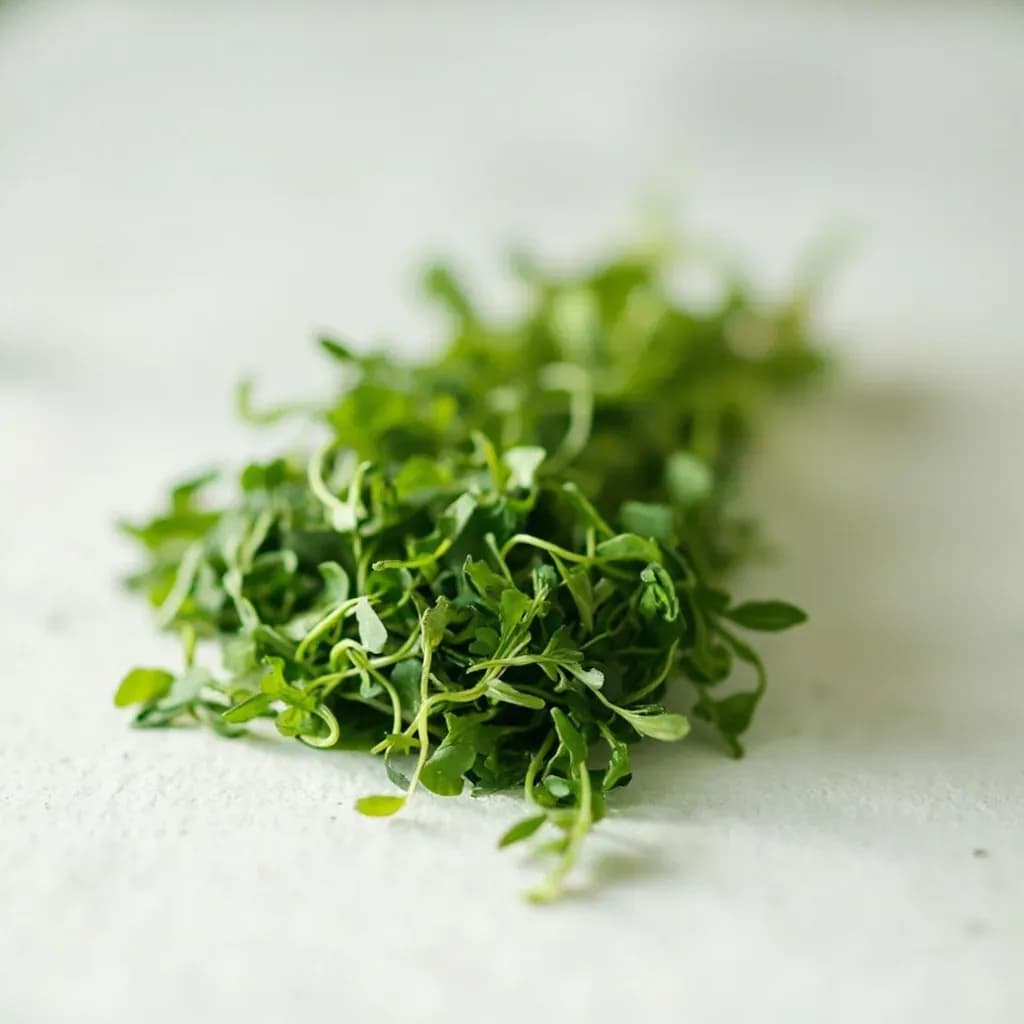
Produce
Chickweed
Mild, tender wild green eaten raw in salads or cooked like spinach.
Chickweed is a low-growing wild plant with small leaves and a mild, fresh, slightly grassy flavor, used as an edible green. The tender stems and leaves are eaten raw in salads, blended into pestos, or wilted like spinach. It is a common springtime foraged green valued for its delicate taste.
Chickweed (Stellaria media) is one of the most abundant and approachable wild greens in temperate regions, appearing in gardens, lawns, and disturbed soil from early spring through late fall—and often wintering over in milder climates. Belonging to the carnation family (Caryophyllaceae), it forms low, spreading mats with delicate oval leaves, thin succulent stems, and tiny white star-shaped flowers with five deeply notched petals. The entire aerial plant is edible, though the tender young leaves and stem tips are the most prized. Its flavor is mild and faintly sweet, with a subtle corn-like or spinach-like note that makes it unusually versatile for a wild green.
Unlike many foraged plants that require caution or advance preparation, chickweed is forgiving in the kitchen. It wilts quickly when heated—typically in under a minute—and maintains a pleasant, tender texture when cooked briefly. Raw, it serves as a delicate salad base that doesn't overwhelm dressings or other components. Nutritionally, it punches well above its humble reputation: rich in vitamins A, C, and B-complex, with notable levels of iron, calcium, potassium, magnesium, and zinc, plus antioxidants and saponins. For gardeners, it colonizes disturbed soil with enthusiasm, making it a reliable, renewable crop once established—though its creeping habit means harvest little and often rather than large single cuts.
Foraging chickweed requires attention to location: avoid roadsides, lawns treated with herbicides or pesticides, and areas frequented by pets. The single line of hairs running along one side of the stem (switching sides at each node) is the most reliable identification marker, distinguishing it from lookalikes like mouse-ear chickweed, which has rounder, hairier leaves and a slightly more fibrous texture.
- Measured in
- g
- Storage
- Fridge
Types & varieties
The most widely foraged species; most tender and mild-flavored of the Stellaria genus
Lookalike with rounder, hairier leaves; similar edibility but slightly more fibrous
Paler, smaller form; less common; similar culinary use
Foraging and Identification
Chickweed thrives in cool, moist conditions and favors disturbed soil—garden edges, pathways, lawn cracks, and compost areas are reliable hunting grounds. The key distinguishing feature is the single line of hairs running along one side of the stem, switching sides at each node. The tiny white flowers, with five petals so deeply notched they appear as ten, bloom most abundantly in mild weather. Avoid plants with rounded, hairy leaves (mouse-ear chickweed is edible but tougher) and steer clear of speedwell (Veronica spp.), which has similar leaves but different flowers. Harvest in the cool of morning for the crispest texture, selecting young bright green growth and avoiding flowering specimens, which turn more bitter and fibrous.
- Harvest from clean, organic sources only—chickweed readily absorbs contaminants
- Select young, bright green growth; avoid plants in full flower
- Wash thoroughly in cold water; sand and small insects lodge in dense mats
- Verify the single line of hairs on the stem before consuming
Cooking Notes
Chickweed is remarkably forgiving in the kitchen, but its tenderness demands respect for timing. When cooking, add it last and remove from heat quickly—it wilts in 30 seconds to 2 minutes depending on quantity. Overcooking produces a slimy texture, the most common mistake with this green. Its mildness is both an asset and a consideration: it blends seamlessly into dishes without overpowering other flavors, but benefits from pairing with more assertive ingredients when cooked. Raw applications preserve its delicate character most faithfully.
- Do not overcook—wilts in under a minute and turns slimy if heated too long
- Add cooked chickweed at the end of cooking; it needs only residual heat
- Combine with stronger greens when cooking for balanced flavor
- Use as a spinach substitute where a more delicate result is desired
Common uses
Tips & pitfalls
- Harvest in cool morning hours for crispest texture and fullest flavor
- Select young, bright green growth; avoid flowering specimens (more bitter and tougher stems)
- Pick from clean, organic sources only—chickweed readily absorbs contaminants
- Wash thoroughly in cold water; sand and small insects lodge in the dense mat-forming growth
- Do not overcook—it wilts in under a minute and turns slimy if cooked too long
- Combine with more assertive greens when cooking; its mildness benefits from balance
- Use as a spinach substitute in any dish where a delicate green is preferred
- If foraging near other Stellaria species, verify the single line of hairs on the stem—a key identification marker for common chickweed
Nutrition
Nutrition
No USDA FoodData Central match for Chickweed yet. We surface a per-100 g profile once a generic whole-food entry is matched and verified.
In the shops
Matched grocery products
No matched grocery products for Chickweed yet.
Good to know
- Scientific name
- Stellaria media
- Family
- Caryophyllaceae (carnation family)
- Season
- Early spring through late fall; frost-tolerant; can winter over in mild climates
- Flavor
- Mild, slightly sweet; subtle corn-like or spinach-like note
- Texture
- Tender and succulent; thin stems and delicate leaves; no tough fibers
- Nutrition
- High in vitamins A, C, and B-complex; rich in iron, calcium, potassium, magnesium, and zinc; contains antioxidants and saponins
- Yield
- Entire aerial parts usable; roughly 1 cup packed leaves per 30–40 stems
- Storage
- Wrap loosely in damp paper towels; use within 1–2 days for best quality
- Identification
- Creeping mat; small oval leaves; white star-shaped flowers with 5 deeply notched petals; single line of hairs along one side of stem
- Caution
- Avoid harvesting from roadsides, lawns treated with herbicides or pesticides, or areas with pet access
Substitutes
- Baby spinach — Most readily available substitute; similar mild flavor and quick cooking time; slightly more neutral in taste
- Watercress — Sharper, pepperier flavor; works in salads and as a cooked green; adjust seasoning accordingly
- Mâche (lamb's lettuce) — Similar tender texture and mild flavor; excellent raw in salads
- Arugula — Much more peppery; use less quantity as a substitute; better for raw applications
- Spinach — Standard cooked-green substitute; nearly identical cooking time and method
Pairs with
Also called
Chickweed · Stellaria
Related
Tomato
Juicy, sun-sweet fruit for sauces, salads, and slow-cooked depth
Yellow Onion
The aromatic backbone of soups, sofritos, and braises
Garlic
Pungent cloves that perfume nearly every savory dish
Lemon
Bright, acidic citrus that wakes up almost any dish
Potato
Humble, hearty staple — roast, mash, fry, or boil
Carrot
Sweet, crunchy root — raw, roasted, or the base of a sofrito
Cucumber
Cool, crisp, and watery — for salads, pickles, and tzatziki

Lettuce
Crisp leaves for salads, wraps, and a fresh crunch