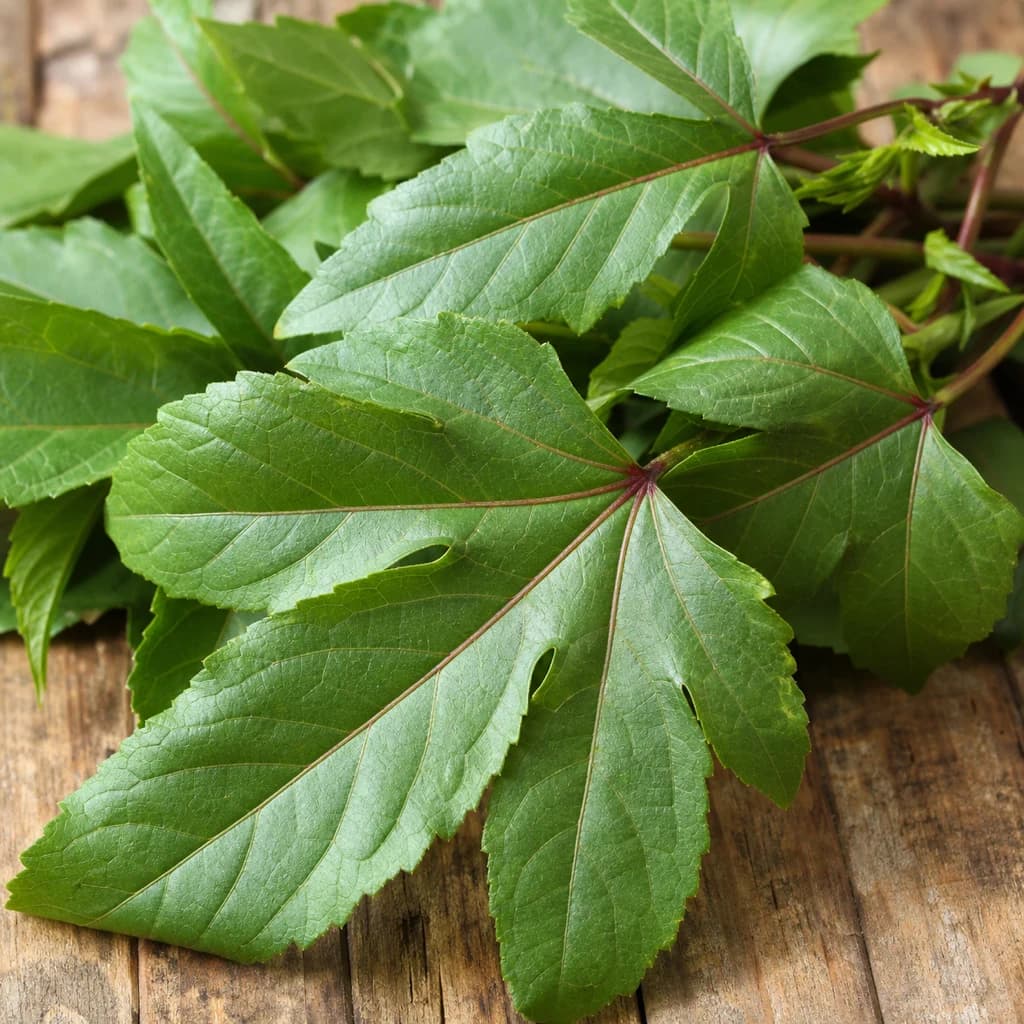
Natural form
Fresh roselle hibiscus leaves showing their distinctive lobed shape and vivid green color.
Shows the reader exactly what to look for when identifying hibiscus leaves at market or in the garden — the characteristic palmate lobed form and color.
Herbs
Hibiscus Leaf
Tangy edible leaf of the roselle hibiscus, cooked as a sour leafy green.
Hibiscus leaves, from the roselle plant, are edible greens with a distinctly sour, lemony flavor. They are cooked like spinach in West African, South Asian, and Caribbean kitchens, added to stews, soups, and stir-fries for their tang. The leaves should be cooked rather than eaten raw and pair well with rich, fatty dishes.
Hibiscus leaf refers specifically to the edible leaves of Hibiscus sabdariffa, the same plant whose red calyces are dried and steeped for hibiscus tea. Unlike the intensely tart calyces, the leaves offer a more nuanced sourness—bright, citrusy, and faintly grassy—along with a cooked texture that ranges from silky to slightly mucilaginous depending on how long they are handled. Young leaves and tender stems are the parts used; older foliage becomes fibrous and overly sticky. The plant is an annual herb growing 1–3 meters tall, originating in West Africa and now central to cooking traditions across tropical Africa, the Caribbean, and Southeast Asia, where it is known by a dozen regional names: sorrel leaf, Jamaica sorrel, bissap, rau quế, yennga, and yakura among them.
In West Africa—particularly Nigeria, Ghana, and Sierra Leone—hibiscus leaf is a cornerstone of everyday cooking, cooked down with palm oil, fermented condiments like locust beans (iri or dawdawa), and sometimes groundnut paste into hearty soups that accompany starches. Southeast Asian cuisines employ the leaves in coconut milk braises and stir-fries, where the sourness cuts through rich coconut fat. The leaf's acidity behaves almost like a natural lemon, which means it responds well to fat for balance and plays nicely with umami-heavy fermented ingredients.
One practical distinction to hold clearly: the leaves and the calyces of roselle are not interchangeable in cooking. Calyces (used in agua de Jamaica and Bissap drink) are extremely tart and typically sold dried; they are rehydrated or steeped like tea and used in beverages, jams, and sauces. Leaves cook like a quick-cooking green and should never be treated as a substitute for calyces or vice versa. The leaves also contain oxalic acid, so those with kidney stone concerns should consume them in moderation.
- Measured in
- g
- Storage
- Fridge
Types & varieties
Most common commercial variety; bright red calyces with green leaves that carry good sourness; widely available in West African and Caribbean markets
Lighter-colored calyces; leaves tend to be milder and less acidic; more common in Thai and Vietnamese varieties
Bred specifically for leaf production; broader, more tender leaves; used for cooking greens in some African regions
Leaf vs. Calyx: A Critical Distinction
The leaves and the fleshy red calyces of Hibiscus sabdariffa come from the same plant but behave entirely differently in the kitchen. Calyces are extremely tart and typically sold dried; they are rehydrated or steeped like tea and used in beverages, jams, and sauces. Leaves cook like a quick-cooking green—sautéed, braised, or added to soups—and should never be substituted for calyces in a recipe expecting that concentrated tartness. Conversely, calyces cannot replace leaves in a sauté or soup without significant adaptation. When purchasing, specify 'leaves' if buying fresh, or clarify whether you need dried calyces for tea versus leaves for cooking.
Working with the Mucilaginous Texture
Hibiscus leaf produces a natural slime—similar to okra or jute leaves—when cooked for extended periods or when crushed and stirred repeatedly. This property is desirable in West African dishes like Nigerian Ewedu, where the viscous consistency is the point. To control it: cook young leaves briefly (5–10 minutes), avoid vigorous stirring mid-cook, and do not pound or crush before cooking if you want to minimize stickiness. If you want the mucilaginous quality, as in a thick soup, cook longer and stir occasionally.
- Brief cooking (5–10 min) keeps leaves silky and bright green
- Longer cooking or crushing produces okra-like slime—desirable in some West African soups
- Mucilaginous texture pairs well with starchy accompaniments like fufu or rice
Common uses
Tips & pitfalls
- Pick or purchase young, tender leaves—older leaves become fibrous and excessively mucilaginous
- Wash leaves thoroughly; dirt and small insects lodge in the serrated folds, so rinse each leaf carefully
- Cook with an acidic liquid (tomato, lime juice, or broth) to balance sourness and preserve the bright green color
- Do not overcook—5 to 10 minutes is sufficient for young leaves to wilt and tenderize; extended cooking turns them mushy and dulls color
- Pair with fat (coconut milk, palm oil, butter) to mellow tartness and build a rounded flavor
- Common mistake: treating hibiscus leaf like spinach and simmering for 15–20 minutes, which ruins the texture and color
- If substituting for spinach in a recipe, add a squeeze of lemon or lime to approximate the natural acidity
- Stems are edible and cook similarly to chard stems—slice and add to soups or stir-fries alongside the leaves
- Refrigerate unwashed leaves and use within 5–7 days; do not freeze raw—texture degrades significantly
Nutrition
Nutrition
No USDA FoodData Central match for Hibiscus Leaf yet. We surface a per-100 g profile once a generic whole-food entry is matched and verified.
In the shops
Matched grocery products
No matched grocery products for Hibiscus Leaf yet.
Good to know
- Botanical name
- Hibiscus sabdariffa var. sabdariffa (leaf cultivar)
- Also called
- Roselle leaf, sorrel leaf, Jamaica sorrel, bissap leaf (Senegal), yennga (Nigeria), yakura (Ghana), rau quế (Vietnam)
- Flavor
- Tangy, sour, faintly grassy; acidity from hibiscus acid and oxalic acid
- Cooked texture
- Silky to slightly mucilaginous (young leaves stay tender; longer cooking increases stickiness)
- Origin
- West Africa; widely cultivated in tropical Africa, Caribbean, and Southeast Asia
- Season
- Year-round in tropics; late summer–fall in temperate zones when grown as annual
- Storage
- Refrigerate wrapped in damp paper towels in a produce bag; use within 5–7 days
- Caution
- Contains oxalic acid—consume in moderation if prone to kidney stones
Substitutes
- Fresh sorrel leaves (Oxalis species) — Different plant but similar tart, lemony flavor; use young leaves raw or briefly cooked; swap 1:1
- Fresh amaranth leaves — Closest texture; mild flavor, so add lemon juice or lime to bring acidity; swap 1:1
- Young spinach with lemon juice — Mimics cooked green texture; add acid to approximate the tang; works for soups and sautéing
- Malabar spinach (basella) — Similar mucilaginous texture when cooked; add lemon or lime for sourness; swap 1:1
- Dried hibiscus calyces, rehydrated and chopped — Very tart and intense; use sparingly and only in soups or braises where strong tartness is welcome; hydrate first, then chop finely
Pairs with
Also called
Roselle Leaf · Sorrel Leaf
Related

Basil
Sweet, fragrant leaves for pesto, pasta, and caprese

Parsley
Fresh, grassy herb for finishing nearly any savory dish

Cilantro
Bright, citrusy herb for salsas, curries, and tacos

Mint
Cool, fragrant herb for teas, salads, and desserts
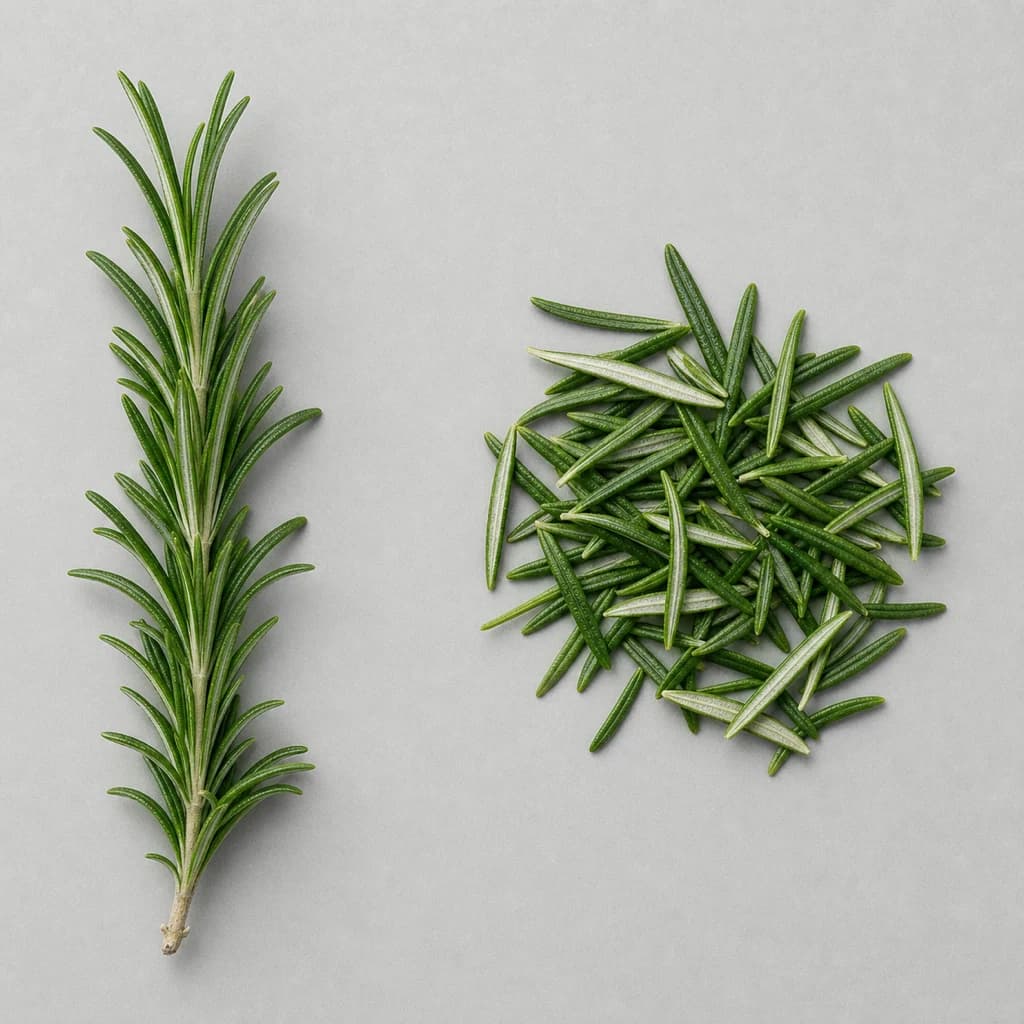
Rosemary
Piney, resinous herb for roasts, breads, and potatoes

Thyme
Earthy, floral herb for braises, roasts, and stocks

Sage
Savory, velvety herb for butter sauces and stuffings

Oregano
Pungent, peppery herb for tomato sauces and grilling