Natural form
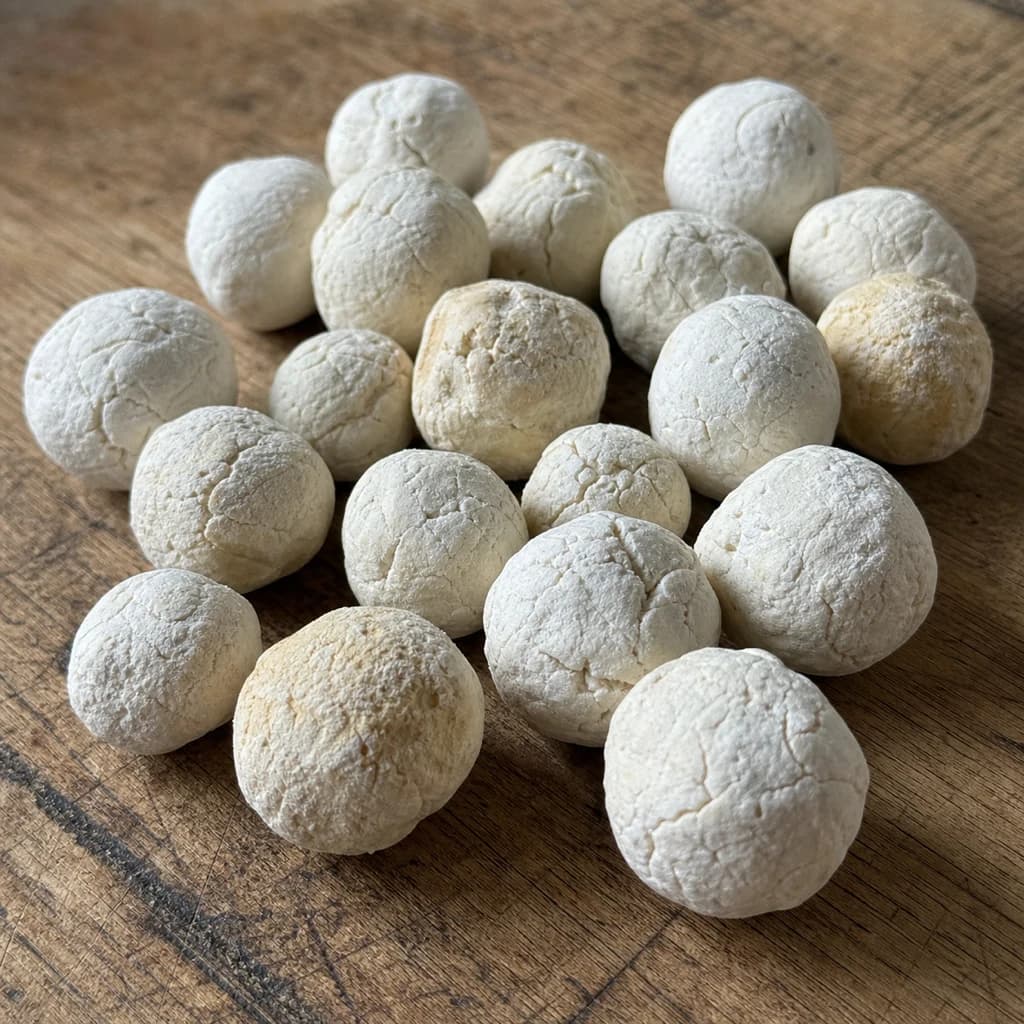
Kurt balls in their hard, dry, unprocessed state — small, rough-surfaced, off-white spheres.
Shows the defining physical form readers will encounter in markets and stores: the characteristic rocky, chalky ball shape that makes kurt unmistakable.
Dairy & Eggs
Dried Curd Balls (Kurt / Qurut)
Hard, salty sun-dried yogurt-whey balls from Central Asia, snacked on or dissolved into soups.
Kurt, or qurut, are small hard balls of strained, salted yogurt or whey dried in the sun until rock-firm. A Central Asian and Mongolian staple, they are eaten as a tangy, salty snack or crumbled and dissolved into soups and drinks. Drying gives them an intense sour flavor and a very long shelf life.
Dried Curd Balls—known across Central Asia as Qurut, Kurt, or Katyk—are an ancient preserved dairy product with roots stretching back to the nomadic cultures of Mongolia, Kazakhstan, Kyrgyzstan, Uzbekistan, and Turkmenistan. They are made from fermented yogurt or whey, rolled into small balls roughly 1–3 cm in diameter, then sun- or air-dried for two to six weeks until they become rock-hard. The extended drying concentrates the dairy's natural acids and develops intensely savory, umami-rich flavor through protein breakdown that differs fundamentally from any fresh cheese. Traditionally, these balls were the primary way steppe nomads preserved dairy protein and fat through harsh winters and long migrations—a portable, shelf-stable food that kept for months or even years when kept dry.
In the mouth, fully dried qurut is almost inedible as-is; the product's magic reveals itself when hydrated or cooked. When soaked in warm liquid, the balls soften and release a tangy, deeply salty broth that forms the flavor backbone of soups like lagman and shorpa. In broths and stews, they dissolve completely, functioning like a combination of stock base, fermented dairy, and seasoning all in one. The flavor is aggressively salty and acidic, with a funky fermented depth that has no real equivalent in Western kitchens—this is not a background note but a foundational element that shapes entire dishes.
Today, authentic qurut and katyk appear in Central Asian and Russian grocery stores, sometimes labeled as "dried cottage cheese balls" or "sour milk balls." Quality varies widely. Properly dried qurut should have a sharp, sour, cheesy aroma with no trace of mold; any hint of mustiness or soft spots indicates improper storage or age. Industrial versions may be more uniform but often lack the intensity of traditionally sun-dried balls. Seek out hand-rolled varieties when possible, and store what you acquire in airtight containers away from humidity.
- Measured in
- piece
- Storage
- Pantry
Allergens
Types & varieties
Dried yogurt curds specifically; higher fat and protein than whey-based varieties, yielding a richer flavor. Primary Kazakh and Kyrgyz product.
Broader term for both yogurt- and whey-based dried balls; used across Uzbekistan, Kazakhstan, Kyrgyzstan, and Turkmenistan.
Alternative spelling of Qurut; used generically for dried dairy balls across Central Asia.
Mongolian term; may be made from airag (fermented mare's milk) or cow's milk.
Kazakh dried fermented milk product, sometimes pressed into balls or cakes.
Smaller, softer dried whey curds common in Mongolian cooking; tends to rehydrate more quickly than traditional balls.
Traditional Production
Hand-rolling qurut is skilled work. Fresh fermented yogurt or whey is strained to remove excess liquid, then worked into a thick, pliable curd. The curd is divided into small portions and rolled between the palms into smooth balls, roughly the size of a large marble. These are placed on clean cloths or mats in direct sunlight, turned daily to ensure even drying. The process takes two to six weeks depending on humidity and temperature. Balls that dry too quickly can crack; those dried too slowly risk fermentation gone wrong. Traditionally dried balls are irregular in shape and vary slightly in color from white to pale yellow; deeper yellow-brown indicates longer aging. Industrial production uses controlled dehydration, producing more uniform balls but often with less complex flavor development.
- Hand-rolled balls are irregular; uniformity suggests industrial production
- Deeper yellow-brown color means longer drying and more concentrated flavor
- Authentic traditionally dried qurut has a sharp, sour, cheesy aroma with no mold
How to Use in the Kitchen
The primary kitchen use for qurut is as a dissolved flavor base in soups and stews. Drop the balls directly into simmering broth early in cooking—they will gradually soften, collapse, and infuse the liquid with salty, tangy depth. For smoother integration, soak balls in warm water for 15–30 minutes first, then crumble or blend the softened mass into your dish. As a finishing element, reconstituted qurut can be crumbled over dumplings, noodles, or grain porridges like a dry aged cheese. To make a quick dip or spread, pound softened qurut with garlic, fresh herbs, and a splash of oil. In Mongolian and Kazakh tradition, a single ball is often steeped directly in tea, softening slightly as it imparts sour, salty flavor to the drink.
- For smooth soup integration: soak 15–30 minutes, then blend or mash before adding
- For visible crumbled garnish: add softened balls near end of cooking to retain some texture
- As a dip: pound with garlic, olive oil, and fresh herbs like dill or cilantro
- In tea: steep one ball per cup; the ball softens and can be eaten after drinking
Common uses
Tips & pitfalls
- Soak dried balls in warm water for 15–30 minutes before using to soften and release flavor more evenly into soups and stews.
- Drop balls into simmering broth early so they dissolve completely and become integral to the liquid, not a floating obstacle.
- Store in an airtight container in a cool, dry place; humidity causes mold and the balls will soften irreversibly.
- If balls become too hard to work with, grate them on a microplane rather than trying to bite or crush them whole.
- Authentic qurut is intensely salty—always taste and dissolve a portion before adding to a dish, then adjust seasoning accordingly.
- The longer the drying period, the more concentrated and sharper the flavor; older balls may need shorter soaking times.
- For a quick traditional snack, hold a ball in the mouth and suck on it slowly like a hard candy—it will gradually soften and release flavor.
- If balls develop any mold, off smells, or soft spots, discard them—improperly stored qurut can develop harmful microorganisms.
Nutrition
Energy
397 kJ · per 100 g
Where the calories come from
Protein
4.4g
9% DV
Carbs
19g
7% DV
Fat
0.2g
0% DV
Fiber
0g
0% DV
Sugars
19g
of which
Sodium
58mg
3% DV
Source · USDA FoodData Central · approx. Yogurt, fruit variety, nonfat
View on FDC →In the shops
Matched grocery products
No matched grocery products for Dried Curd Balls (Kurt / Qurut) yet.
Good to know
- Origin
- Central Asia (Mongolia, Kazakhstan, Kyrgyzstan, Uzbekistan, Turkmenistan)
- Type
- Preserved fermented dairy product
- Base
- Yogurt or whey from yak, cow, goat, sheep, or mare's milk
- Form
- Hard balls, 1–3 cm diameter; rock-hard when fully dry
- Flavor
- Intensely salty, tangy, umami-rich; savory not sweet
- Preservation
- Sun- or air-dried 2–6 weeks; keeps months to years dry
- Cultural role
- Portable protein and fat source for steppe nomads
- Shelf life
- Months to years when stored airtight in cool, dry place
Substitutes
- Hard aged feta — Similar saltiness and crumbly texture when crumbled or dissolved into soups, though lacking the tangy fermented complexity of true qurut.
- Kashkaval or aged Parmesan — Hard texture and strong savory flavor; grate or crumble as a finishing element, but neither has the fermented dairy tang.
- Ricotta salata — Milder saltiness but similar dry, crumbly texture; works in soups but add a splash of vinegar or lemon juice to approximate the acidity.
- Dried whey powder — Not a substitute for texture or flavor intensity, but can add a salty dairy base to soups; lacks the umami depth and fermented character entirely.
Pairs with
Also called
Kurt · Kurut · Qurut · Aaruul · Irimshik · Dried Yogurt
Appears in these dishes
Related

Whole Milk
Rich, full-fat milk for drinking, coffee, sauces, and baking
Butter
Golden fat for searing, baking, and finishing a sauce
Yogurt
Tangy, creamy culture for breakfast, sauces, and marinades
Cheddar Cheese
Sharp, melty cheese for sandwiches, gratins, and grating
Skim Milk
Fat-free milk for lighter drinking, coffee, and cooking
Heavy Cream
Rich cream that whips, enriches sauces, and sets ganache

Sour Cream
Tangy, thick cream for dolloping, baking, and dips
Mozzarella
Soft, milky cheese that melts into stretchy pizza pulls