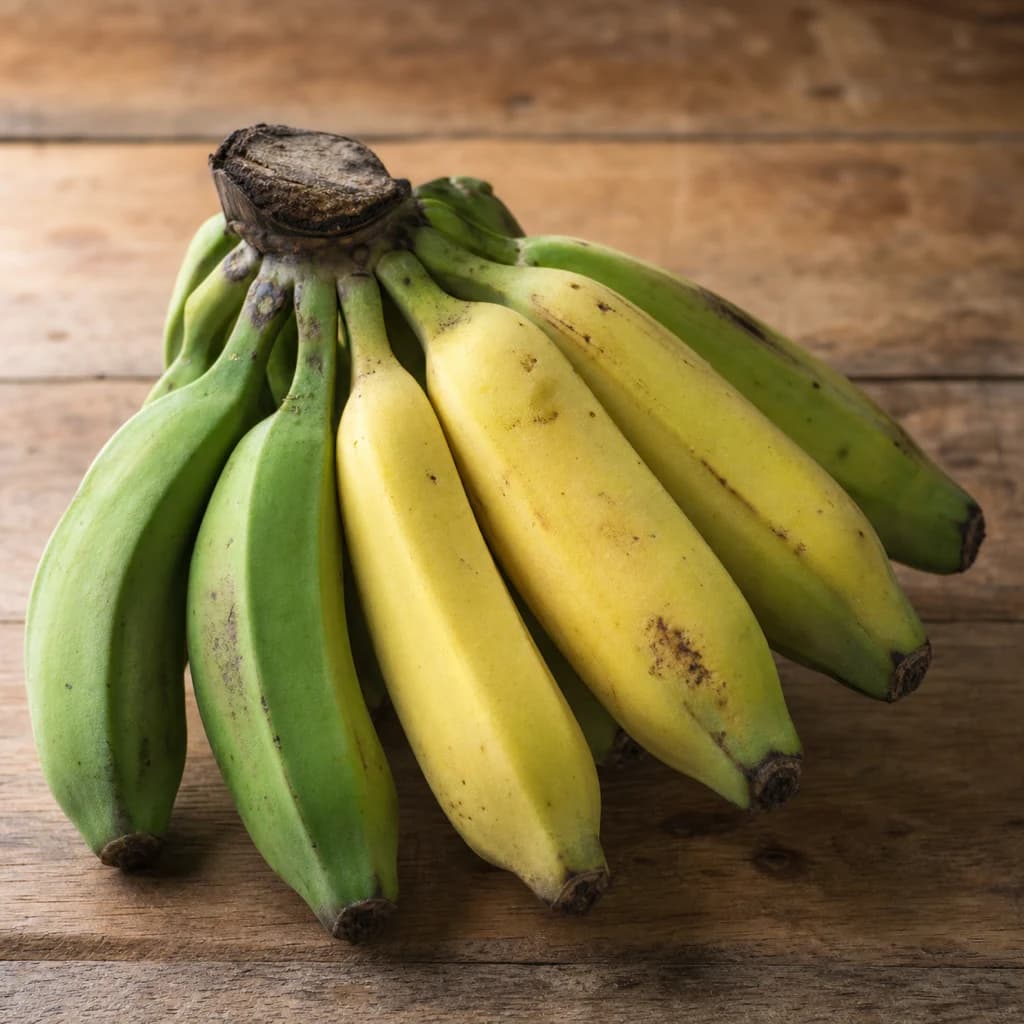
Natural form
Saba bananas are short and stout, with angular ridges and thick green-to-yellow skin.
Shows the recognizable shape, size, and skin color that distinguish saba from common dessert banana varieties.
Produce
Saba Banana
Starchy Philippine cooking banana boiled, fried, or grilled when ripe.
The saba is a short, stout cooking banana from the Philippines, with starchy flesh that is firm even when ripe. It is boiled, grilled, or fried in dishes like banana cue and turon, and added to the stew ginataang and the dessert halo-halo. Unlike dessert bananas it is best cooked rather than eaten raw.
Saba is the workhorse cooking banana of Philippine cuisine, a starchy cultivar (Musa balbisiana, AAB group) bred specifically for the pot rather than the fruit bowl. Unlike the sweet dessert bananas sold globally, Saba contains high levels of resistant starch that break down into sugars only when cooked, giving it a dense, satisfying texture whether boiled, fried, or grilled. The fruit is large and blocky—typically 10–15 cm long—with a thick green peel that transitions from dark green when unripe to bright yellow when ripe, and creamy white flesh beneath.
In the Philippines, Saba is a foundational starch consumed alongside rice, particularly in regions where the plant thrives in lowland conditions year-round. A single Saba stalk can carry over 20 hands of fruit, making it an abundant and economical ingredient. The fruit's versatility is remarkable: it holds its shape in soups and stews when unripe, yet develops a caramelized sweetness and crispy shell when fried ripe. Frozen pre-peeled Saba is a standard product in Filipino grocery stores—a testament to how essential it is in everyday cooking. The related Cardaba variety, with its darker peel and slightly higher starch content, is preferred by many Filipino cooks for wet dishes like ginataan precisely because it resists breaking down.
Saba occupies a specific culinary niche: it is not a dessert banana, and eating it raw is unpleasant—starchy, chalky, and mildly astringent. Its entire character is revealed through heat. When boiled whole, the flesh becomes buttery and mildly sweet. When fried in sugar, as in the beloved street snack banana cue, the surface caramelizes into a lacquered amber crust. When sliced thin, battered, and deep-fried for turon, the edges turn shatteringly crisp while the center stays creamy. Understanding this transformation is the key to working with Saba effectively.
- Measured in
- piece
- Storage
- Pantry
Types & varieties
The standard Philippine cooking banana; the most widely available variety in Southeast Asian markets.
Close relative, often considered the same cultivar; smaller with very dark green peel, slightly higher starch content, excellent for boiling and coconut milk dishes.
A dwarf variant with smaller fruit; same cooking properties as standard Saba.
Indonesian/Malaysian equivalent (Musa balbisiana 'Kepok'); similar starchy texture and interchangeable in recipes.
Saba vs. Other Cooking Bananas
Saba is frequently confused with plantains and other starchy bananas, but it occupies distinct culinary territory. Plantains (Musa acuminata × balbisiana, AAB or ABB groups) are firmer when cooked and less sweet than Saba. Saba's flesh is more tender and gains sweetness more readily, which is why it works in desserts without added sugar in the same way plantains do. Burro bananas, despite their squarish shape, are dessert bananas and not suitable substitutes. When a recipe calls for Saba, reach for the closest starchy cooking banana available—green plantain works in savory applications, while Pisang Kepok is nearly interchangeable in any Saba preparation.
- Saba is sweeter than plantain when cooked
- Cardaba holds shape in liquids better than standard Saba
- Pisang Kepok is the Indonesian equivalent and can be used interchangeably
The Plant and Its Other Uses
The Saba banana plant yields more than just edible fruit. The large, waxy leaves serve as natural food wrappers and serving platters throughout traditional Philippine cooking—steaming fish in banana leaves is a classic technique that imparts a subtle grassy aroma. The thick pseudostem is used as animal feed. In rural areas, banana trunk fibers are even harvested for weaving. When cooking with Saba, consider using the leaves as a wrapper or liner: it is a sustainable, heat-resistant cooking vessel that adds a faint herbal note and connects the dish to centuries of Philippine culinary tradition.
- Banana leaves are ideal for steaming fish and savory fillings
- Use leaves as a natural plate liner for tropical presentations
- The trunk is animal feed, not human food—discard when buying peeled Saba
Common uses
Tips & pitfalls
- Never eat Saba raw—the flesh is starchy and unpalatable uncooked; always cook it first
- Choose firm, dense bananas with no give when pressed gently; soft spots mean overripeness for cooking
- Use green Saba (dark green peel) for soups, stews, and boiling—it holds shape best in wet cooking
- Use yellow Saba (ripe) for frying and sweet desserts—it caramelizes better and has developed natural sugars
- Score the peel lengthwise before boiling whole to prevent bursting and ensure even cooking throughout
- For frying: pat slices completely dry and heat oil to 175°C (350°F) before adding fruit to achieve a caramelized crust, not soggy edges
- Frozen pre-peeled Saba is a legitimate, widely-used shortcut—thaw completely and blot dry before cooking
- Do not confuse Saba with Burro bananas, which are squarish dessert varieties despite their shape
Nutrition
Energy
372 kJ · per 100 g
Where the calories come from
Protein
1.1g
2% DV
Carbs
22.8g
8% DV
Fat
0.3g
0% DV
Fiber
2.6g
9% DV
Sugars
12.2g
of which
Sodium
1mg
0% DV
Source · USDA FoodData Central · Bananas, raw
View on FDC →In the shops
Matched grocery products
 €0.26
€0.26Banana
170 g · Mercadona
 €0.22
€0.22Banana 1 unit
ud · Bonpreu
 €0.81
€0.81Plantain
280 g · Mercadona
 €0.41
€0.41Canary Islands Banana IGP
150 g · Mercadona
 €1.49
€1.49Banana Cluster 800 g
kg · Bonpreu
 €0.68
€0.68Canary Islands IGP Banana
LA COLLITA · ud · Bonpreu
Good to know
- Type
- Cooking banana (Musa balbisiana, AAB group)
- Origin
- Philippines; widely cultivated throughout Southeast Asia
- Physical form
- Large, angular fruit with thick green peel; creamy white starchy flesh
- Typical size
- 10–15 cm (4–6 inches) long; blockier and larger than dessert bananas
- Flavor when cooked
- Mild, sweet, and starchy; buttery texture when boiled; caramelized and crispy when fried
- Ripening stages
- Dark green (firm, best for soups and boiling) → bright yellow (softer, best for frying and desserts)
- Peak season
- Year-round in the Philippines; frozen peeled Saba widely available internationally
- Storage
- Unripe: room temperature. Ripe: refrigerate up to 1 week. Frozen: indefinite, thaw before use.
Substitutes
- Plantain — Closest substitute in texture and behavior; use green plantain for savory dishes, ripe for desserts. Saba is sweeter and slightly softer when cooked.
- Pisang Kepok — Virtually interchangeable in Indonesian and Filipino recipes; slightly firmer texture when cooked.
- Mashed sweet potato — Works in desserts like binignit; provides similar sweetness and starch content but distinct flavor.
- Blue Bali banana — A workable starchy cooking banana, though less traditional in Southeast Asian recipes.
Pairs with
Also called
Banana-Pão · Cooking Banana · Cardaba Banana
Appears in these dishes
Related
Tomato
Juicy, sun-sweet fruit for sauces, salads, and slow-cooked depth
Yellow Onion
The aromatic backbone of soups, sofritos, and braises
Garlic
Pungent cloves that perfume nearly every savory dish
Lemon
Bright, acidic citrus that wakes up almost any dish
Potato
Humble, hearty staple — roast, mash, fry, or boil
Carrot
Sweet, crunchy root — raw, roasted, or the base of a sofrito
Cucumber
Cool, crisp, and watery — for salads, pickles, and tzatziki

Lettuce
Crisp leaves for salads, wraps, and a fresh crunch