 American
Medium · Hot
Honey Walnut Sourdough Boule
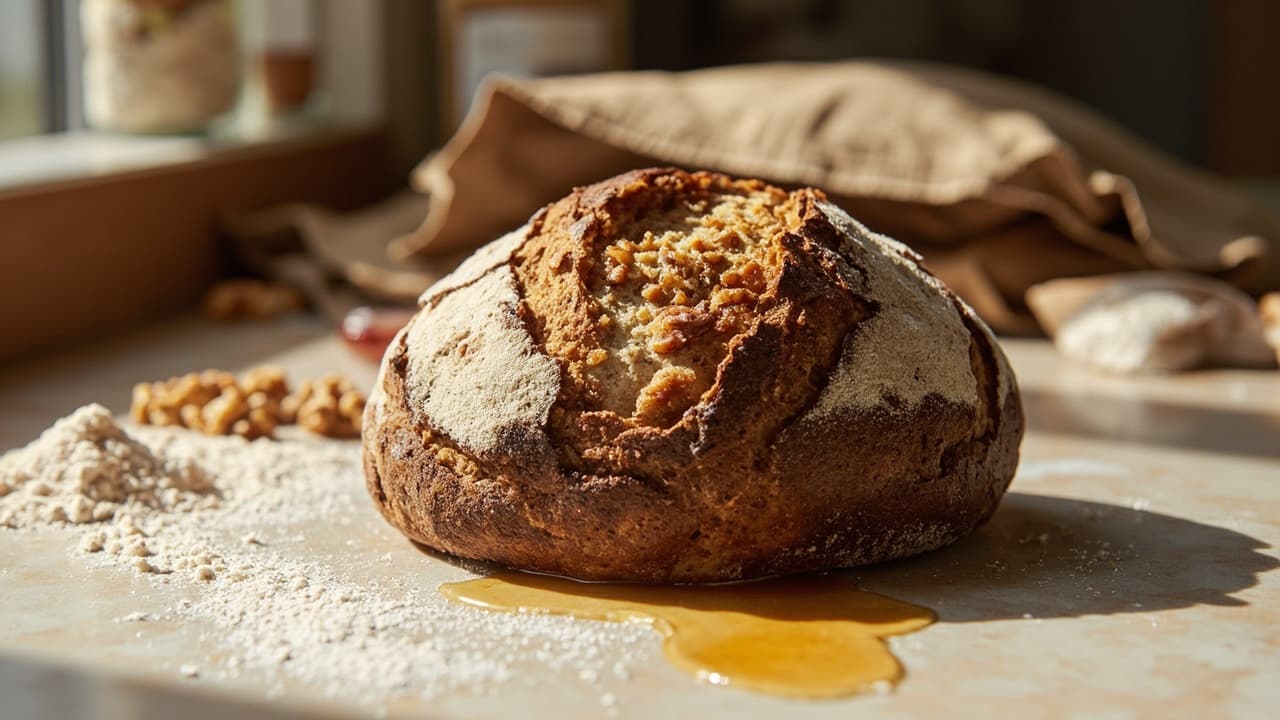
A deeply caramelized sourdough boule enriched with honey and toasted walnuts, with a crackling crust and tender, open crumb.

Prep
30 min
Cook
45 min
Rest
12h
Total
13h 15m
Method
Build the Sponge
1
Combine bread flour, yeast, and warm water in a large bowl. Stir until no dry flour remains. Cover and let rest at room temperature for 4 to 6 hours, or until bubbly and doubled in size.
Toast the Walnuts
2
Preheat the oven to 175°C (350°F). Spread walnut pieces on a baking sheet and toast for 8 to 10 minutes, until fragrant and lightly browned. Let cool completely before folding into the dough.
Mix the Final Dough
3
Add the remaining bread flour, salt, and honey to the risen sponge. Mix by hand or with a stand mixer until a shaggy dough forms. Turn out onto a lightly floured surface.
Knead and Incorporate Walnuts
4
Knead the dough for 8 to 10 minutes, adding the cooled toasted walnuts during the last 2 minutes of kneading. The dough should become smooth, supple, and slightly tacky.
Bulk Fermentation
5
Place the dough in a lightly oiled bowl. Cover and let rise at room temperature for 1 to 2 hours, until doubled in bulk. Perform one stretch-and-fold after 30 minutes.
Shape and Proof
6
Turn the dough onto a floured surface. Shape into a tight round boule by folding the edges toward the center and sealing the bottom with a bench scraper. Place seam-side up in a floured banneton or towel-lined bowl. Cover and refrigerate for 10 to 12 hours for a slow, cold proof.
Bake the Boule
7
Preheat your oven to 245°C (475°F) with a Dutch oven inside for at least 45 minutes. Remove the dough from the refrigerator. Score the top with a sharp blade in a circular arc. Carefully transfer to the hot Dutch oven, cover, and bake for 20 minutes.
Finish and Cool
8
Remove the lid and continue baking for 20 to 25 minutes, until the crust is a deep, rich brown and the internal temperature reads at least 95°C (205°F). Remove from the oven and cool on a wire rack for at least 2 hours before slicing.
C
Nutri-Score
Fair balance
A–E · lower is better · score 8
Calories
2557
per serving
High in salt · 3961mgCalorie-dense · 2557 kcalSource of fibre · 21gLow saturated fat · 8g
Protein
76g
Carbs
404g
Fat
74g
Sat. fat
8g
Fiber
21g
Sugar
34g
Sodium
3961mg
SourdoughArtisan BreadEgg FreeDairy FreeHigh CarbSugar ConsciousHeart Health AwareHigh FiberPlant ProteinWhole Grain Oriented
Nutri-Score is a general nutritional-balance guide, not medical or dietary advice.
B
Environmental impact
Low impact
A–E · lower is better · includes estimates
kg CO2e
0.9
per serving
BCarbonAEU all-round· carbon sets the grade
Water
1.1m³
Land
109Pt
Runoff
0.1g P
Bread flour drives 62% of this recipe’s estimated footprint.
Carbon from Poore & Nemecek 2018; water, land & runoff from Agribalyse — modelled averages for comparing recipes, not a measurement of your groceries.
Flavor Profile
4
Umami
5
Sweet
3
Salty
4
Sour
2
Bitter
0
Spicy
Textures
CrispyTenderAiryChewy
Aromas
EarthyNuttyCaramelizedHerbal
Kitchen Equipment
Primary Tool
OvenOvenDutch OvenBaking SheetStand MixerMixing BowlKitchen ScaleBench ScraperSharp BladeWire RackFlour DusterPlastic WrapTowelFlour For Dusting
Counter FootprintMedium
Techniques
Safety & Storage
High Risk Population
Honey is not recommended for infants under 12 months due to risk of infant botulism. This bread contains raw honey which may persist in the crumb even after baking.
Cooking Temperature
Dutch oven must preheat at 245°C (475°F) for 45 minutes before baking. Use oven mitts rated for high heat when handling - severe burn risk from direct contact with Dutch oven lid and interior.
Bread is safe to consume when internal temperature reaches 95°C (205°F). Use a probe thermometer to verify doneness and avoid consuming underbaked dough center.
Handling
Score the dough with a sharp blade (lame or sharp knife) before baking. Apply controlled, swift motion to avoid slipping and hand injury when scoring the cold, taut dough surface.
Cross Contamination
Allergen cross-contact risk exists if equipment (stand mixer, bowls, banneton, bench scraper) is used for allergen-free products after walnut and gluten contact. Clean thoroughly with soap and water between uses.
Storage
After baking, cool completed bread on wire rack for minimum 2 hours before slicing. Store sliced bread in breathable container or paper bag at room temperature for up to 3 days to maintain crust texture.
Refrigerate shaped and proofed dough if proofing exceeds 12 hours. Do not freeze shaped unbaked dough as walnuts may become discolored and texture degraded upon thawing.
Allergen Warning
This recipe contains tree nuts (walnuts) and wheat (gluten). Individuals with tree nut allergies, wheat allergies, or celiac disease must avoid this product entirely. Be aware that sourdough products labeled 'gluten-free' differ from this recipe.
Walnuts are tree nuts, distinct from peanuts which are legumes. Some individuals with tree nut allergies may tolerate peanuts and vice versa, but always verify specific allergen tolerances.
Sponge fermentation at room temperature for 4-6 hours creates ideal conditions for wild yeast activity. Keep covered to prevent contamination from airborne particles and fruit flies while allowing gas escape.
Pro Tips
Technique
Don't skip the cold overnight proof in the refrigerator. That slow, patient rise develops a depth of sourness that rushed fermentation simply cannot replicate, and it makes the dough far easier to score and handle when it hits the hot Dutch oven.
Substitution
If walnuts aren't to your taste, toasted pecans or roughly chopped hazelnuts work beautifully in their place — just be sure they're completely cool before folding them in, or they'll gum up the dough.
Equipment
A Dutch oven is genuinely essential here. The enclosed heat traps steam released from the dough itself, which is what gives the crust that characteristic shatter and deep, even caramelization. Without it, you'll get a pale, soft crust instead.
From the chef
I baked my first honey walnut loaf in a tiny stone-mill bakery in the Dordogne, watching the light catch the caramelized crust as it emerged from the oven — and I thought, this is what bread should feel like. The honey doesn't just sweeten the crumb; it feeds the crust, coaxing those deep amber tones you see when you pull off a wedge. I've been chasing that same crackle and tenderness ever since, and this recipe — with its slow overnight proof and toasted walnuts folded in at just the right moment — is the closest I've come.
TagsSourdoughHoneyWalnutsBouleCrustyLong FermentationCold ProofArtisan
AllergensWheatTree Nuts
Source: generated · June 10, 2026