Prep & Assembly
Blending a Spice Mix
Combining toasted, ground spices in measured ratios to build a balanced seasoning blend.
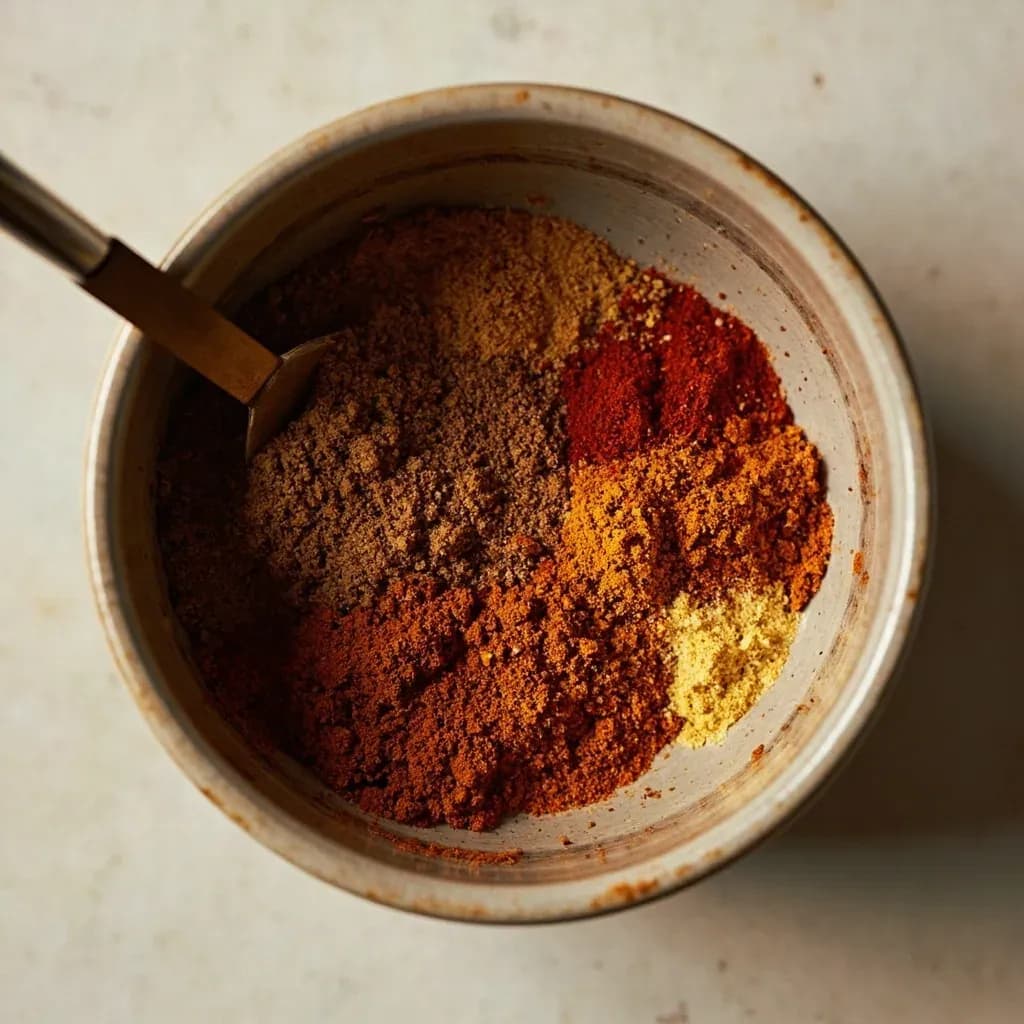
Blending a spice mix combines individual spices, often toasted and freshly ground, in deliberate proportions to create a balanced seasoning like a curry powder, masala, or rub. The order and ratio control how sweet, hot, earthy, or aromatic the blend lands. Toasting before grinding draws out volatile oils and deepens the flavor before everything is combined.
Blending a spice mix is the deliberate construction of a seasoning from individual whole or ground spices, weighed into a fixed ratio, often toasted and ground together, then stored as a single working ingredient. It is less a recipe than a grammar: every successful blend — whether a Tamil sambar powder, a Moroccan ras el hanout, or a Korean gochugaru blend — sits on the same architectural skeleton of a base, a top note, a warm bridge, and an accent of heat. Once you see that skeleton, the world's spice cabinets read as variations on a theme rather than as separate, intimidating lists.
The behavior of a finished blend depends on three controllable variables: freshness of the raw spices, particle size, and contact with fat. Whole spices keep their volatile oils sealed inside a husk for one to three years; the moment they are ground, those oils begin to oxidize, and a blend made today will be markedly quieter in three months. Particle size determines how a blend sits on the tongue, how it distributes through a dish, and how quickly it releases its aromatics when heated. And contact with hot oil — the technique cooks call blooming — is what unlocks the fat-soluble compounds (capsaicin, curcumin, eugenol) that the palate actually perceives. A dry sprinkle and a bloomed sprinkle of the same powder taste like two different seasonings.
The payoff for blending your own is disproportionate to the effort. A few dollars of bulk whole spices, a dry skillet, and a small grinder yield dozens of custom blends that out-aroma any commercial packet, let you control salt and allergens, and can be retuned to a single dish. Active time per batch is rarely more than fifteen minutes; storage life, handled correctly, is long enough that one afternoon of work seasons a month of cooking.
- Difficulty
- Medium
Types & varieties
South Asian templates built on turmeric, cumin, coriander, and chili, toasted and ground together — Madras curry powder, garam masala, sambar powder.
Baharat, ras el hanout, berbere, and za'atar — warm spices (cinnamon, clove, allspice), often dried herbs and occasionally dried rose.
Adobo, recado, jerk seasoning, taco and chili powders — chili-forward, typically with cumin, oregano, and garlic powder.
Chinese five-spice, Japanese shichimi togarashi, and Korean gochugaru blends, each defined by a single dominant note (star anise, sansho, or chili).
Paprika- and pepper-driven, with thyme, oregano, garlic, and onion; saltier and coarser than most other rubs.
Rubs are coarse, salt-forward, and applied pre-cook; finishing blends are fine, often salt-free, and sprinkled at service.
Celery salt, garlic salt, smoked salt blends — salt is the majority component and spices serve as accent.
Restaurant-specific combinations tuned to a single menu, dish, or even a single cut of meat.
How to do it
- 1
Define the blend's purpose
Decide whether the mix is a pre-cook dry rub, a finishing sprinkle, or the foundation of a wet dish. This dictates salt content, grind size, and which spices belong — a finishing blend should be fine and salt-free, a braise base can be coarse and salt-forward.
- 2
Select and measure whole spices by weight
Choose whole spices whenever possible. Build the blend around a base (coriander, cumin, or pepper), a top note (fennel, citrus zest, or dried herb), a warm bridge (cinnamon, clove, or allspice), and a heat accent as needed. Weighing beats measuring by spoon for repeatability.
- 3
Toast in a dry skillet, in waves
Heat a dry skillet over medium heat. Add dense seeds first (coriander, cumin, mustard) and toast 60–90 seconds, then add faster-toasting spices (fennel, fenugreek, dill) for 30–60 seconds, then leaves and buds (bay, thyme, clove) for 15–30 seconds. Transfer each batch to a cool plate the moment it smells fragrant and darkens one shade — over-toasted spices turn bitter fast.
- 4
Cool completely before grinding
Spread the toasted spices on a plate or sheet pan and let them reach room temperature, 5–10 minutes. Warm spices steam in the grinder, producing a gummy paste rather than a dry powder, and volatile aromatics escape into the air rather than into your blend.
- 5
Grind to the target texture
Use a mortar and pestle for varied, slightly coarse texture with visible flecks; use a blade grinder for speed and a uniform powder. Work in short pulses and stop at the desired fineness — over-grinding heats the spices, melts the oils, and clumps the powder. Reserve delicate, heat-sensitive spices (smoked paprika, sumac, Aleppo pepper) for the next step rather than the grinder.
- 6
Combine, sift, and adjust
Whisk the ground spices together in a bowl with measured salt, sugar, dried herbs, garlic or onion powder, and any post-toast additions. Pass the whole mixture through a fine-mesh sieve to even the texture and break up clumps. Taste on a neutral carrier (plain rice, a cracker) before salting further — salt is a multiplier and easier to add than to remove.
- 7
Bloom-test a small portion
Heat a tablespoon of neutral oil in a small pan, add ½ teaspoon of the finished blend, and fry for 30 seconds. The flavor you taste now is the flavor the dish will actually carry. Adjust salt, heat, or balance at this stage — not after the blend has been jarred.
- 8
Store properly
Transfer to a clean, dry, airtight glass or metal container, label with the name and date, and store away from the stove, sunlight, and humidity. Use within 1–3 months for peak flavor; older blends are best bloomed vigorously to revive them.
The ratio architecture of a good blend
Almost every cuisine's signature spice mix can be diagrammed as four overlapping roles. Once you see them, you can improvise rather than transcribe.
- Base (50–70% of the blend by weight): a workhorse spice that defines the volume of flavor — coriander seed in curry powders, cumin in taco seasoning, black pepper in European blends, paprika in Cajun rubs. Pick one; do not stack two bases at full strength or neither will read clearly.
- Top note (10–20%): a brighter, often floral or citrus-leaning spice that lifts the base — fennel, cardamom, citrus zest, dried herbs. This is what you smell before you taste.
- Warm bridge (5–15%): the low, sweet, almost-background spices that connect everything — cinnamon, clove, allspice, nutmeg, star anise. Use sparingly; a 3% clove note reads as 'mulled wine,' a 6% note reads as medicine.
- Heat or accent (0–10%): chili, black pepper, mustard, horseradish, ginger — the spice that pushes the blend from savory to vivid. Adjust to the eater, not the recipe.
Common uses
Tips & pitfalls
- Buy whole spices and grind per batch — pre-ground spice is the single biggest reason a homemade blend tastes flat next to a freshly made one.
- Toast spices individually rather than all at once; dense seeds need 60–90 seconds, leafy or floral spices need 15–30, and they will scorch if combined in the pan.
- Cool toasted spices to room temperature before grinding, or the residual heat will drive off the very aromatics you just developed and turn the powder gummy.
- Add salt last, by weight, and taste as you go — a salt-heavy blend hides every other spice in the mix.
- Reserve heat- and aroma-sensitive ingredients (smoked paprika, sumac, Aleppo pepper, dried citrus zest) until after toasting and grinding; they scorch and turn bitter fast.
- Sieve the finished blend through a fine mesh to remove husks and even the texture, especially after mortar-and-pestle work.
- Bloom the blend in hot oil for 20–60 seconds before adding any liquid; this is the single technique that most separates a good blend from a great one, because it converts fat-soluble flavor compounds into a form the palate actually perceives.
- Label every jar with the blend name and the date — potency drops measurably after three months once a blend has been opened, and an undated tin on a crowded shelf is a guess you do not need to make.
- Keep a dedicated blade grinder (a thrift-store coffee grinder works) for spices only; coffee oils contaminate spice blends within a few uses and the cross-flavor is impossible to fully clean out.
Good to know
- Whole-spice shelf life
- 1–3 years stored airtight in a cool, dark place; volatile oils remain sealed inside the husk.
- Ground-spice shelf life
- 6–12 months at best; volatile aromatics dissipate quickly after milling.
- Toasting effect
- Dry heat releases volatile oils and lightly toasts the spice surface, deepening aroma; spices turn fragrant within 1–3 minutes over medium heat.
- Standard batch size
- Home cooks typically blend 30–120 g (about 2–8 tablespoons); restaurants often work in 500 g–1 kg batches.
- Salt ratio rule of thumb
- Pre-cook dry rubs sit at 15–25% salt by volume; finishing blends usually contain no salt at all.
- Blooming
- Frying a dry blend in oil for 20–60 seconds before adding wet ingredients dramatically increases flavor release.
- Active time per batch
- 10–20 minutes, including toasting, cooling, and grinding.
- Storage
- Airtight glass or metal tin, away from light and heat; peak potency holds 1–3 months after grinding.
Also called
Spice Blending · Masala Making
Related

Whisk
Beat ingredients smooth and aerated with a looping wire motion

Sift
Pass dry ingredients through mesh to aerate and remove lumps

Strain
Pour through mesh to separate solids from liquid for a smooth result

Filter
Pass liquid through fine material to clarify out the smallest particles

Rice
Press cooked potatoes through small holes for fluffy, lump-free texture

Mash
Crush soft cooked food into a rustic, creamy purée

Grind
Crush food into a coarse to fine texture, from spices to meat

Grate
Shred food into fine bits against a sharp-toothed surface