Transform & Preserve
Cooking / Scalding the Curd
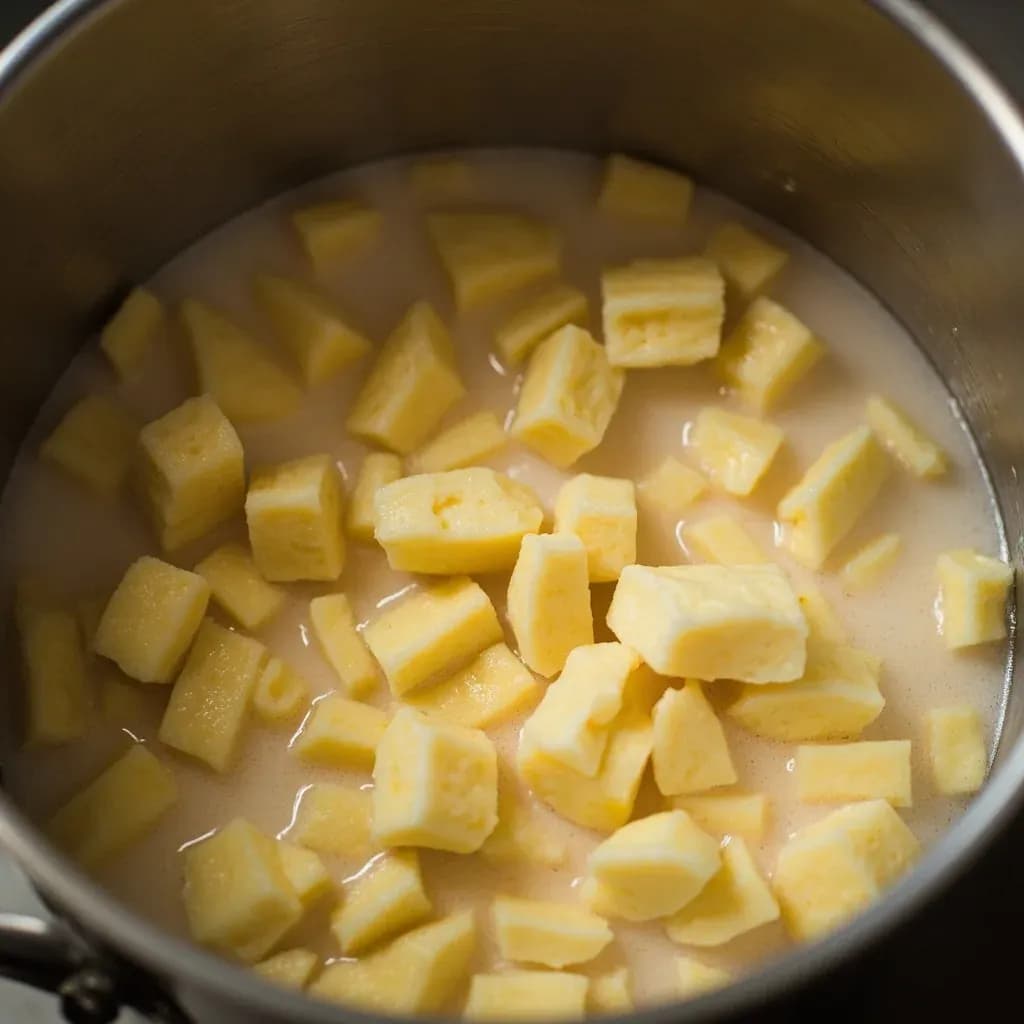
Gently heating cut cheese curds to expel whey and firm them for the target cheese style.
Cooking or scalding the curd is a cheesemaking step where freshly cut curds are slowly heated in their whey while stirring. The rising temperature shrinks the curds and drives out moisture, controlling the final firmness and texture of the cheese. Higher scald temperatures produce harder, longer-aging cheeses, while gentle cooking keeps softer styles moist.
Scalding the curd — the cook, in cheesemaker's shorthand — is the controlled heating of cut curds in their whey that sits between cutting and draining. Its job is to contract the protein matrix, squeeze out whey (syneresis), and set the final body of the cheese before the curds are hooped, pressed, or stretched. More than any other single step in the make, scalding decides whether a wheel will be soft and creamy, sliceable and springy, or hard enough to grate.
The mechanism is straightforward but unforgiving. As curds warm, the casein network tightens and expels water along with dissolved lactose and some whey proteins; at the same time, the warmer environment accelerates starter culture metabolism, so acidity builds during the cook. The cheesemaker balances four coupled variables — cut size, heating rate, final temperature, and pH at end of cook — and any one of them can pull a recipe from one cheese style into another. A 5–10°F (3–6°C) shift in target temperature is often the difference between a young Gouda and an aged Cheddar made from the same milk.
In practice, scalding is a slow, deliberate process. Heat is added gradually, the curds are kept in continuous motion so they don't fuse on the vat wall, and the cook is held at temperature until pH (not the clock) reaches a target range. The reward for getting it right is predictable texture, controlled moisture, and a wheel that ages the way the recipe intends.
- Difficulty
- Medium
Types & varieties
Curd held near rennet set temperature (~88–90°F / 31–32°C); used for cream cheese, fromage frais, fresh chèvre, bloomy-rind styles like Camembert, and fresh lactic cheeses
Cook to ~92–95°F (33–35°C); used for Havarti, Butterkäse, and young Gouda-style cheeses
Cook to 95–102°F (35–39°C); standard for Gouda, Edam, mild Cheddar, Colby, and Monterey Jack
Cook to 102–115°F (39–46°C); used for aged Cheddar, Cheshire, Cantal, and Tomme-style cheeses
Cook to 120–130°F (49–54°C) with vigorous stirring; produces the firm, low-moisture curd needed for Emmentaler, Gruyère, Comté, and Jarlsberg
After cutting, curd is stirred and cooked as acidity develops; characteristic of Cheddar-making, where matting and turning (cheddaring) follows
Some whey is partly drained before heating to concentrate the curd mass and intensify protein contraction
How to do it
- 1
Confirm cut size and starter pH before heating
Decide the target cook temperature based on the cheese style. Size the cut to match: rice- to corn-kernel size for hard, high-scald cheeses; pea to hazelnut size for soft, low-scald styles. Let the cut curd rest 5–10 minutes so the freshly cut surfaces firm up before heat is applied.
- 2
Begin gentle heating
Turn on jacket heat or introduce hot water or steam slowly, aiming for a rise of about 1–2°F (0.5–1°C) per minute. Start stirring immediately so curds don't settle and fuse on the bottom of the vat.
- 3
Stir through the temperature ramp
Maintain steady, gentle stirring as the curd-whey mass climbs to the target temperature. Curds will shrink, firm, and release more whey. Whey should turn pale yellow-green; bright white whey suggests fat loss from broken curds.
- 4
Hold at target temperature
Hold the vat at the target for 15–45 minutes, longer for hard cheeses. Use the hold to drive syneresis and to let starter cultures drop pH to the style's target — commonly pH 6.2–6.4 for semi-hard, pH 6.0–6.2 for Cheddar-style, pH 6.4–6.5 for washed-curd styles.
- 5
Test curd firmness
Press a small handful of curds together: they should feel firm and springy, and squeak slightly against the teeth when bitten. A clean break (not a smear) and a translucent rind on the broken surface are good signs the cook is complete.
- 6
Stop the cook and move to the next step
Cut the heat, then proceed to the style-specific next step: drain whey for Cheddar-style cheddaring; partial whey removal and water addition for washed-curd cheeses; direct molding for stirred-curd Dutch styles; or transfer to hot water for pasta filata. Waiting too long at temperature risks over-acidification and a brittle curd.
- 7
Record the batch
Log starting pH, end pH, time to target temperature, hold time, and final temperature. These numbers are what let you reproduce a successful wheel batch after batch.
Why scalding is the cheesemaker's main lever
Scalding sits at the center of the cheesemaking decision tree because it controls three outcomes at once: how much moisture stays in the curd, how much acidity develops before molding, and how the protein matrix is set for everything that follows. A higher cook expels more water and produces a denser curd that ages slowly and resists bacterial softening — that's the route to aged Cheddar, Cheshire, and the Alpine and Italian grating styles (Gruyère, Emmentaler, Parmigiano-Reggiano). A lower cook keeps moisture and lactose inside the curd, which is essential for bloomy-rind cheeses, fresh lactic styles, and anything that will be stretched (pasta filata) — the curd must remain soft and pliable enough to knead in hot water.
The four variables — cut size, heating rate, final temperature, and pH at end of cook — are coupled, not independent. Smaller curds release whey faster and tolerate higher cook temperatures; larger curds protect moisture and pair with low cooks. Plan the target temperature before you cut, then size the cut to match. Trying to chase a style by adjusting temperature after the cut is already set is the most common route to a wheel that lands between two cheese types.
- Low cook + large cut + high end pH → soft, moist, lactic cheeses (cream cheese, fresh chèvre, Camembert)
- Medium cook + medium cut + pH 6.2–6.4 → semi-hard table cheeses (Gouda, Havarti, mild Cheddar)
- High cook + small cut + pH 6.0–6.2 → aged, firm, grating cheeses (aged Cheddar, Cheshire)
- Swiss cook + small cut + hot-water wash → low-lactose curd that forms eyes (Emmentaler, Gruyère, Comté)
Reading the cook as it happens
Beyond the thermometer, the cook gives the cheesemaker three live signals: whey color, curd firmness, and a clean break when a curd is torn. Whey should shift from cloudy white to a clear pale yellow-green as the cook progresses; bright white whey usually means fat is being lost, almost always because the curds have been broken by over-stirring or rough handling. A well-cooked curd, pressed between thumb and forefinger, feels springy and resists a smear — it breaks cleanly with a slightly translucent edge. For Swiss-style cheeses, a properly cooked curd squeaks audibly against the teeth when bitten; that squeak is one of the most reliable field tests in cheesemaking.
Common scalding problems and what they mean
- Rubbery curds with whey trapped inside — heating too fast, or a vat hot spot scorching the curd exterior
- Brittle, shattering curds — over-acidified before the cook, or held too long at temperature
- Greasy, white whey and lost yield — curds broken by aggressive stirring, especially after they have firmed up
- Slow pH drop during the hold — starter culture under-performing, or cook temperature too low for the strain
- Curd matting into clumps on the vat wall — insufficient stirring at the start of the temperature ramp
- Slimy or slippery curd body — mucoid-bacterial contamination, or extended holding that allowed unwanted flora to dominate
Common uses
Tips & pitfalls
- Heat slowly at 1–2°F (0.5–1°C) per minute — too fast creates a tough skin on the curd that traps whey inside and produces a rubbery wheel.
- Stir gently but continuously once the cut curd begins to float; undisturbed curds mat into clumps that cook unevenly and resist proper whey release.
- Watch pH, not just time — finish the cook when the curd reaches the style's target pH (often ~6.0–6.3) for predictable texture and acidity.
- Use a calibrated thermometer; a 2°C error can move a cheese from semi-soft into hard territory and undo a whole batch.
- Plan the final cook temperature before you cut — cut size has to match it, and trying to adjust temperature after the cut is already set is the most common route to a wheel that lands between two cheese styles.
- Don't over-stir once curds have firmed up — broken or shattered curds release fat into the whey and measurably reduce yield.
- For Swiss-style, hold near 125–130°F (52–54°C) with active stirring until curds squeak when chewed; that squeak is the most reliable field test for a properly cooked Alpine curd.
- If scalding in a direct-fired vat, use a water bath or diffused heat to avoid scorching the curd mass against the kettle wall.
- Rinse and sanitize pH probes between dips; residual whey skews readings and can carry contamination from one vat to the next.
Good to know
- Technique type
- Cheesemaking transformation step, performed after cutting the curd and before draining or molding
- Also called
- Scalding, cooking the curd; in French: 'cuisson'
- Primary purpose
- Expels whey, contracts the curd protein matrix, controls moisture, drives acidity, and sets final body and texture
- Temperature range
- From a no-scald baseline of ~88–90°F (31–32°C) up to ~130°F (54°C) for Swiss-style; most cheeses cook to 95–110°F (35–43°C)
- Heating rate
- 1–2°F (0.5–1°C) per minute; faster rates risk case-hardening the curd exterior
- Hold time at target
- 15–60 minutes, often until pH (commonly 6.0–6.3) rather than a fixed time
- Effect on yield
- Higher scalding temperatures reduce yield: more water, fat, and whey proteins are expelled with the whey
- Effect on texture
- Higher cook produces firmer, drier, more elastic curd; low cook produces soft, moist, fragile curd
Also called
Cooking Curd · Scalding the Curd · Curd Cooking
Related

Confit
Cook slowly submerged in fat for silky tenderness and keeping

Cure
Draw out moisture with salt and time to preserve and concentrate

Pickle
Steep in acidic brine for bright, tangy, crunchy preservation

Ferment
Let friendly microbes transform food into tangy, complex flavor

Marinate
Soak in a seasoned mix to flavor and tenderize before cooking

Brine
Soak in salt water so meat stays juicy and seasoned throughout

Dehydrate
Slowly dry out moisture to concentrate flavor and extend shelf life

Cold-Smoke
Perfume cured food with smoke without cooking it through