Transform & Preserve
Pasta Filata (Stretching Curd)
Kneading and stretching warm cheese curd in hot water to make stringy, elastic mozzarella-style cheeses.
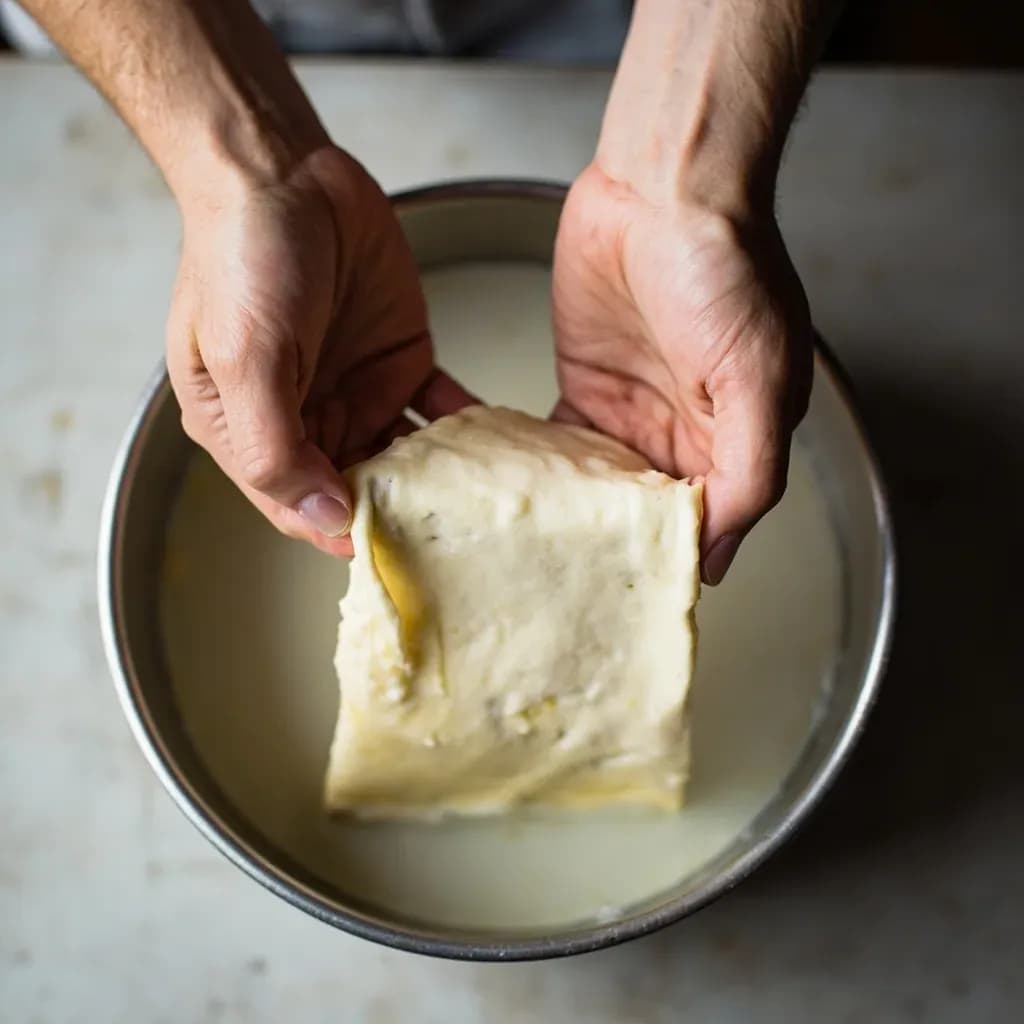
Pasta filata, meaning spun paste, heats acidified cheese curd in hot water and then kneads and stretches it until it becomes smooth, glossy, and elastic. The stretching aligns the proteins into fibers, giving cheeses like mozzarella, provolone, and scamorza their characteristic stringy, pliable texture. The hot, stretched curd is then shaped into balls, braids, or logs before cooling.
Pasta filata — literally "spun paste" — is the Southern Italian technique of heating an acidified curd in hot water or whey and then kneading, stretching, and shaping it while the casein proteins are still plastic. What makes the method extraordinary is that the same basic process yields an enormous family of cheeses, from the soft, milky balls of fresh mozzarella to the dense, sharp wheels of aged provolone piccante. The transformation is structural, not flavored: the kneading aligns the paracasein micelles into long, parallel fibers, which is why a properly stretched curd looks satiny, draws into glossy strings, and holds its shape without crumbling.
Success hinges on three variables working together: pH (the curd must be sufficiently acidified, generally in the 5.0–5.4 window), temperature (stretching water between roughly 80 and 95 °C for cow's-milk curd, slightly lower for delicate buffalo curd), and timing (the plastic window opens for only a minute or two once the curd hits the water, so shaping must be brisk). Change any one of these and the cheese changes character: lower pH and longer aging give provolone its pungent, sulfurous bite; higher pH and immediate shaping give fior di latte its gentle sweetness; buffalo milk adds fat and elasticity for the prized mozzarella di bufala.
For the home cook, pasta filata is one of the most rewarding projects in a cheesemaker's repertoire because it requires no specialized equipment — just a vat, a thermometer, a pH meter, and a kettle of near-boiling water. The skills transfer across the whole family: once you can pull a smooth string of mozzarella, you can make scamorza, provola, caciocavallo, and even burrata with the same curd.
- Difficulty
- Hard
Types & varieties
Water-buffalo milk; soft, juicy, slightly tangy; DOP from Campania and surrounding regions.
Cow's-milk mozzarella; milder and slightly drier than the buffalo version; the everyday southern Italian fresh cheese.
Braided ropes, cherry-size balls, and small knot-shaped pieces, all formed from the same stretched curd.
Cow's-milk, Northern Italian; 'dolce' stretched within hours for a mild, sweet paste, 'piccante' ripened longer and aged 2–6+ months for a sharp, piquant character.
Southern Italian; traditionally hung over a beam (hence "horse cheese"); aged versions develop a firm, sharp paste that grates and grills beautifully.
Teardrop-shaped, often dry-salted and sometimes affumicata (cold-smoked).
Sicilian aged pasta filata, formed in a wooden mold (mastredda) into large rectangular wheels.
Smaller, pear- or egg-shaped provolone-style cheeses of southern Italy; frequently smoked.
A pouch of stretched mozzarella enclosing stracciatella — torn pieces of pasta filata soaked in fresh cream. Best within a day or two.
The shredded, cream-soaked filling of burrata, originating in Andria, Puglia.
Southeastern European and Turkish pasta filata, aged and often yellow; prized for grilling, frying, and grating into pastries.
Mexican pasta filata wound into skeins; soft, white, and mild; the classic melting cheese for quesadillas and tlayudas.
How to do it
- 1
Acidify the milk and set the curd
Heat milk to about 32–35 °C, add a mesophilic starter (and a small amount of thermophilic culture for richer flavor), and ripen until acidity begins to rise. Add rennet, let the curd set firmly, then cut into 1–2 cm cubes to release whey.
- 2
Cook and drain the curd
Stir gently while heating the curd to roughly 38–42 °C to expel more whey. Drain off most of the whey and let the curd mat together under its own weight, then press lightly or hang in cheesecloth to remove additional moisture.
- 3
Ripen the curd until it stretches
Hold the curd warm (about 35–40 °C) for several hours, until the pH drops to target — roughly 5.2–5.4 for mozzarella, scamorza, and provolone dolce; 5.0–5.2 for provolone piccante and aged caciocavallo. Test by plunging a small piece into hot water: it should draw into smooth, glossy strings rather than snap or crumble.
- 4
Heat the stretching water
Fill a large kettle with water or reserved salted whey and bring to 80–95 °C. Hold it just off the boil; top up with boiling water between batches so the temperature does not crash when fresh curd is added.
- 5
Stretch and knead
Lower a portion of the matured curd into the hot water. As it softens (15–60 seconds), fold it over itself and knead with a wooden paddle, slotted spoon, or gloved hands until the mass becomes silky, smooth, and elastic with no visible grain. Add salt near the end of kneading if salting in the water.
- 6
Shape while hot
Work quickly: pinch off pieces and stretch into balls for mozzarella and bocconcini; braid for treccia; form a pear and tie a string around the neck for provolone; roll ropes and drape them over a stick or beam for caciocavallo; or tear pieces into cream to make stracciatella for burrata.
- 7
Cool, store, or age
Shock the shaped cheeses in cold water or ice brine to set the skin. For fresh styles, transfer to lightly salted water or their own whey and refrigerate; use within 2–5 days (fresh mozzarella and burrata are best submerged in a little of their own milky whey — drain only just before serving). For aged varieties, dry-salt the surface, hang to dry, and move to a cool, humid aging room (10–14 °C, 85–90% RH) for the desired time.
The science of the stretch
Pasta filata works because of what the acid does to the curd before it ever touches hot water. As the curd ripens after the initial draining, lactic acid drops the pH and solubilizes calcium out of the casein network. The proteins (now properly called paracasein) become less tightly bound to each other, and the curd gains a smooth, rubbery plasticity. When that ripened curd is plunged into hot water, the casein softens enough to flow, and the kneading physically drags the protein strands into parallel alignment. The aligned strands are what give the finished cheese its characteristic smooth surface, its snap when torn, and its ability to draw into long, glossy strings rather than crumbling like a fresh cheddar curd. Cool the curd too soon, and you trap unaligned protein; overshoot the pH, and the strands become brittle and short.
- Acidification is non-negotiable — an under-ripened curd will not stretch no matter how hot the water.
- Hotter water and longer kneading tighten the fiber and lower moisture, which is the path to aged pasta filata.
- Lower pH at stretching produces more free sulfur compounds, which is why provolone piccante smells sharper than provolone dolce made from the same milk.
Milk, pH, and what changes
Three dials determine the final cheese: the species of milk, the pH at which you stretch, and what you do after shaping.
- Buffalo milk is roughly 7–8% fat (versus 3.5–4% for cow), giving a whiter, sweeter, more elastic curd that holds more moisture.
- Cow's-milk curd stretches fine too, especially with a touch of calcium chloride and a mixed mesophilic/thermophilic culture for body and yield.
- Stretching at pH 5.3–5.4 → mild, sweet fresh cheese (mozzarella, fior di latte, scamorza).
- Stretching at pH 5.0–5.2 → sharper, more sulfurous cheese suited to aging (provolone piccante, aged caciocavallo, Ragusano).
- Aging dries the paste, concentrates flavor, and, in well-aged wheels, encourages the formation of small tyrosine crystals that give a faint crunch.
Common uses
Tips & pitfalls
- Always test a small piece of curd in hot water before committing the whole batch. If it snaps cleanly, the pH hasn't dropped enough — let the curd ripen another 30–60 minutes and retest. If it tears apart or crumbles at the edges, the pH has overshot; use it for a sharper fresh style or work it into a cooked dish.
- Water below about 75 °C leaves rubbery, tearing curd; a full rolling boil (100 °C+) turns the outside grainy and the inside tough. Aim for 80–95 °C and keep the kettle just off the boil.
- Once the curd softens, you have only a minute or two before it cools and firms again. Have your shaping tools, salt, strings, and ice bath staged before the curd ever hits the water.
- Heavy salt in the stretching water delays skin formation and can make the surface grainy. For most fresh styles, salt the shaped cheese in brine; for provolone and caciocavallo, dry-salt the surface over several days.
- Smoke only after the cheese has fully cooled and the surface is dry to the touch. Warm, wet paste takes smoke unevenly, weeps, and can develop a bitter skin.
- Save the salty whey from the stretching pot for the next batch, for soaking stracciatella, for braising vegetables, or for bread dough — it carries real flavor and a useful salt level.
- Pasteurized cow's milk can be slow to develop a good body. A small dose of thermophilic culture alongside the mesophilic starter, plus a pinch of calcium chloride, noticeably improves stretch and yield.
- A common beginner mistake is leaving the curd too long and dropping pH below 5.0 for a fresh style. The cheese will be brittle, sour, and won't melt smoothly on pizza. Time the ripening actively with a pH meter or strip.
Good to know
- Italian name
- Pasta filata (literally "spun paste" or "stretched curd")
- Defining mechanism
- Heating acidified curd in hot water and kneading aligns the casein (paracasein) proteins into smooth, elastic, parallel fibers
- Target pH at stretching
- Roughly 5.0–5.4; lower pH gives sharper, more sulfurous aged cheese, higher pH gives milder fresh styles
- Stretching water temperature
- Typically 80–95 °C (175–205 °F) for cow's-milk curd, slightly lower for buffalo curd
- Approximate yield
- About 1 kg of cheese from 8–10 L of buffalo milk or 10–13 L of cow's milk
- Primary milks
- Water buffalo (mozzarella di bufala), cow (fior di latte, provolone, scamorza, caciocavallo), occasionally sheep or goat
- Difficulty
- Intermediate to advanced; success depends on pH, temperature, and timing rather than equipment
- Protected status examples
- Mozzarella di Bufala Campana DOP, Provolone Valpadana DOP, Caciocavallo Silano DOP, Ragusano DOP
Also called
Stretching Curd · Spun Curd
Related

Confit
Cook slowly submerged in fat for silky tenderness and keeping

Cure
Draw out moisture with salt and time to preserve and concentrate

Pickle
Steep in acidic brine for bright, tangy, crunchy preservation

Ferment
Let friendly microbes transform food into tangy, complex flavor

Marinate
Soak in a seasoned mix to flavor and tenderize before cooking

Brine
Soak in salt water so meat stays juicy and seasoned throughout

Dehydrate
Slowly dry out moisture to concentrate flavor and extend shelf life

Cold-Smoke
Perfume cured food with smoke without cooking it through