Prep & Assembly
Crushing / Cracking Whole Spices
Breaking whole spices to release their volatile oils and aromas before cooking.
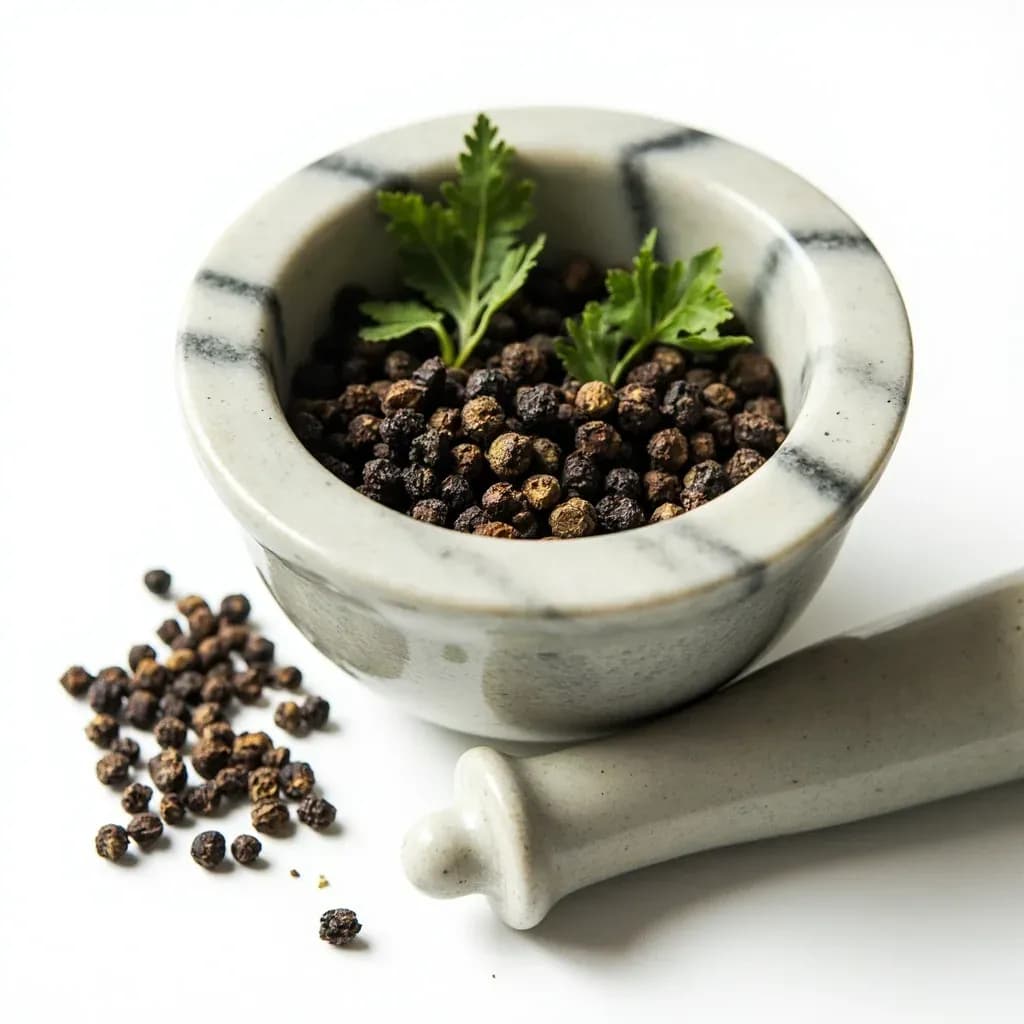
Crushing or cracking whole spices like peppercorns, coriander, or cardamom ruptures their cell walls to release fragrant volatile oils far fresher than pre-ground powder. Cooks use a mortar and pestle, the flat of a knife, or a rolling pin, controlling how coarse or fine the result is. Toasting first intensifies the aroma before crushing.
Crushing, sometimes called cracking, is the practice of breaking whole dried spices into coarse, irregular fragments — visibly broken but not powdered. The mechanical point is to rupture the cell walls that hold the spice's volatile oils, exposing far more surface area to fat, liquid, or heat than a whole seed or bark can offer. A cracked spice begins releasing aroma within seconds in hot oil, while an intact peppercorn or cumin seed can take five to ten minutes to catch up.
The technique is distinct from grinding, which reduces a spice to a uniform powder, and from splitting, which is a precise lengthwise cut (a vanilla bean, a cardamom pod) usually made to expose seeds rather than release oils. For most cooked applications — long braises, curries, stocks, rubs, and infusions — a coarse crush is preferable to a powder: it releases flavor gradually, strains out cleanly, and avoids the dusty, sometimes bitter note that a fine powder can take on during long cooking.
The single most important habit that separates good crushed-spice cookery from forgettable work is dry-toasting the whole spices first; the brief Maillard browning compounds with the cell rupture and roughly doubles the perceived intensity of seeds like cumin, coriander, and fennel.
- Difficulty
- Easy
Types & varieties
The classic method. Best for oily seeds such as coriander, cumin, and fennel, and the easiest way to control crush size from coarse to fine. Lightweight wooden mortars tend to bounce small seeds out and don't transfer force well.
Quick and widely used for peppercorns, cumin, and coriander crushed under a heavy blade on a board. A pinch of coarse salt helps keep small seeds from scattering.
Clean, controlled, and gentle on coated pans. Good for peppercorns and small seeds; press the air out first so a sharp shard doesn't pierce the bag.
Pressing a hot, heavy pan down on spices in a folded towel. Suited to brittle bark like cinnamon sticks and star anise.
The right tool for hard, dense spices — cinnamon quills, whole nutmeg, and large pods — where more force is required.
Old-school method for very hard whole spices like cinnamon quills and whole nutmeg. Effective but harder to control.
Not a crush in the strict sense, but the right move for very hard whole spices that are grated rather than cracked — most often whole nutmeg, sometimes tonka.
Primarily a grinding tool, but a single one- or two-second pulse yields a coarse crack. Risk of over-processing to powder if you don't stop the machine quickly.
How to do it
- 1
Measure the whole spices
Decide how much you need — roughly 1 to 2 teaspoons of whole spice per quart of braising liquid, scaled to taste for finishing. Whole spices are easier to portion accurately before crushing, especially small seeds that scatter once broken.
- 2
(Recommended) Dry-toast the spices
Add the whole spices to a dry skillet over medium heat. Shake or stir constantly for 1–3 minutes, until the aroma sharpens and the color just begins to deepen. Transfer immediately to a plate or bowl so residual heat from the pan doesn't carry them past toasted into burnt.
- 3
Match the tool to the spice
Hard bark (cinnamon, star anise) and large seeds (peppercorns, coriander): use a bag and mallet, or a heavy pan press. Small oily seeds (cumin, fennel, mustard): use a mortar and pestle or the flat of a chef's knife. Very hard whole spices like nutmeg: reach for a microplane to grate it.
- 4
Crack with controlled force
Apply firm, even pressure rather than one hard smash. With a mortar and pestle, use a circular grinding motion; with a knife, press down evenly with the heel of your palm; with a bag and mallet, two or three measured strikes are usually enough.
- 5
Check the crush size as you go
Aim for a coarse crack — fragments roughly the size of a coarse peppercorn — for most cooked applications. Stop short of powder. Powders extract too fast and can turn muddy in long-cooked dishes.
- 6
Discard papery husks and chaff
After cracking, pick out cardamom pods, dried chili stems, and the chaff from coriander. A coarse strainer given a gentle shake will separate the fines if you want a cleaner result.
- 7
Use immediately, or hold briefly
Crushed spices are at their best within minutes. If you must hold them, seal in a small airtight jar and use within 24 hours; beyond that the volatile oils fade quickly and the work loses its point.
Crush vs. grind vs. split
These three actions are easy to conflate, and each has a different job in the kitchen. Crushing breaks the spice into irregular, textured fragments in the few-millimeter range. The point is gradual, controlled extraction: the fragments are big enough to hold back some of their flavor and small enough to give up plenty of it quickly. In a long braise, a crushed spice slowly leaches its oils into the liquid, then can be strained out at the end, leaving a clear, spiced stock rather than a cloudy one.
Grinding reduces the spice to a uniform powder. The flavor hits immediately and disperses through the dish, which is what you want in a quick sauté, a finishing dust, or a spice cake. The trade-off is that powders go muddy in long cooking, can turn bitter, and are impossible to strain out cleanly.
Splitting is a precise lengthwise cut rather than a rough break — running a knife down a vanilla bean, or snapping open a cardamom pod to expose the small black seeds inside. Splitting is often paired with crushing: split the pod, then crush or grind the seeds it was protecting.
- Crush for slow, controlled extraction that you can strain out (braises, stocks, infusions, mulling).
- Grind for immediate, full integration (sauté aromatics, rubs that need to cling as a paste, finishing dusts).
- Split to expose seeds hidden in a pod or pod-like casing (cardamom, vanilla), then crush or grind the seeds.
Common uses
Tips & pitfalls
- Always dry-toast whole spices in a skillet over medium heat for 1–3 minutes before crushing; the aroma gain over un-toasted spice is larger than any other variable you control.
- Crush just before you cook. Pre-crushed spices — even ones sitting in a jar for a few days — have lost most of their volatile oils.
- Match crush size to cook time: coarse crack for long braises, finer crush for quick sautés and finishing. A powder is almost never the right call for a long-cooked dish.
- Add a small pinch of coarse salt to small, oily seeds before crushing; the salt acts as grit, keeps the seeds from skittering across the board, and can be left in or sifted out.
- For cinnamon sticks and star anise, seal them in a bag and give them a few firm whacks — they shatter cleanly without scattering shards across the kitchen.
- Crack cardamom pods first, then crush the tiny black seeds inside separately. The empty pods can be saved and added to stocks for a whisper of flavor.
- Don't crush delicate, paper-thin spices like saffron threads or dried bay leaves. Steep saffron in warm liquid and crumble bay by hand; crushing them destroys their structure without helping extraction.
- Switch to a composite or plastic cutting board when crushing strongly flavored spices. Wooden boards absorb the oils and will pass that flavor on to the next thing you prep.
Good to know
- Definition
- Breaking whole dried spices into coarse, irregular fragments — coarser than a powder — to rupture cell walls and release volatile aromatic oils.
- Surface area
- Crushing dramatically increases exposed surface area, the main driver of faster flavor release in oil, fat, or liquid.
- Release time
- Cracked spices begin releasing aroma in seconds in hot oil; whole spices may need 5–10+ minutes to match intensity.
- Best paired with toasting
- Dry-toasting before crushing is the largest single flavor upgrade — Maillard browning plus cell rupture compounds aroma.
- Crush size targets
- Coarse crack (~2–4 mm fragments) for braises and stocks; finer crush for quick sautés and finishing.
- Yield loss
- Minimal with controlled force; aggressive pounding in a cloth bag loses a small percentage as dust and fines.
- Shelf life
- Cracked spices fade noticeably within hours to a few days; whole spices keep 1–4 years depending on type.
- Common equipment
- Mortar and pestle, flat of a chef's knife, rolling pin, heavy skillet, meat pounder, or zip-top bag with a mallet.
Related

Whisk
Beat ingredients smooth and aerated with a looping wire motion

Sift
Pass dry ingredients through mesh to aerate and remove lumps

Strain
Pour through mesh to separate solids from liquid for a smooth result

Filter
Pass liquid through fine material to clarify out the smallest particles

Rice
Press cooked potatoes through small holes for fluffy, lump-free texture

Mash
Crush soft cooked food into a rustic, creamy purée

Grind
Crush food into a coarse to fine texture, from spices to meat

Grate
Shred food into fine bits against a sharp-toothed surface