Transform & Preserve
Draining the Whey
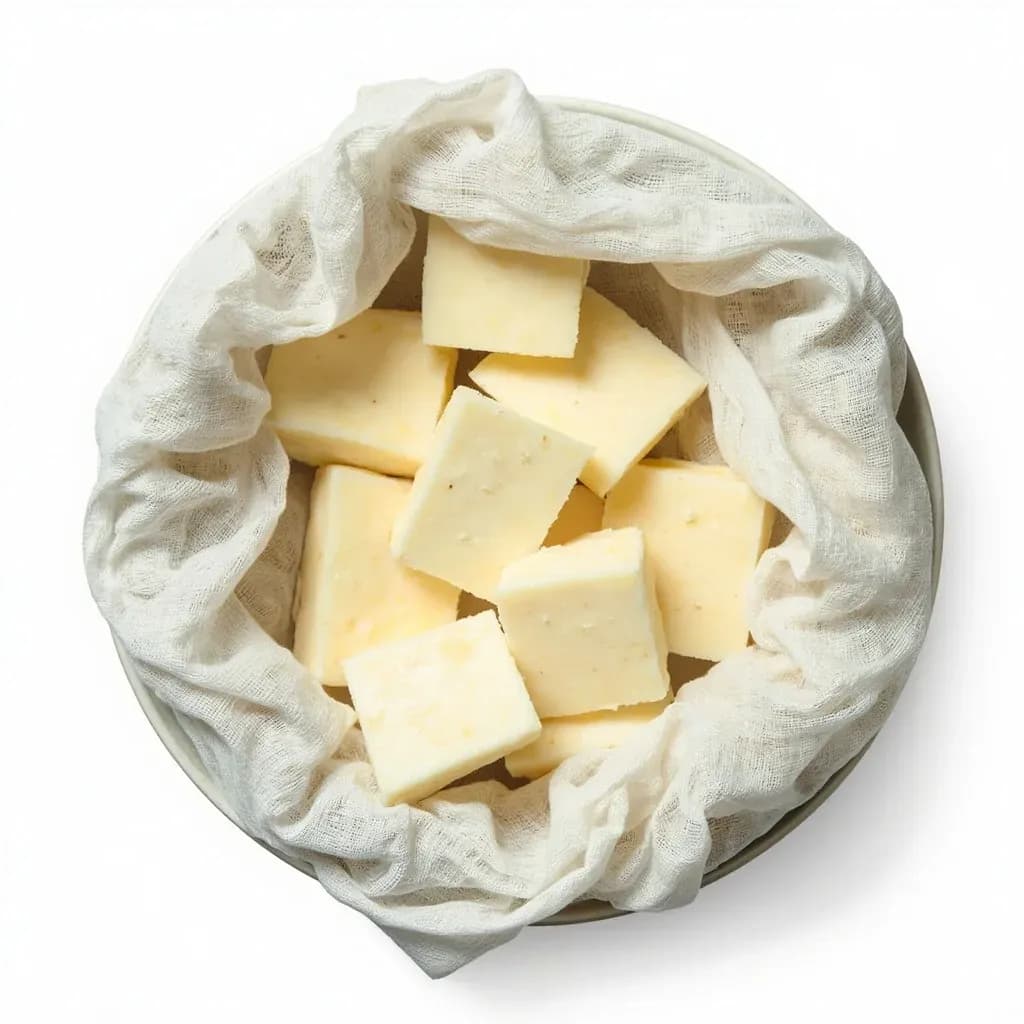
Letting whey run off cut curd through cloth or a mold to firm up the cheese.
Draining the whey separates the liquid from the curd after cutting, using cheesecloth, a colander, or a perforated mold so gravity pulls the whey away. The longer and more firmly the curd drains and is pressed, the drier and denser the resulting cheese. It is a key control point for moisture, salting, and final texture in cheesemaking.
Draining the whey is the third major step in cheesemaking, sitting between coagulation and salting or pressing. Physically, it is the deliberate management of syneresis — the natural tendency of a milk gel to contract and squeeze out its liquid once the casein network has been cut, warmed, and acidified. In practice it covers everything from a ricotta hanging in butter muslin for an hour to a wheel of Gruyère spending a full day under graduated pressure in a mold.
The step is deceptively simple and entirely style-defining. The size of the cut, the cook temperature, the pH at which the curds leave the vat, the cloth, and the weight applied all combine to decide how much moisture, fat, and lactose stay behind. Two cheesemakers making the same recipe can produce a soft, creamy wheel or a dry, sharp one purely by how they drain.
A useful mental model: you can always drain more, but you cannot un-drain. Beginning gently and checking often — by feel, by pH, and by the clarity of the whey running off — almost always beats pressing hard and ending up with an acidic, crumbly cheese.
- Difficulty
- Easy
Types & varieties
Curds settle in a cloth-lined colander or mold and whey drips out under their own weight; used for ricotta, fromage frais, mascarpone, quark, and paneer.
Curds are gathered in a cloth bag or muslin suspended from a hook or rod; the original method for many soft cheeses and the easiest way to make labneh from yogurt.
Curds are ladled into perforated molds; whey exits through the holes. Standard for bloomy-rind cheeses like Brie and Camembert and for small tomme-style wheels.
A follower and graduated weights apply increasing pressure to curds in a mold; used for harder cheeses (cheddar, gouda, gruyère, manchego) to drive out remaining whey and knit the curd into a wheel.
Specific to Cheddar and a few related cheeses: slabs of matted curd are stacked and turned repeatedly, expelling more whey by their own weight and through continued acidification before milling and hooping.
Traditional method on a slightly tilted table; curds mat into a slab while whey runs off into a trough. Used for many alpine, farmhouse, and tomme styles.
After heating curds to 38–55°C in the whey, they are held briefly, then scooped and pressed; standard for Swiss, alpine, and pasta-filata cheeses (mozzarella, provolone, halloumi).
How to do it
- 1
Cut and stir the curds to start syneresis
After coagulation, cut the curd to your target size — small cuts (rice to pea) for drier cheese, larger cuts (hazelnut to walnut) for moister styles. Rest briefly, then stir gently for 5–20 minutes, optionally raising the temperature 1–2°C, until clear yellow-green whey pools between the curds and the curds feel firm enough to hold their shape.
- 2
Choose a draining method that matches the cheese
Soft fresh cheeses (ricotta, mascarpone, fromage frais, labneh, paneer): gravity drain in a cloth-lined colander or hang in muslin. Bloomy-rind cheeses (Brie, Camembert): ladle curds gently into perforated molds at room temperature to preserve moisture. Pressed cheeses (cheddar, gouda, alpine): transfer curds to a mold and apply a follower and graduated weights. Cheddar family: cheddaring first (stack and turn slabs), then mill and salt before hooping and pressing.
- 3
Line equipment with the right cloth
Rinse and wring out cheesecloth or butter muslin so it is damp, not soaking. Drape it into a colander, draining basket, or mold with enough overhang to fold over the top of the curds later.
- 4
Transfer the curds gently
Use a slotted spoon, ladle, or hands dipped in warm whey to move curds without crushing them. For pressed cheeses, scoop curds directly into the mold, packing evenly. For bloomy-rind cheeses, ladle in two or three passes so the curd settles without trapping large pockets of whey.
- 5
Drain or press to the target moisture
Soft curds: leave to gravity-drip 1–12 hours in a cool place, longer for thicker styles like labneh. Pressed wheels: start at light pressure (~1× curd weight) for 15–30 minutes, then increase gradually to 5–10× curd weight, flipping and rewrapping in dry cloth every 30–60 minutes. Cheddared curds: mill, salt, then hoop and press to knit the wheel.
- 6
Check moisture and acidity as you go
A properly drained curd knits together when pressed, feels firm, and breaks cleanly when torn. The whey running off should change from cloudy to nearly clear — that is the sign that fat and fine curd are being retained. Pressed wheels should spring back lightly when the press is released.
- 7
Recover the whey
Strain collected whey through a fine cloth to capture any escaped curds (which can be salvaged as a rustic ricotta). Refrigerate the whey promptly and use within 1–2 days, freeze for longer storage, feed to livestock, or reserve for bread, stocks, or ferments.
- 8
Move on to salting, shaping, or ripening
Dry-salt, brine, or pack the drained curd as the recipe requires. Pressed wheels go to a cheese cave or ripening space; fresh cheeses are chilled and eaten within days; bloomy-rind wheels go to a humid aging room to develop their rind.
Reading the whey
The look of the liquid running off your curds is the single most useful diagnostic in cheesemaking. Learn to read it and you can stop guessing about moisture, fat loss, and progress.
- Cloudy, milky whey early on is normal — fine curd particles and butterfat are still washing out.
- Whey that turns from milky to a clear, slightly yellow-green color (sometimes described as 'straw' or 'pale beer') signals that the curd has firmed and is now retaining its solids. Pressing or hanging past this point loses very little.
- If the whey stays milky late in the drain, slow down: switch to a finer cloth, reduce pressure, or stop the press and let gravity do the work.
- Tangy whey with a clean, yogurt-like aroma indicates healthy lactic acidification; a yeasty, fecal, or fizzy smell warns that the ferment is off and the wheel may be compromised.
Matching drain method to cheese style
Each style of cheese evolved around the drain method that holds or expels the right amount of moisture. A short cheat sheet for the most common home and small-production styles:
- Soft and fresh (ricotta, mascarpone, fromage frais, quark, labneh, paneer): gravity or hang draining, no pressure, sometimes overnight in the fridge.
- Bloomy and washed-rind (Brie, Camembert, Pont-l'Évêque, Époisses): ladled into perforated molds at room temperature, drained without pressure or with very light weight so the curd stays wet enough to support a soft interior.
- Pressed semi-hard and hard (cheddar, gouda, gruyère, manchego, tomme): hooped and pressed with graduated weights, often flipped and rewrapped several times for even moisture.
- Pasta-filata (mozzarella, provolone, halloumi): cooked and pressed firmly to expel whey, then kneaded and stretched in hot water so the curd becomes smooth and elastic.
Common uses
Tips & pitfalls
- Stop squeezing. Wrapping and wringing curds by hand expels fine curd and butterfat along with the whey and gives dry, grainy cheese. Let gravity or steady, even weight do the work.
- Choose the right cloth. Loosely-woven cheesecloth is fine for rustic draining but lets small curds escape; butter muslin, a tightly-woven fine cloth, or a reusable nylon cheese bag is better for soft cheeses.
- Drain at the right pH. Most draining happens as the curd approaches the isoelectric point of casein (~pH 4.6). Draining too early leaves excess moisture and lactose; too late gives an acid-driven, brittle texture.
- Resist pumping the cloth. Lifting and squeezing the bundle shocks the curd and gives uneven moisture. Leave it alone and let syneresis happen steadily.
- Stir curds before draining (for most pressed cheeses). A short 'dry stir' after cutting releases more whey, firms the curds, and improves the final texture, especially for hard styles.
- Mind temperature. Warmer curds expel whey faster. Cool the curds if a soft, moist cheese is the goal; warm them if a drier, firm cheese is the goal.
- Use the 'clear whey' test. Properly drained whey turns from milky to slightly yellow-green and translucent. If it stays milky, you are losing fat and fine curd — slow down or use a finer cloth.
- Save the whey. It still contains lactose, whey protein, and minerals; excellent for bread, stocks, brines, and as a fermentation medium. Refrigerate and use quickly, or freeze.
- Sanitize everything. Whey is a near-perfect medium for pathogens. Rinse all cloths and molds in very hot water (or a food-safe sanitizer) and drain over food-grade vessels.
- Start with light pressure, then build. For pressed wheels, begin at roughly the weight of the curd for 15–30 minutes, then double or triple the pressure in stages. Flipping and rewrapping in dry cloth at 30–60 minute intervals gives even drainage.
Good to know
- Also called
- Whey drainage; the underlying physical process is syneresis (the spontaneous expulsion of whey from a coagulated milk gel)
- Stage in cheesemaking
- Third major step, after coagulation and (usually) cutting and cooking the curd, before salting, pressing, and aging
- Approximate whey yield
- Roughly 80–90% of milk volume exits as whey; only 10–20% becomes curd/cheese, depending on style
- Key equipment
- Cheesecloth or butter muslin, draining mats, cheese molds (hoops/forms), slotted spoon or ladle, colander, follower and weights, thermometer
- Working temperature
- Generally 30–40°C (86–104°F) for most pressed and cooked-curd cheeses; fresh soft cheeses drain at room temperature or chilled in the fridge
- Time
- 30 minutes to a few hours for fresh soft cheese; 4–24 hours under gentle pressure for pressed wheels; cheddaring requires 1.5–2+ hours of stacking and turning
- Driving forces
- Acid development (lowering pH toward the casein isoelectric point of ~4.6), heat, mechanical cutting, stirring, gravity, and applied pressure
- Whey handling
- Refrigerate and use within 1–2 days, freeze up to 3 months, feed to livestock, compost, or use in bread, stocks, brines, and ferments
Also called
Whey Draining · Draining the Curd
Dishes that rely on it


Related

Confit
Cook slowly submerged in fat for silky tenderness and keeping

Cure
Draw out moisture with salt and time to preserve and concentrate

Pickle
Steep in acidic brine for bright, tangy, crunchy preservation

Ferment
Let friendly microbes transform food into tangy, complex flavor

Marinate
Soak in a seasoned mix to flavor and tenderize before cooking

Brine
Soak in salt water so meat stays juicy and seasoned throughout

Dehydrate
Slowly dry out moisture to concentrate flavor and extend shelf life

Cold-Smoke
Perfume cured food with smoke without cooking it through