Heat & Fire
Dry-Braising (Gan Shao)
Chinese technique of cooking ingredients in seasoned liquid until it reduces fully and clings as a glaze.
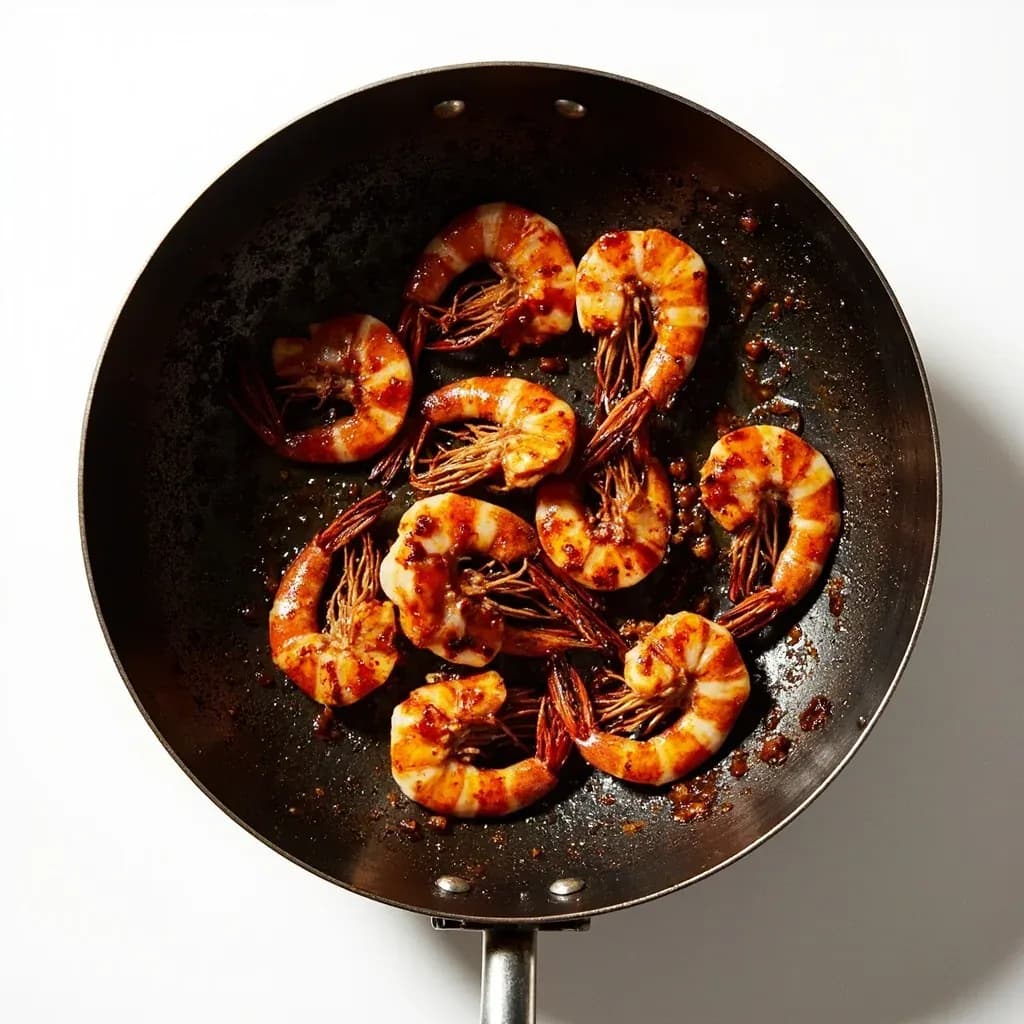
Dry-braising, or gan shao, simmers ingredients such as prawns or fish in a flavored sauce over heat until the liquid almost entirely evaporates, leaving the food coated in a concentrated, slightly caramelized glaze. Unlike a wet braise, no sauce is served separately. It is common in Sichuan cooking for dishes like dry-braised shrimp, where the technique intensifies flavor and gives a glossy finish.
Dry-braising — gan shao (干烧) — is the braise that ends where most braises begin. The cook sears the main ingredient, builds a seasoned cooking liquid, simmers the food covered until tender, then removes the lid and drives that liquid off completely. What is left is not a sauce to be ladled, but a thin, glossy, intensely flavored glaze that clings to the surface of the food. That single decision — to reduce the braising liquid all the way to a coating rather than stopping at "almost done" — is what separates gan shao from its better-known cousin hong shao (red-braising), and it is the reason the technique has a place of honor in Sichuan and Shanghai banquet cooking.
The method rewards patience with aromatic layering. The Maillard crust from the initial sear, the fragrance of bloomed doubanjiang and ginger, and the savory-sweet seasoning of soy, Shaoxing wine, and a thread of vinegar all compress into a glaze that tastes more concentrated than the sum of its parts. It also rewards good timing: the last minute of reduction moves from perfect to scorched in seconds, and the cook who pulls the pan a moment too late will taste the difference immediately.
Gan shao is most often applied to whole firm-fleshed fish, bone-in chicken, duck, eggplant, and fried tofu — ingredients that hold their shape under long heat and benefit from being served without a pool of sauce beside them. The signature dish, gan shao yu (dry-braised fish), shows the method at its most theatrical: a scored whole carp or sea bass arrives glistening, with shredded ginger and scallion draped over a glaze that tastes of fermented chili, sweet wine, and the caramelized bottom of the pan.
- Difficulty
- Medium
Types & varieties
The signature expression — a whole scored fish, often carp, sea bass, or snapper, finished with a sticky, savory-sweet glaze and a topping of shredded ginger, scallion, and sometimes ham or ya cai.
Bone-in chicken pieces (often chopped through the bone) browned, then braised with ya cai, doubanjiang, and the seasoning liquid until dry-glazed; a classic banquet dish.
Dry-braised duck, sometimes incorporating smoked or cured duck; the reduction concentrates richness against the strong flavor of the meat.
Pan-fried firm tofu or tofu puffs glazed with a meat- or mushroom-enriched reduction; a common vegetarian adaptation.
Eggplant slabs or wedges, often paired with minced pork and doubanjiang, finished dry-glazed and oily.
Shanghai/Zhejiang variation that tends toward more sugar and Shaoxing wine, less doubanjiang, often featuring river fish like grass carp.
How to do it
- 1
Prepare the main ingredient
For a whole fish, score the flesh in deep diagonal cuts every 2–3 cm and pat thoroughly dry with paper towels. For chicken, chop through the bone into bite-sized pieces and dry the skin. Season lightly with salt and a thin film of cornstarch if the recipe calls for a crisper sear.
- 2
Sear hard
Heat a wok or wide pan over medium-high with a generous slick of neutral oil. Lay the ingredient in and leave it undisturbed for 2–3 minutes per side until a deep golden crust forms. Remove and reserve. Pour off all but about 2 tablespoons of fat.
- 3
Bloom aromatics and base seasoning
Lower the heat to medium. Add minced ginger, smashed garlic, and the white parts of scallion; stir 20–30 seconds. Add 1–2 tablespoons doubanjiang (and 1–2 tablespoons of ya cai or pork slivers if using) and stir until the oil turns red and fragrant, about 1 minute.
- 4
Add the seasoning liquid
Pour in Shaoxing wine to deglaze, scraping up the browned fond. Add stock or water to come about one-third of the way up the ingredient, then season with light soy sauce, a small amount of sugar, and a modest splash of black vinegar. Stir to combine.
- 5
Braise covered
Return the seared ingredient to the pan, spoon some liquid over the top, and bring to a simmer. Cover, reduce heat to low, and cook until the ingredient is just cooked through — roughly 8–12 minutes for a thin fish, 20–30 minutes for bone-in chicken. Baste once or twice through the lid.
- 6
Uncover and reduce to a glaze
Remove the lid, raise the heat to medium-high, and let the liquid boil down. Tilt the pan to monitor; the goal is for the sauce to go from soupy to syrupy, then to disappear entirely while leaving a glossy, clinging film on the food, with reddish oil separating at the edges.
- 7
Finish and serve
Off the heat, add a final small splash of Chinkiang vinegar, a scattering of julienned scallion or ginger, and a drizzle of very hot neutral oil for sheen. Transfer the ingredient to a plate and spoon any remaining glaze over the top. Serve immediately.
Gan Shao vs. Hong Shao vs. Gan Bian
Three names get confused at the stove: gan shao, hong shao, and gan bian. They share a flavor vocabulary — soy, Shaoxing, sometimes doubanjiang — but end with very different pans, and confusing them is the most common reason home-cooked versions of these dishes disappoint.
- Hong shao (红烧, red-braising) is the everyday braise. The seared ingredient simmers in soy-and-sugar liquid and is served swimming in a thick but pourable, mahogany sauce. Think hong shao pork or hong shao fish at a neighborhood Chinese restaurant. Gan shao uses the same flavor base but strips the sauce away at the end.
- Gan shao (干烧, dry-braising) is the dry-braise. The liquid is added, the food is cooked through, and then the liquid is boiled off entirely. The flavor lives on the food, not in a pool beside it.
- Gan bian (干煸, dry-frying) is a Sichuan stir-fry technique, not a braise at all. Ingredients — usually pre-fried or blanched first — are tossed in a wok over high heat with minimal added liquid to drive off their own moisture and concentrate flavor, typically finished with ya cai, garlic, and chili. The glossy, oil-sheened look can resemble gan shao, but the method is a fast stir-fry from start to finish.
Common uses
Tips & pitfalls
- Pat the main ingredient very dry before searing; surface moisture kills browning and dilutes the eventual glaze.
- Brown hard in oil first and set the ingredient aside — the glaze will only taste as good as the fond left in the pan.
- Bloom the aromatics and doubanjiang in the residual oil over low heat for 30–60 seconds before adding liquid; raw doubanjiang tastes harsh and grainy.
- Use just enough liquid to come partway up the ingredient — this is a reduction, not a stew. Too much liquid and you will overshoot the sear stage by the time it reduces.
- Cover during the simmer phase to tenderize, then uncover for the final reduction so evaporation can drive the glaze.
- The last 60–90 seconds are the danger zone: swirl the pan constantly off the heat or on low, and pull it the moment the liquid turns syrupy and the oil begins to separate and glisten. It goes from glazed to burnt in seconds.
- A final splash of Chinkiang vinegar and a thread of hot oil just off the heat brightens the glaze and adds sheen.
- If the glaze reduces too far and sticks, deglaze with a tablespoon of stock, swirl, and re-coat rather than scraping burned bits into the dish.
Good to know
- Chinese Name
- 干烧 (gān shāo)
- Cuisine
- Chinese — most strongly associated with Sichuan and Shanghai/Zhejiang traditions
- Also Known As
- Dry-braise, dry-burning, 'no-sauce' braise; sometimes mistranslated as 'dry-fry' (that is 干煸 gān biān, a different technique)
- Family
- Reduction-braising; the dry endpoint of the same family as 红烧 (hóng shāo) red-braising, which leaves a pool of sauce
- Defining Feature
- The seasoned cooking liquid is fully reduced by the end of cooking so that no loose sauce remains — flavor clings to the main ingredient as a glossy glaze
- Core Seasoning Liquid
- Stock or water, Shaoxing wine, Chinkiang or black vinegar, light soy sauce, a small amount of sugar, often doubanjiang
- Heat
- Sear over high heat, simmer covered over low heat, finish uncovered over medium-high to drive off the liquid
- Time Range
- Roughly 20–45 minutes total, depending on ingredient (a thin fish about 20 minutes, bone-in chicken 30–40 minutes)
- Iconic Dish
- 干烧鱼 (gān shāo yú), most famously a whole carp or sea bass
Also called
gan shao · dry braise
Dishes that rely on it
Related

Sear
Blast the surface hot for a deep-browned, savory crust

Sauté
Cook quickly in a little fat over lively heat, tossing as you go

Stir-Fry
Toss bite-sized pieces over roaring heat for fast, smoky cooking

Pan-Fry
Crisp food in a shallow layer of hot fat, turning once or twice

Deep-Fry
Submerge in hot oil for an all-over crackling crust

Roast
Cook uncovered in dry oven heat for browned edges and tender centers

Bake
Cook with steady, surrounding oven heat — the soul of bread and pastry

Broil
Hit food from directly above with fierce overhead heat