Prep & Assembly
Foam / Espuma Making
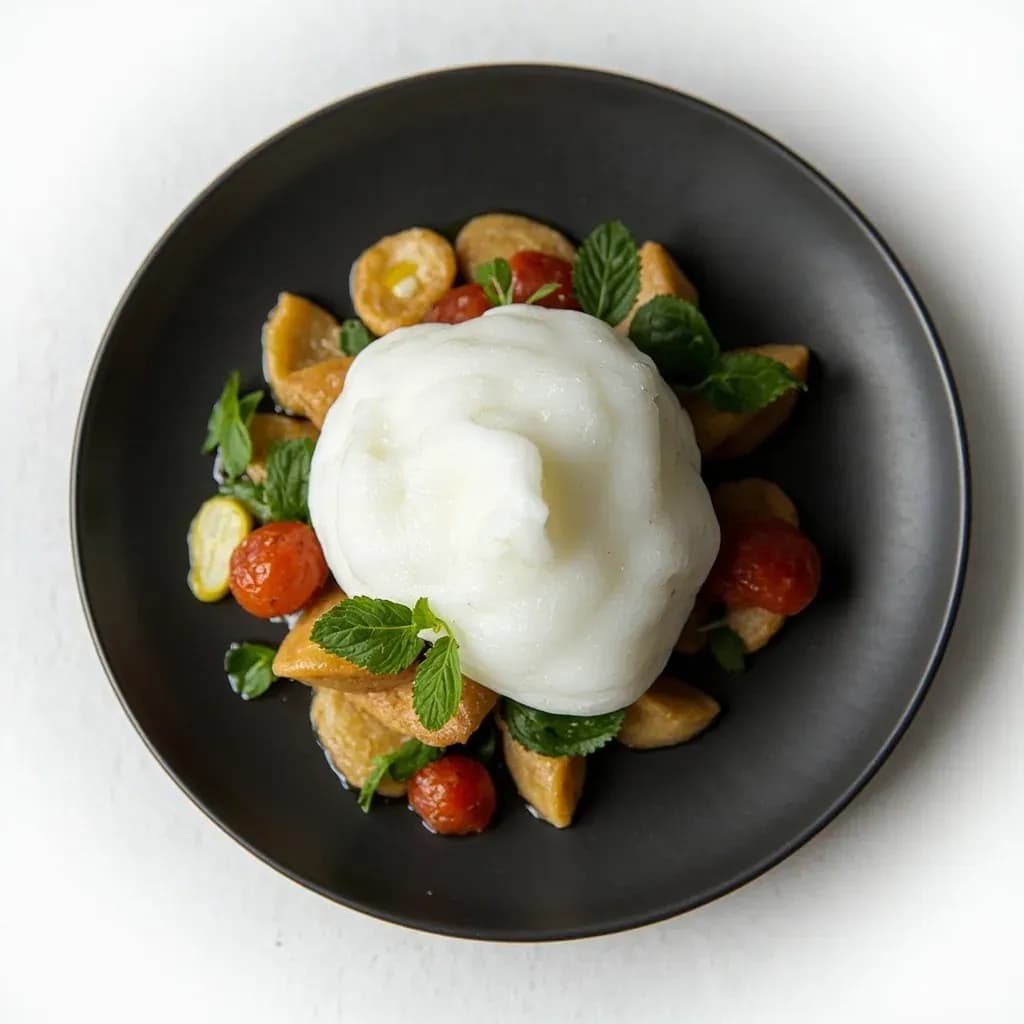
Whipping a liquid with a stabilizer into a light, airy foam to add flavor and texture without weight.
Foam making aerates a flavored liquid into bubbles using a stabilizer such as soy lecithin, gelatin, or egg white, often dispensed from a whipping siphon. It lets cooks deliver concentrated flavor in a weightless form, a signature of modernist and fine-dining plating. Lecithin 'airs' produce loose surface bubbles, while siphon espumas give a denser, mousse-like foam.
A foam is one of the most efficient ways a cook can deliver flavor: by trapping a small amount of flavored liquid inside a network of bubbles, you get the full aroma and taste of the base on the tongue with almost no weight. The technique splits into two modern methods. Siphon espumas charge a thickened liquid with nitrous oxide in a whipping siphon, producing a glossy, stable, pipeable foam that holds for an hour or more in the dispenser. Lecithin airs, popularized alongside espumas at elBulli in the mid-1990s, blend a thin flavored liquid with soy or sunflower lecithin to build a drier, more ephemeral foam that is scooped off the surface and served at once. Both rest on the same logic — air plus a stabilizer plus flavor — but they behave very differently in the kitchen and on the plate, and that difference shapes which one a cook reaches for.
Stabilizers are what separate a foam from a fleeting froth. Gellan, xanthan, agar, gelatin, and methylcellulose give espumas the body to hold through service; soy or sunflower lecithin does the same for airs by lowering surface tension around each bubble. The choice matters at the table, not just in the dispenser. Low-acyl gellan yields a firm, almost sliceable foam; xanthan a soft and glossy one; gelatin a melt-in-the-mouth texture ideal for warm savory sauces; high-acyl gellan a softer, more elastic set that mimics gelatin's melt; and lecithin a light froth that vanishes within minutes. Understanding that spectrum is what lets a cook match a foam to a dish rather than reaching for the siphon by reflex.
Because foam carries flavor efficiently, a small amount of well-reduced base goes a long way — a teaspoon of intense parsley espuma can top a slow-roasted cod where a spoonful of sauce would smother it. The flip side is that errors in seasoning are amplified, which is why over-seasoning and over-thickening account for most foam failures. A good base should taste one and a half to two times stronger than you want on the plate, and it should be thoroughly cold and still before it ever sees a charger or a blender.
- Difficulty
- Hard
Types & varieties
Wet, glossy foam made by charging a thickened, often dairy- or stock-based liquid with N₂O in a whipping siphon. Stable, pipeable, and the workhorse of modernist plating.
Dry, ephemeral foam made by blending a thin flavored liquid with 0.3–1% soy lecithin. Scooped off the surface and served at once; vanishes on the tongue.
Classical foam stabilized by whipped egg white or cream; denser and richer than an espuma, built with folding rather than pressure.
Hot foam built on an egg-yolk-and-liquid sabayon aerated over a bain-marie; unstable, served at once, prized for warm savory applications.
Loose, large-bubble foam from a steam wand or hand pump, with little or no stabilizer. Common on coffee and cocktails.
Very light, often translucent foam set with gellan or agar that holds its shape for plating — closer to a set gel than a true foam.
How to do it
- 1
Build and concentrate the base
Make a strongly flavored liquid — a reduction of stock, juice, or infused cream, a vegetable water, or a clarified consommé — and strain it through a fine mesh or coffee filter. The base should taste 1.5–2× stronger than you want on the plate, since air dilutes flavor perception. Season at this stage and remember that the final dish will only carry a teaspoon or two of foam.
- 2
Choose and dose the stabilizer
For an air: whisk 0.3–1% soy or sunflower lecithin into the cold base and let it hydrate 5–10 minutes before blending. For a siphon espuma: thicken with 0.1–0.4% gellan (heat to dissolve, then cool), 0.1–0.3% xanthan (cold-blended), 1–2% gelatin (bloomed and melted in), or 0.2–0.5% agar for a firmer, plant-based set. Methylcellulose at 0.5–1% is the choice when you want a foam that gels on contact with a warm plate and melts again on the palate.
- 3
Adjust body and temperature
The base should coat the back of a spoon but still pour freely — too thick and the foam will be doughy, too thin and it will collapse. Chill to 2–4 °C. If you used gelatin or gellan, let the base fully set, then blend or whisk it back to a smooth liquid just before loading the siphon. Warm or carbonated bases must be cooled and degassed or they will not hold.
- 4
Load the whipping siphon (espuma)
Fill the siphon to its indicated max line — never past it, or it will not seal. Screw on the head, insert an 8 g N₂O charger, and listen for the gas release. Shake vigorously 8–10 times, rest 30 seconds, then shake once more. For thicker bases, charge a second time after a minute. Test with a small purge into a cup to check texture before service.
- 5
Blend the air (lecithin foam)
Pour the lecithin base into a tall, narrow glass so the immersion-blender head sits just under the surface. Tilt the blender and run it on low, drawing air down into the liquid to build a thick, stable foam that holds a soft peak. Stop as soon as a peak forms; over-blending breaks the bubbles and the foam will weep.
- 6
Hold and serve
Espumas: keep the siphon at room temperature for service, or refrigerated for up to 2 hours. Dispense with the head pointing down for a clean dollop, and purge a small amount first to clear any watery liquid pooled inside. Airs: scoop the foam off the surface with a spoon immediately — it begins losing bubbles within minutes. Plate both at the last moment.
- 7
Troubleshoot and clean
If the foam is runny, increase stabilizer or chill the base longer. If it tastes chalky or beany, drop the lecithin toward 0.3%. If the siphon leaks, the head is over-filled or the seal is dirty. After every use, disassemble the head, run all parts through hot soapy water, and rinse the nozzle — clogged orifices are the single most common cause of failed foams.
Choosing between siphon and air
The decision usually comes down to how long the foam has to live and how wet you want it to feel in the mouth. A siphon espuma is the right call for any dish that is plated to order over a service — it stays pipeable in the dispenser for a couple of hours, dispenses cleanly, and gives a glossy, almost sauce-like foam. A lecithin air is the right call when you want something that disappears the instant it hits the dish: a citrus air over oysters, a herb air over a crudo, a fleeting cloud of aroma on a composed plate. If you are stabilizing a foam for a hot application, gelatin is the classic choice because it melts cleanly on the tongue; if you are keeping things plant-based, high-acyl gellan gives a similarly elastic melt, while low-acyl gellan trades melt for a firmer, more brittle set.
Stabilizer cheat sheet
Match the stabilizer to the dish and the service conditions.
- Gellan, low-acyl (0.1–0.4%): firmest set, brittle and sliceable, holds longest; best for plated clouds and warm applications when dosed low.
- Gellan, high-acyl (0.1–0.4%): softer, elastic, melt-in-mouth set; the plant-based stand-in for gelatin in warm foams.
- Xanthan (0.1–0.3%): soft, glossy, slightly stringy; forgiving and easy to cold-blend; the everyday choice for savory espumas.
- Agar (0.2–0.5%): plant-based, sets firmly on cooling and re-blends smoothly; good vegan alternative to gelatin for firmer foams.
- Gelatin (1–2%): classic warm-friendly stabilizer; melts on the palate; cannot be used in truly vegan foams.
- Methylcellulose (0.5–1%): reverse-thermoreversible — liquid when cool, gels when warmed, melts again on cooling — useful for foams dispensed cool that set on contact with a warm plate.
- Soy or sunflower lecithin (0.3–1%): the only choice for airs; lowers surface tension around bubbles, no thickening power.
Common uses
Tips & pitfalls
- Reduce and strain the base before stabilizing; foams carry flavor far more efficiently than liquids, and over-seasoning is the most common mistake.
- For airs, hydrate soy lecithin in the cold base and rest 5–10 minutes before blending, or it clumps and tastes chalky.
- Charge a siphon in short bursts and shake firmly between charges — over-shaking or over-pressurizing makes the foam weep and collapse.
- Always chill the siphon and the base; warm liquid expands too fast, produces coarse bubbles, and leaks from the nozzle.
- Skim the densest, wettest foam that emerges first from a siphon; the lighter, more stable foam comes after a small initial purge.
- Never charge a siphon with a carbonated or already-aerated base — it foams explosively and will not hold a controlled texture.
- Dispense foam onto a cold spoon or chilled plate to slow collapse and keep bubbles tight; warm plates accelerate collapse, especially for gelatin-based espumas.
- Clean the siphon thoroughly after every use — residual fat or protein clogs the nozzle and ruins the next charge.
Good to know
- Origin
- Modern espumas popularized by Ferran Adrià at elBulli (Roses, Spain) in the mid-1990s as part of the broader molecular gastronomy movement.
- Two main methods
- Siphon-charged espumas (pressurized with N₂O) and lecithin airs (blended with an immersion blender to incorporate air).
- Why N₂O, not CO₂
- Nitrous oxide dissolves into the liquid and supports stable foam without carbonating or acidifying it; CO₂ makes fizzy, sharper foams.
- Standard equipment
- 0.5 L or 1 L stainless steel whipping siphon (iSi or similar); 8 g N₂O chargers; for airs, a tall narrow glass and an immersion or stand blender.
- Stabilizer range
- Soy or sunflower lecithin for airs (0.3–1% by weight); gellan, xanthan, agar, gelatin, or methylcellulose for siphon espumas (0.1–1%).
- Hold time
- Espumas hold 1–2 hours chilled in the siphon; airs collapse within 10–30 minutes and must be used at once.
- Base temperature
- Siphon bases should be 2–4 °C and fully degassed before charging; warm or carbonated bases prevent proper foam set.
- Yield
- A 0.5 L siphon charged twice yields roughly 1.5–2 L of finished foam; airs roughly double the volume of the base liquid.
Also called
Lecithin Airs (Bubbles) · Espuma · Culinary Foam · Air
Dishes that rely on it
Related

Whisk
Beat ingredients smooth and aerated with a looping wire motion

Sift
Pass dry ingredients through mesh to aerate and remove lumps

Strain
Pour through mesh to separate solids from liquid for a smooth result

Filter
Pass liquid through fine material to clarify out the smallest particles

Rice
Press cooked potatoes through small holes for fluffy, lump-free texture

Mash
Crush soft cooked food into a rustic, creamy purée

Grind
Crush food into a coarse to fine texture, from spices to meat

Grate
Shred food into fine bits against a sharp-toothed surface