Water & Steam
Slow Bhuna Reduction (Kosha)
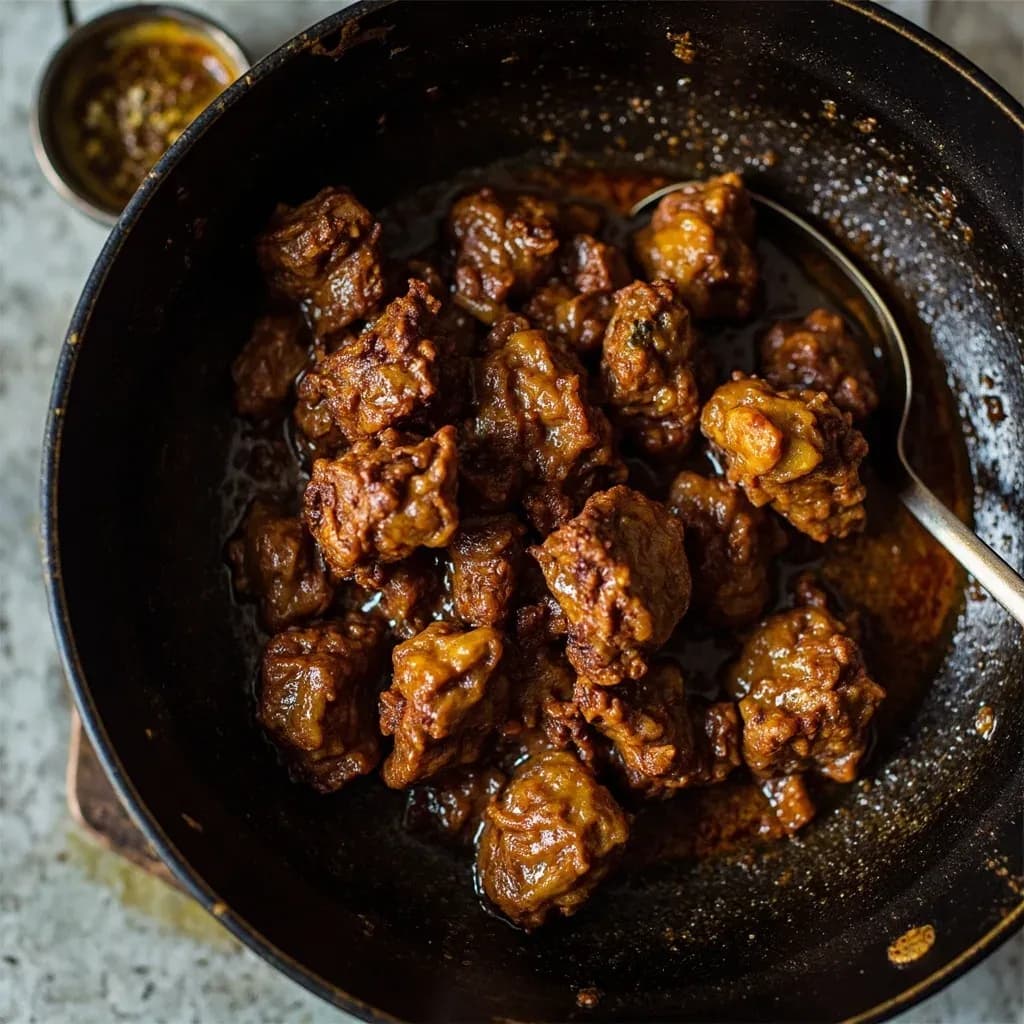
Slow-cooking meat with little water, stirring as the masala reduces to a thick, oil-glossed coating.
Kosha is the Bengali technique of cooking meat low and slow with minimal added water, frequently stirring while the spiced masala bhunas and reduces. The dish dries down until the gravy clings tightly to the meat and the oil separates out to the edges, signaling the spices are fully cooked. It produces an intensely concentrated, dark, almost dry curry such as kosha mangsho, where patience over the heat is the whole point.
Kosha (Bengali কষা, 'to be condensed by slow coaxing') is a Bengali technique for cooking meat in its own juices with almost no added water, finishing when the spice paste has reduced so far that it splits and releases pools of reddish oil around each piece. The cook's job is to manage evaporation: a wide pan, a low flame, patient stirring, and the discipline not to reach for water when the pan looks dry halfway through. The end result is not a curry in the usual sense — there is no loose gravy to spoon — but pieces of meat thickly cloaked in a dark, almost paste-like masala with a glossy oil sheen, the kind of dish you scoop up with a fried luchi or a piece of soft paratha rather than pour over rice. The dish deepens noticeably as it rests, and Bengali cooks will tell you a kosha is better the next day, when the masala has firmed up further in the cold and the flavors have settled into the meat.
The technique works because every drop of liquid in the pan — onion juice, yogurt, meat juices — eventually leaves as steam, taking aromatic volatiles with it but leaving behind a concentrated residue of browned sugars, milk solids from the yogurt, and ground spices. The cook's signature moment is the 'oil split,' tel chhede or koshano jhol chhute, when the emulsion of fat and water finally breaks and the oil collects in shiny pools around the meat. Reaching that point is what separates a finished kosha from a stewed curry that simply ran out of liquid.
Kosha sits in a family of slow reduction methods — bhuna, dum, and the dry-style Mughlai curries — but is set apart by three things: a heavy base of onion paste cooked to a deep reddish-brown rather than just translucent, a finish defined by visible oil separation, and mustard oil as the characteristic cooking fat. It is closer to a long braise without liquid than to a stir-fry; the meat is not seared hard and fast, but coaxed for hours, with the masala slowly darkening around it.
- Difficulty
- Hard
Types & varieties
The benchmark — goat or mutton on the bone, slow-reduced in an onion-yogurt masala until the oil splits.
Bone-in chicken thighs, same reduction logic, finished in roughly half the time of mutton.
Common in Bangladeshi and Kolkata Muslim traditions, especially for special-occasion meals.
Meat first seared on a hot stone (pathar) for a crusty surface, then finished by the kosha method.
Onion-doubled version using two batches of fried onions for a sweeter, deeper base.
How to do it
- 1
Marinate the meat
Toss 1–1.5 kg bone-in mutton with about 1/2 cup yogurt, 1 tsp turmeric, and salt. Rest 30–60 minutes at room temperature, or several hours in the refrigerator. The yogurt seasons the meat and supplies controlled moisture for the early phase of the cook.
- 2
Heat the fat and temper whole spices
Heat 4–5 tbsp mustard oil (or a mustard oil–ghee blend) in a wide heavy kadai until just smoking, then drop the heat. Add bay leaves, green and black cardamom, a cinnamon stick, cloves, and a couple of dried red chilies. Bloom 30–45 seconds until fragrant — these whole spices form the aromatic spine of the dish.
- 3
Build the onion base
Add onion paste (from 3–4 large onions, ground smooth) and cook on medium heat, stirring often, until it turns deep reddish-brown and the oil begins to leave the paste. This step alone can take 15–25 minutes; the color you reach here is the color your final dish will be.
- 4
Add ginger-garlic and ground spices
Stir in about 2 tbsp ginger-garlic paste and cook 2–3 minutes until the raw smell disappears. Add turmeric, red chili powder (Kashmiri for color plus a hotter variety for heat, if you want it), cumin, and coriander; fry 60–90 seconds so the raw edge of the spices cooks off but the mixture does not scorch.
- 5
Sear the meat in the masala
Add the marinated mutton with all its yogurt. Briefly raise the heat and stir to coat every piece; let the meat sear lightly on its surfaces for 3–4 minutes. The yogurt will loosen the paste — that is expected; it will cook back in as the reduction proceeds.
- 6
Begin the covered reduction
Cover the kadai, drop to the lowest flame, and cook 60–90 minutes, lifting the lid to stir every 10–15 minutes. The meat releases its juices, the yogurt breaks down, and the pan goes through a visibly watery, stew-like stage. Do not add water during this phase.
- 7
Uncover and reduce to kosha
Remove the lid and continue on low-medium heat, stirring every 5–8 minutes and scraping the paste from the base of the pan. Over 45–90 more minutes the liquid evaporates, the paste thickens and darkens, and eventually 'splits' — pools of red oil seep out around the meat. This oil separation is the finish line of the technique.
- 8
Finish and rest
Sprinkle about 1 tsp garam masala and, if you like, a small spoon of ghee over the top. Fold once, cover off-heat, and rest 20–30 minutes. Serve with luchi, paratha, or steamed rice; the masala should cling thickly to each piece with a glossy oil sheen rather than pool as a loose sauce.
Reading the oil split
The single most important visual cue in a kosha is the moment the masala stops looking like a wet paste and starts to look like a thick sauce with oil pooling at the edges of the pan and around the meat. This is the fat from the yogurt, the mustard oil, and the rendered meat fat finally breaking out of the watery emulsion. Before this point, the dish is technically a curry that has not finished reducing. After this point, the masala begins to darken quickly and to set on cooling, which is exactly the texture you want. The Bengali shorthand is 'tel chhede' — the oil has split. If you stir at this moment and the oil briefly disappears back into the paste, only to seep out again within a minute, you have arrived at the finish line.
Why the wide pan matters
Most failures of a kosha are failures of geometry. A narrow, tall saucepan gives you too much depth and not enough surface area, so steam rises through the food rather than escaping, and the meat effectively stews in its own vapor. A wide, heavy kadai or cast-iron skillet spreads the food into a thin layer so evaporation is fast and even, and the paste at the base can be scraped and folded back over the meat. The wider the pan relative to the volume of food, the more a kosha behaves like the dry, clinging dish it is meant to be, and the less it behaves like a wet curry.
Common uses
Tips & pitfalls
- Use a wide, heavy pan — surface area drives evaporation, and a narrow pot will stew the meat instead of reducing the masala.
- Brown the onion paste properly; this is the color and backbone of the dish. A pale, undercooked onion paste yields a thin, sharp-tasting result.
- Add yogurt in small splashes, whisking each time into the hot paste, to keep it from breaking into grainy bits in the oil.
- Keep the flame on low-medium and stir every 5–8 minutes once the pan is uncovered — scorching at the base is the most common failure.
- Do not add water partway through to 'rescue' a drying pan. That is a curry, not a kosha. Trust the reduction and keep scraping the base.
- Salt early so the meat seasons through, but taste and adjust near the end: evaporation concentrates salt, and finishing-seasoning prevents oversalting.
- Add garam masala (and any finishing ghee) off the heat; adding them during active reduction burns off their aroma.
- If using mustard oil, heat it to its smoking point first, cool slightly, then add the whole spices — this mellows the raw pungency that is characteristic of the fat.
Good to know
- Origin
- Bengal (West Bengal, India and Bangladesh); the benchmark technique in Bengali home cooking and on Kolkata restaurant menus.
- Etymology
- Bengali 'kosha' (কষা) — 'to be reduced/condensed' or 'coaxed slowly,' describing the long concentration of the masala onto the meat.
- Core principle
- Slow-cook meat in its own juices and yogurt with minimal added water; let moisture evaporate until the spice paste thickens and releases oil, coating each piece in a glossy, dark masala.
- Signature dish
- Kosha Mangsho (slow-reduced mutton), traditionally served with luchi (deep-fried flatbread) or steamed rice.
- Traditional fat
- Mustard oil, briefly heated to its smoking point to drive off raw pungency, sometimes blended with ghee.
- Doneness signal
- The masala splits and oil separates around the meat — the classic visual cue called 'tel chhede' or 'koshano jhol chhute.'
- Time range
- Roughly 2 to 4 hours of active reduction for 1–1.5 kg mutton on a low flame; older goat or larger shoulder cuts run longer.
- Make-ahead behavior
- Improves overnight; the masala firms up and the flavors settle deeper into the meat when reheated.
Also called
kosha · bhuna reduction · kosha mangsho method
Related

Boil
Cook in vigorously bubbling liquid at full rolling heat

Simmer
Hold liquid at a gentle shimmer for tender, unhurried cooking

Poach
Cook gently in barely-trembling liquid for silky, tender results

Steam
Cook in rising vapor to keep color, nutrients, and shape intact

Blanch
Plunge briefly in boiling water, then shock cold to lock color

Braise
Sear, then cook slow in a little liquid until fall-apart tender

Stew
Simmer bite-sized pieces fully submerged into a rich, unified pot

Sous-Vide
Seal and cook in precise warm water for edge-to-edge doneness