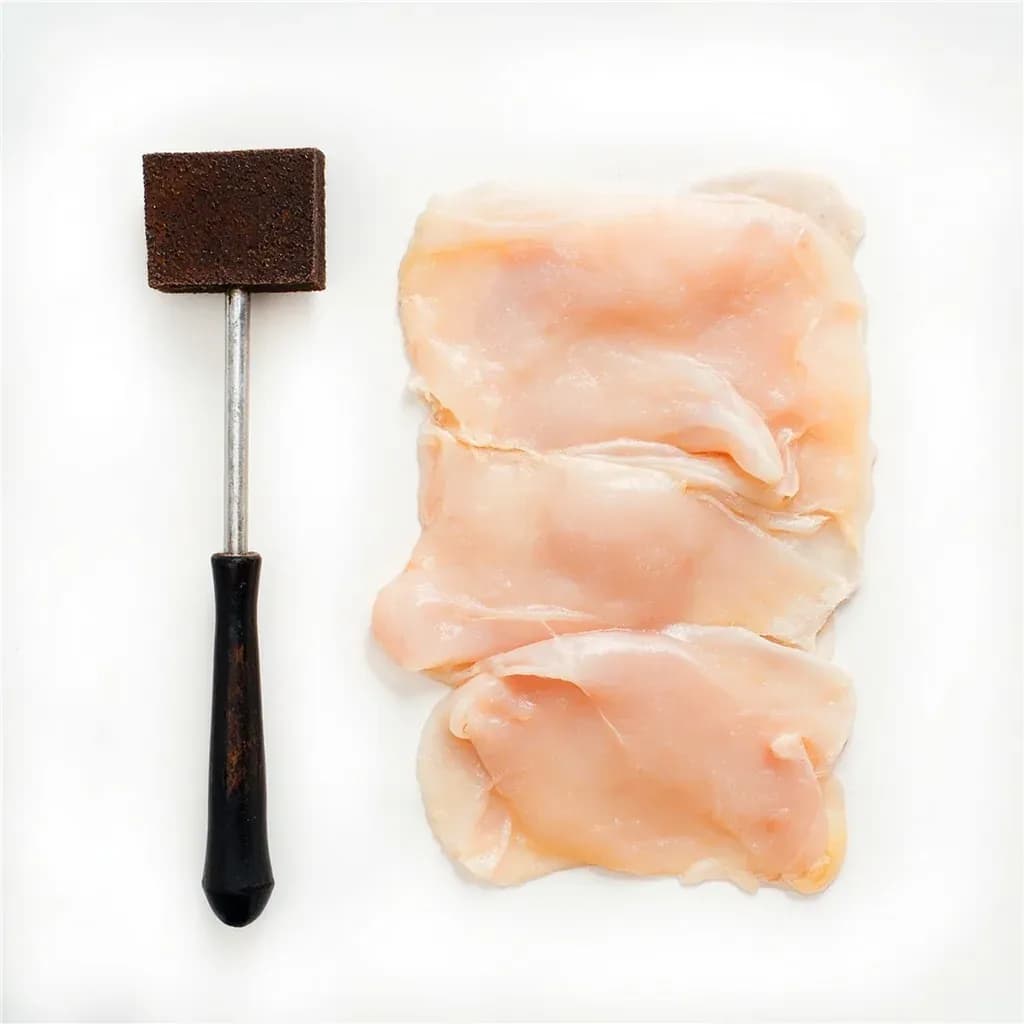
Prep & Assembly
Meat Tenderizing
Mechanically breaking down tough muscle fibers by pounding to make meat tender.
Meat tenderizing physically breaks down connective tissue and muscle fibers, usually by pounding with a mallet, beating, or repeatedly slamming the protein against a surface. It both softens tough cuts and flattens them for even, faster cooking, as with schnitzel or scaloppine. Octopus is famously tenderized by beating or massaging it, since its dense muscle is otherwise rubbery.
Tough meat is tough for a reason: long, intact muscle fibers, dense connective tissue, or tightly coiled protein networks. Tenderizing is the family of techniques that disrupts one or more of these structures so the meat feels softer in the mouth and cooks more predictably. The methods range from a few sharp blows with a heavy mallet to a 24-hour salt rest in the refrigerator, but they all share the same goal — turning an otherwise chewy cut into something you actually want to chew.
The choice of technique depends on the cut, the dish, and how much time you have. Pounding with a mallet is the fastest route to a thin, even cutlet; a Jaccard-style needle tenderizer severs fibers without changing the shape of the steak; a salt rest relaxes proteins and seasons deeply with no special equipment; and acidic or enzymatic marinades (yogurt, citrus, papaya, pineapple) work on the surface in minutes. Each method has trade-offs: mechanical tenderizing is fast and controllable but physically alters the cut, while chemical and enzymatic methods are subtle and easy to overdo, producing mushy or chalky meat if left too long.
Used thoughtfully, tenderizing is the difference between a chewy chuck steak and a silkier stir-fry, between a stubborn brisket flat and a sandwich-worthy braise, between an uneven chicken breast and a uniform paillard. It is not a fix for everything — already-tender cuts like filet mignon and well-marbled ribeye do not need it and can be made worse — but for the long-fibered, collagen-rich cuts that make up much of what we actually cook, it is one of the most useful skills in the kitchen.
- Difficulty
- Easy
Types & varieties
Flattening cutlets or steaks with a smooth or textured mallet to break fibers and even thickness; the classic approach for schnitzel, milanesa, chicken-fried steak, and paillard.
Pressing rows of fine needles or blades through the meat to sever individual muscle fibers without flattening the cut; widely used for flank, skirt, and inexpensive steaks.
Shallow crosshatch cuts across the surface to shorten long fibers; common on skirt steak and octopus.
Coarse salt drawn into the meat via osmosis relaxes muscle proteins and retains moisture while seasoning deeply.
Vinegar, citrus, wine, or yogurt gently denatures surface proteins; a building block of ceviche, carne adobada, and most quick marinades.
Papaya (papain), pineapple (bromelain), kiwi (actinidin), ginger, and fig contain proteases that actively break down protein; potent and easy to overdo.
Chinese treatment of coating sliced meat in egg white, cornstarch, and rice wine, then briefly passing through hot oil or water to keep it silky in stir-fries.
How to do it
- 1
Choose the right cut and method
Reserve tenderizing for tough or long-fibered cuts (chuck, round, flank, skirt, hanger, brisket, shank). For premium tender cuts such as filet mignon or well-marbled ribeye, skip it entirely. Decide whether you want to flatten the cut (pounding), pierce it (Jaccard), score it (knife), chemically soften it (salt or acid), or enzymatically break it down (fruit-based).
- 2
Trim and prepare the surface
Remove excess silver skin and any loose fat. Pat the meat dry. For pounding, set it between two sheets of plastic wrap or inside a sturdy zip-top bag to contain splatter and prevent tearing.
- 3
Apply the tenderizing treatment
Pound evenly from the center outward to about 1/4 to 1/2 inch thick for cutlets. For needle tenderizing, press the Jaccard straight down through the meat across the entire surface, rotating 90° for a second pass on very tough cuts. For salt, season generously 40 minutes to 24 hours ahead. For acid or enzymes, marinate 15 to 60 minutes depending on the agent.
- 4
Rinse, dry, and rest (if applicable)
After acid, enzymatic, or baking-soda treatments, briefly rinse and pat dry to remove residual surface liquid or off-flavors. Let the meat rest briefly so fibers relax and surface moisture evaporates.
- 5
Season and cook
Season simply with salt and pepper. Cook over high heat for a short time — tenderized cuts overcook easily — using a quick sear, stir-fry, or shallow fry. Use an instant-read thermometer and pull a few degrees below the target; carryover heat will finish the job. Rest the meat 5 minutes before slicing, and always slice tenderized cuts (especially flank, skirt, and pounded cutlets) across the grain.
The three families of tenderizing
Every tenderizing method belongs to one of three families, and knowing which is which helps you choose the right tool for a given cut and dish.
- Mechanical methods (pounding, piercing, scoring) physically disrupt the muscle structure. They are immediate, controllable, and the only choice when you want to change the shape of the cut — flattening a breast into a paillard, for example, or piercing a flank steak to mimic the texture of a more expensive cut.
- Chemical methods (salt, acids, dairy) work on the protein itself. Salt dissolves some of the muscle proteins and lets them relax and reabsorb moisture; acids and dairy denature surface proteins and prevent the meat from contracting as aggressively during cooking.
- Enzymatic methods (papaya, pineapple, kiwi, ginger, fig) introduce proteases that actively digest protein. They are the most powerful by weight but also the least forgiving — leave meat in pineapple juice for an hour and it can turn to mush on the surface while staying raw inside.
Why a plain salt rest is the most useful technique in the book
For most home cooks, dry-brining with salt outperforms every other single technique. It requires no special equipment, improves both texture and flavor, and is almost impossible to overdo within a 24-hour window. Salt draws some of the meat's own moisture to the surface, where it dissolves the salt and is then pulled back in — carrying seasoning deep into the muscle and partially dissolving the protein filaments that make meat feel tough. Rest the meat uncovered in the refrigerator so the surface dries; that dry surface is what browns deeply in a hot pan. Salt works on steaks, chops, roasts, and even ground meat, and it pairs with virtually any other seasoning or marinade you plan to use.
- Use about 1/2 to 1 teaspoon of kosher salt per pound of meat (roughly 0.5 to 1 percent by weight, depending on the salt's density).
- Salt at least 40 minutes before cooking; for thicker cuts, salt the night before and leave uncovered in the refrigerator.
- Skip the rinse — the salt has been absorbed and there is nothing to wash away.
Common uses
Tips & pitfalls
- Place meat between two sheets of plastic wrap or inside a heavy zip-top bag before pounding — this contains splatter and prevents tearing.
- Pound from the center outward in an even pattern; aim for roughly 1/4 to 1/2 inch thickness for cutlets so they cook in seconds.
- Use the smooth side of a mallet for delicate cuts (veal, fish, poultry) and the textured side only for thicker, tougher cuts where a little surface scoring is welcome.
- Do not over-marinate in acid or fruit enzymes — 15 to 30 minutes is usually enough, and papaya or pineapple can turn meat mushy in under an hour.
- Reserve tenderizing for cuts that need it; prime tenderloin and well-marbled ribeye will not benefit and can turn mealy or dry.
- After mechanical tenderizing, pat the surface dry — extra moisture from pierced fibers will otherwise steam rather than sear.
- If using baking soda (common in Chinese stir-fry prep), toss sliced meat with about 1 teaspoon per pound, rest 20 to 30 minutes, then rinse thoroughly and pat dry to avoid a soapy aftertaste.
- Clean the Jaccard between batches to prevent cross-contamination, and check that no needles are bent before each use.
- Do not reuse a marinade that has touched raw meat unless you boil it first; set aside a portion before adding meat if you plan to use it as a sauce.
Good to know
- Primary purpose
- To break down or soften the tough connective tissue and muscle fibers that make otherwise flavorful but chewy cuts pleasant to eat.
- Best suited cuts
- Tough, collagen-rich, or long-fibered cuts: chuck, round, flank, skirt, hanger, brisket, shank, and tri-tip.
- Main categories
- Mechanical (pounding, piercing), chemical (salt, acids, dairy), and enzymatic (plant or fungal proteases).
- Common tools
- Meat mallet (smooth or textured), Jaccard-style needle/blade tenderizer, rolling pin as a substitute, kitchen fork for small jobs.
- Timing
- Salt: 40 minutes to overnight; acid and enzymatic agents: 15 minutes to a few hours; longer turns meat mushy.
- Effect on cooking
- Tenderized meat cooks faster and more evenly; reduce cooking time and pull a few degrees below the final target temperature.
- Food safety
- Needle- or blade-tenderized meat can carry surface bacteria into the interior; cook to a slightly higher internal temperature than untenderized equivalents.
- Origin
- Pounding meat is one of the oldest forms of food preparation; needle/blade tenderizers became standard in U.S. butcher shops and steakhouse kitchens from the mid-20th century onward.
Also called
Meat Tenderizing (Golpear) · Octopus Tenderizing · Tenderizing Octopus · Pounding Meat
Dishes that rely on it
Related

Whisk
Beat ingredients smooth and aerated with a looping wire motion

Sift
Pass dry ingredients through mesh to aerate and remove lumps

Strain
Pour through mesh to separate solids from liquid for a smooth result

Filter
Pass liquid through fine material to clarify out the smallest particles

Rice
Press cooked potatoes through small holes for fluffy, lump-free texture

Mash
Crush soft cooked food into a rustic, creamy purée

Grind
Crush food into a coarse to fine texture, from spices to meat

Grate
Shred food into fine bits against a sharp-toothed surface