Heat & Fire
Microwave Cooking
Heating food with microwave radiation that excites water molecules to cook quickly from within.
Microwave cooking uses electromagnetic waves to agitate water and fat molecules in food, generating heat throughout the item rather than only at the surface. It is fast and efficient for reheating, steaming vegetables, melting and quick cooking, but it browns poorly because it does not produce dry surface heat. Uneven heating is common, so stirring or resting helps the temperature equalize.
Microwave cooking heats food by dielectric heating: an oscillating electric field at 2.45 GHz forces polar molecules — almost entirely water, with secondary contributions from fats and sugars — to rotate billions of times per second. That molecular friction raises temperature from the inside out, the opposite of how an oven or skillet works, where heat migrates inward by conduction from a hot surface. The practical consequence is speed: a cup of water boils in roughly two to three minutes at full power, and a plate of leftover stew comes back to life in 90 seconds without the dry, leathery edges a saucepan leaves behind.
The waves penetrate only about 1 to 1.5 cm into water-rich food before losing energy, so anything thicker than a small burger finishes by conduction from the heated outer shell toward the cool core. This inside-out geometry explains the familiar pattern of scorching edges around a still-cold center when you simply press start and walk away. It also explains why microwave cooking barely browns food: Maillard reactions need sustained surface temperatures above roughly 140 °C (285 °F) in dry conditions, and the moisture-rich surface of a microwaved item never reaches that regime. The microwave is a tool for speed and gentle, moisture-retentive heating, not a substitute for roasting, frying, or baking.
What it does well it does better than anything else — rapid reheating without driving off moisture, defrosting frozen protein in minutes, melting butter and chocolate without seizing, steaming vegetables in a covered dish, and small-batch tasks like lemon curd or mug cakes. For dishes that need both speed and color (seared greens, crisp-skinned fish, deeply caramelized onions), treat the microwave as a prep tool and finish in a hot pan, under a broiler, or in a screaming-hot oven.
- Difficulty
- Easy
Types & varieties
Magnetron only. The workhorse for reheating, defrosting, melting, steaming, and microwave-specific recipes. No browning element.
Adds a quartz or sheath heating element for surface browning — useful for toast, kebabs, and gratinéed toppings, though the element is small and slow compared with a broiler.
Combines the magnetron with a convection fan and element, allowing true roasting and baking up to about 220 °C (425 °F). Versatile but smaller cavity than a wall oven.
Runs the magnetron at continuously variable, lower power rather than cycling. Gives more even results at 30–50% power and noticeably gentler defrosting.
Built-in unit with an integrated vent hood that saves counter space; often runs 100–200 W lower than comparably sized countertop models.
1000–3000 W with a heavy-duty door, no turntable, and programmable presets — built for back-of-house rapid reheating rather than finesse.
Pairs microwave energy with injected steam, common in European combi ovens for fast, gentle cooking that preserves moisture and color.
How to do it
- 1
Select the right vessel
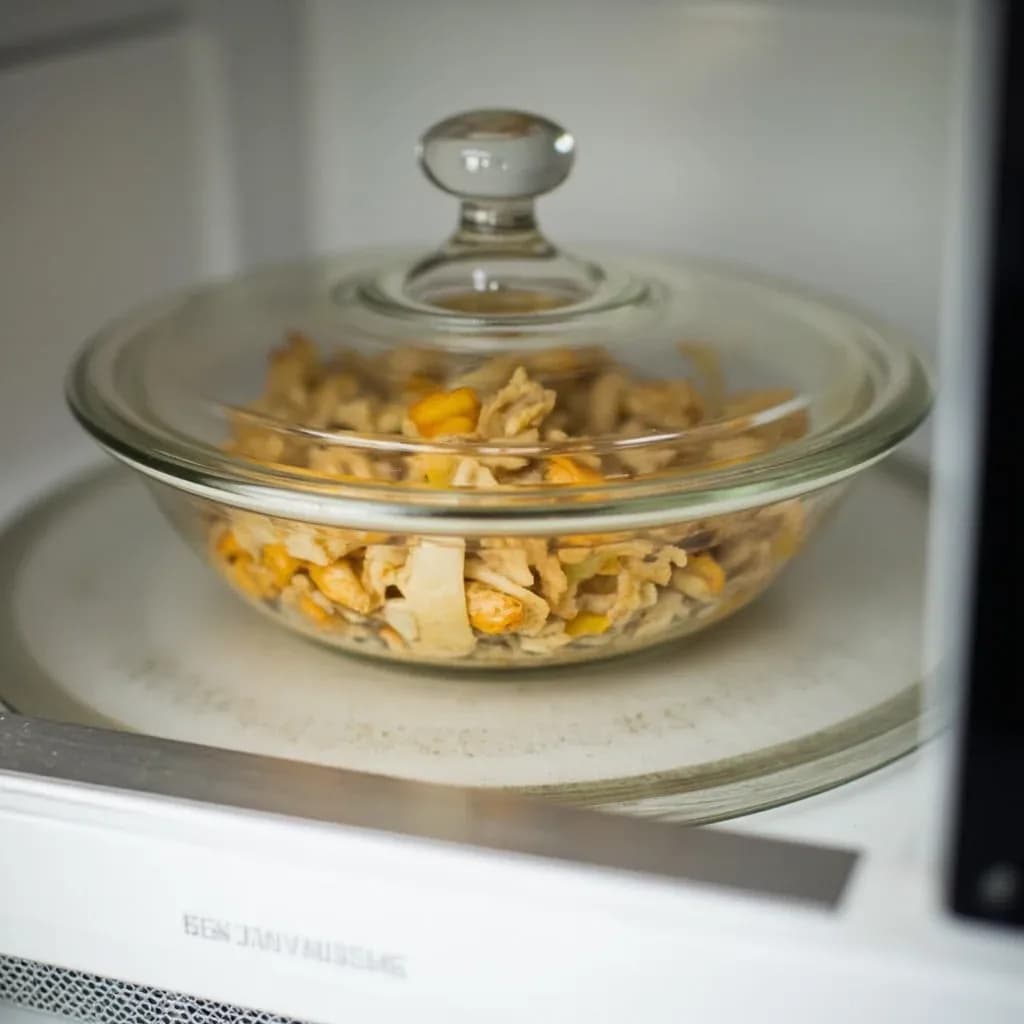
Use glass (Pyrex), ceramic without metallic trim, microwave-safe plastic (#5 PP or labeled), parchment, or silicone. Avoid metal, foil-lined containers, single-use clamshells, and any plastic not explicitly rated for microwave use.
- 2
Arrange food for even exposure
Spread food in a shallow, even layer or shape it into a ring with an empty center so the same depth faces the microwave field from all sides. Cut thick items in half or score them deeply.
- 3
Add moisture and cover
Splash 1–2 tbsp water over vegetables, grains, or pasta to generate steam. Cover with a vented lid, an inverted plate, or plastic wrap that has been pierced — sealed wrap can balloon or split.
- 4
Set power and time
Use full power (100%) for boiling water and dense reheating; 70% for vegetables and rice; 50% for melting, defrosting, and delicate sauces; 30% for gentle finishing or proofing yeast dough.
- 5
Cook in intervals
Start with the shorter end of any recommended time. Pause to stir, flip, or rotate the dish — on a turntable-less model, give the dish a quarter turn each pause to walk past the standing-wave pattern.
- 6
Check and continue
Probe with a microwave-safe instant-read thermometer or test for doneness. Add short bursts, returning to lower power as the food approaches target temperature — edges cook faster than centers.
- 7
Rest before serving
Let the food stand covered, off the magnetron, for 1–5 minutes depending on mass and density. Carryover heat will equalize the temperature and finish the cook without overrunning the edges.
- 8
Clean between uses
Wipe the interior with a damp cloth while the cavity is still warm. A 30-second burst with a cup of water and a squeeze of lemon softens stuck-on food and deodorizes the cavity without harsh scrubbing.
How Microwaves Actually Heat Food
Inside the oven, a cavity magnetron — the same vacuum tube developed during WWII for radar — generates microwaves at 2.45 GHz. These waves bounce off the metal walls and create a standing-wave pattern of high- and low-energy nodes throughout the cavity. Anything containing polar molecules absorbs the energy: the molecules try to align with the rapidly flipping field and, in doing so, jostle their neighbors, converting electromagnetic energy into thermal energy.
The crucial detail for cooks is that only polar molecules respond, which is why dry, oily, or sugary foods heat slowly while anything with significant water content heats quickly. Penetration is shallow — roughly 1–1.5 cm in water-rich food — so a thick steak or a whole potato cooks in a hot shell that gradually transfers heat inward by conduction. Liquids, vegetables, and any food sliced thin enough to expose the field from both sides cook most evenly. This is also why the oven seems to have hot spots: the standing-wave pattern produces predictable nodes, which is why stirring or rotating the dish halfway through is not optional.
- Polar molecules (water first, then fats and sugars) absorb the energy; non-polar substances stay cool.
- Penetration depth is roughly 1–1.5 cm at 2.45 GHz — beyond that, conduction takes over.
- Standing waves create predictable hot and cold spots, which is why turntables and stirring matter.
- Density and water content govern heating speed far more than starting temperature.
Why Microwaves Don't Brown
Maillard browning and caramelization both need dry, sustained surface heat — Maillard above roughly 140 °C (285 °F) and the caramelization of common table sugars starting around 160 °C (320 °F). The microwave works against this in two ways: it heats from the inside out, so the surface is among the last regions to reach high temperatures, and the moisture that migrates outward keeps that surface in a steamy, low-temperature regime. The result is pale, soft, often steamy exteriors even when the interior is properly cooked.
This is not a flaw to fix but a characteristic to plan around. Foods that are meant to look roasted or seared — chicken skin, bread crust, gratins, blistered or roasted vegetables — are best finished in a hot pan, under a broiler, or in a convection oven. Conversely, dishes that benefit from a soft, even texture (custards, polenta, risotto-style rice) are ideal microwave territory.
- Maillard browning needs ~140 °C (285 °F) at a dry surface; caramelization of common sugars needs ~160 °C (320 °F). The microwave's moist, inside-out heating delivers neither.
- Expect pale exteriors on microwave-finished dishes; compensate with a finishing sear or broiler pass.
- Foods meant to be soft and moist — custards, polenta, scrambled eggs — are ideal microwave candidates.
- Combination or convection-microwave ovens partially solve this with added dry-heat elements.
Power Levels, Demystified
A standard microwave does not actually run at lower wattage when you dial down the power — it cycles the magnetron on and off. '50% power' on most machines means the tube fires at full wattage for 5 seconds, then rests for 5 seconds, repeating for the duration you set. The food receives bursts of intense heat separated by periods of conductive equalization, which is gentler than continuous full power but is not the same as a true half-wattage output.
Inverter models, by contrast, run the magnetron at continuously variable lower output, which produces more uniform heating at low power — markedly better for defrosting, melting chocolate, and finishing delicate sauces. If you cook a lot of these tasks, an inverter is worth seeking out. For everything else, treat the power dial as a pulse-rate control: full power for boiling water and dense reheating, 70% for vegetables and rice, 50% for melting and defrosting, and 30% for gentle finishing or proofing yeast.
- Standard microwaves cycle the magnetron on and off — '50%' is a duty cycle, not half the wattage.
- Inverter models run continuously at reduced output, giving more even low-power cooking.
- Use 70% for vegetables and rice; 50% for melting, defrosting, and delicate sauces; 30% for finishing.
- Lower power plus longer time generally gives more even results than full power for the same target temperature.
Common uses
Tips & pitfalls
- Use 50–70% power for butter, chocolate, cheese, and eggs; full power overcooks the edges long before the center warms through.
- Arrange food in a ring with an empty center — it equalizes exposure and prevents cold cores in dishes like stews and mashed potatoes.
- Stir or flip at the halfway point whenever the dish allows; standing waves create predictable hot and cold spots that stirring evens out.
- Always pierce foods with sealed skins (potatoes, sausages, egg yolks, whole squash, hot dogs) or internal steam pressure will burst them.
- Let food rest 1–3 minutes after cooking — residual heat continues moving toward the center and finishes the job without burning the edges.
- Never microwave whole eggs in shell, grapes, or concentrated oils on high; each can explode or, in the case of oil, ignite.
- Skip the microwave for anything that needs a crust or deep browning — Maillard reactions barely occur. Finish seared or roasted items in a hot pan, under a broiler, or in a convection oven.
- For microwave caramel or sugar syrup, drop in a wooden skewer or bamboo skewer — it nucleates boiling and prevents the explosive superheating that scalded sugar can produce.
Good to know
- Invented
- Percy Spencer, an engineer at Raytheon, patented the microwave oven in 1945 after a chocolate bar in his pocket melted near an operating magnetron.
- First commercial model
- The Raytheon Radarange, introduced in 1947, stood about 5 ft tall and weighed roughly 750 lb.
- Operating frequency
- 2.45 GHz (wavelength ~12.2 cm), in an ISM band reserved for industrial, scientific, and medical use to avoid interfering with radar and communications.
- Heating mechanism
- Dielectric heating — the alternating field rotates polar molecules (chiefly water) billions of times per second, generating heat volumetrically rather than from a surface.
- Penetration depth
- Roughly 1–1.5 cm in water-rich food at 2.45 GHz; thicker items finish by conduction from the heated outer layer toward the center.
- Home wattage
- 600–1250 W; 800–1100 W is the modern household norm and the figure to anchor any recipe conversion.
- Power levels
- Produced by cycling the magnetron on and off (e.g., 50% = 5 sec on, 5 sec off); only inverter models run continuously at reduced output, which gives more even results.
- Time to heat
- Near-instantaneous — food begins warming within seconds of pressing start.
- Standing time
- Carryover cooking continues after the magnetron stops; most dishes benefit from 1–5 minutes covered rest for temperature to equalize.
- Safe materials
- Glass (Pyrex), ceramic without metallic glaze, microwave-safe plastics (#5 PP and labeled), parchment, wax paper, and microwave-safe silicone.
- Materials to avoid
- Metal (reflects waves, can arc), non-labeled plastics (can leach or melt), sealed airtight containers (pressure buildup), and single-use takeout clamshells.
Also called
microwaving · nuking
Related

Sear
Blast the surface hot for a deep-browned, savory crust

Sauté
Cook quickly in a little fat over lively heat, tossing as you go

Stir-Fry
Toss bite-sized pieces over roaring heat for fast, smoky cooking

Pan-Fry
Crisp food in a shallow layer of hot fat, turning once or twice

Deep-Fry
Submerge in hot oil for an all-over crackling crust

Roast
Cook uncovered in dry oven heat for browned edges and tender centers

Bake
Cook with steady, surrounding oven heat — the soul of bread and pastry

Broil
Hit food from directly above with fierce overhead heat