Water & Steam
Oil-Poaching
Cooking proteins or vegetables fully submerged in warm oil held well below frying temperature for exceptionally moist, tender, infused results.
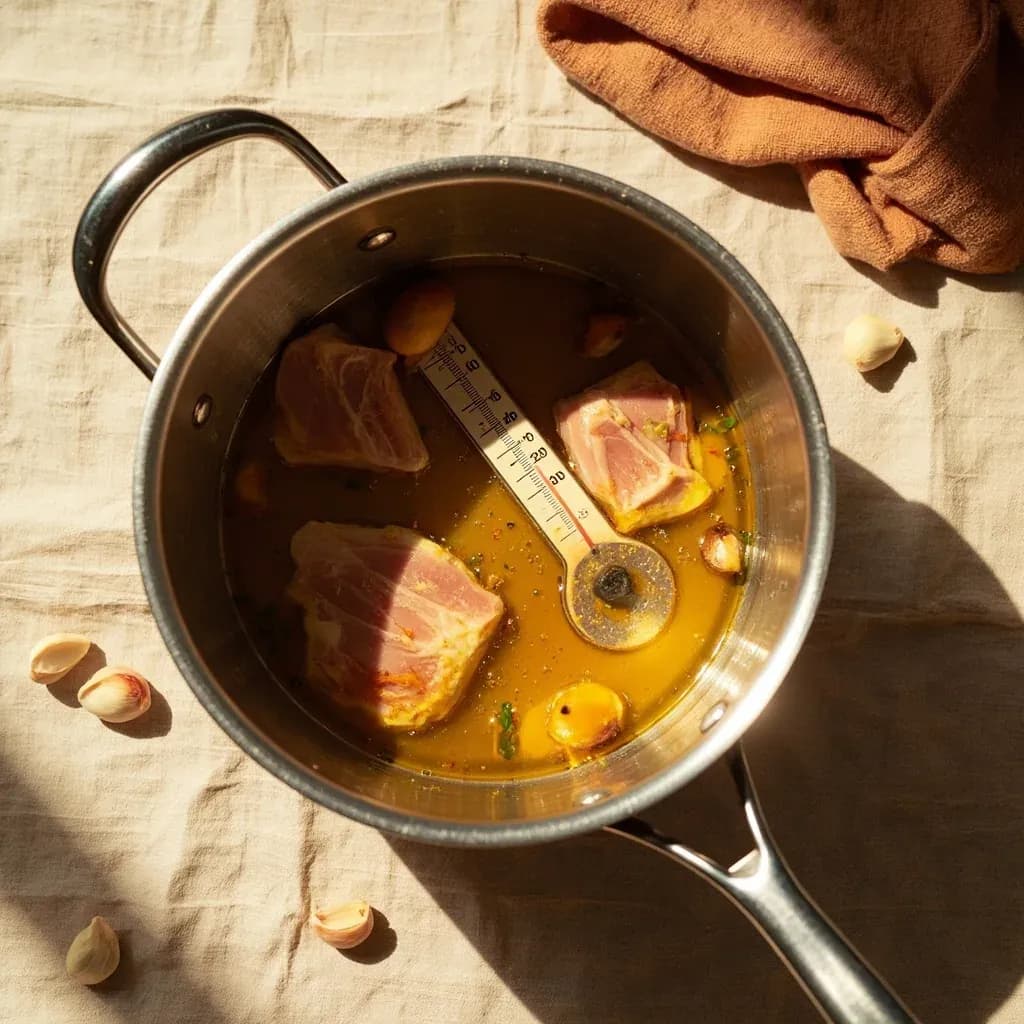
Oil-poaching is a low-temperature, fat-based cooking method in which food — usually a delicate protein or a soft vegetable — is fully submerged in oil held well below frying temperature, typically between 120 and 185°F (50–85°C). Because the oil sits below the boiling point of water, the food's internal moisture cannot escape as steam; instead it stays trapped in the cells while the proteins denature and the tissue relaxes, producing a texture that roasted or pan-seared versions rarely match. The technique is the wet, modern cousin of confit, sharing confit's tenderness and its ability to carry flavor, but it usually skips the salt-cure step and is treated as a service technique rather than a preservation one.
The trade-off is color. With no Maillard browning and no crust, oil-poached food comes out pale and looks almost underdone, which is exactly right — finishing is typically done at the plate with a brief sear, a sizzle of browned butter, a squeeze of citrus, or a drizzle of the now-flavored cooking oil. Used thoughtfully, oil-poaching gives a cook two things at once: an ingredient that is cooked perfectly through, and a pot of seasoned oil that becomes a finishing fat for the rest of the meal.
- Difficulty
- Moderate
Types & varieties
Neutral oil at 120–150°F / 50–65°C; the goal is gentle, even cooking with no added flavor from the fat, so the ingredient's own taste leads.
The food is salt-cured first, then submerged in fat at roughly 170–185°F / 75–85°C until tender. The cured, cooked meat is stored in the cooled fat for keeping.
The oil is infused with herbs, garlic, citrus zest, peppercorns, or warm spices before the food goes in. The food absorbs those aromatics, and the oil itself becomes a finished product.
A brief, lighter version used for vegetables, herbs, and garlic — a few minutes in warm oil to soften, set color, or mellow sharpness rather than cook through.
A Mediterranean preparation in which fish is gently cooked in extra-virgin olive oil with aromatics and served warm or at room temperature, the oil itself spooned over as sauce.
How to do it
- 1
Select and prepare the oil
Choose a neutral oil (grapeseed, canola, sunflower) for a clean poach, or extra-virgin olive oil or a pre-infused oil when you want the fat to flavor the food. Pour enough into a heavy-bottomed pot to cover the food by at least an inch, and clip a reliable thermometer to the side.
- 2
Build aromatics (optional)
For a flavored poach, drop herbs (thyme, bay, rosemary), crushed garlic, peppercorns, citrus zest, or warm spices into the cold oil and warm gently for 10–20 minutes to infuse. Strain for a clear oil, or leave the aromatics in for visual effect and deeper flavor.
- 3
Bring the oil to target temperature
Heat the oil to 120–150°F / 50–65°C for most fish, 150–170°F / 65–75°C for chicken breast, or 170–185°F / 75–85°C for duck breast and confit. Hold this range steadily for the entire cook — temperature drift is the most common reason oil-poaching fails.
- 4
Prepare the food
Pat the protein or vegetables very dry with paper towels; surface water splatters and chills the oil on contact. Season lightly with salt. For confit, salt-cure the meat for the prescribed time, then rinse and dry before it goes into the oil.
- 5
Submerge and cook gently
Lower the food in so it is fully covered. Cook undisturbed at a steady temperature: roughly 8–15 minutes for a fish fillet, 20–35 minutes for a chicken breast, 45 minutes to 2 hours for duck confit, 20–40 minutes for lobster tails, 25–40 minutes for peeled garlic cloves.
- 6
Test for doneness
For fish, the center should be just opaque and flakes should meet slight resistance. For poultry, an instant-read thermometer in the thickest part should read 150–155°F / 65–68°C — carryover heat will finish the cook. For garlic and shallots, a paring knife should slide in with no resistance.
- 7
Remove, finish, and store
Lift the food out with a spider or slotted spoon and let excess oil drip back. Serve immediately, often with a brief sear or a drizzle of the reserved oil, or cool in the oil and refrigerate fully submerged in a clean container for later use. Strain and reserve the flavored oil separately — it is now a finishing fat for vegetables, grains, or bread.
How oil-poaching actually works
Oil is a far more efficient heat-transfer medium than air, which is why a 140°F bath cooks a piece of fish faster than a 350°F oven cooks a roast. But because the food sits in oil held below the boiling point of water, its internal moisture cannot flash to steam; that moisture stays inside the cells and acts as the food's own thermal buffer. Heat moves in steadily from every direction, the proteins denature without tightening up, and the texture stays succulent rather than dry.
This is also why oil-poached food looks pale. The Maillard reaction needs surface temperatures of roughly 285°F / 140°C and up, and a dry surface to boot. Oil-poached food is neither. The technique trades appearance for texture; a cook who wants both finishes the food briefly on a hot pan, under a salamander, or with a grating of citrus and a drizzle of the reserved oil.
- Because the oil sits below 212°F / 100°C, the food's internal moisture cannot escape as steam and stays locked inside the cells.
- Heat transfer is fast and even because oil surrounds the food on all sides, eliminating hot spots and dry edges.
- The food's pale, almost waxy appearance after cooking is normal and a sign the temperature was held correctly.
Choosing the right oil
The oil you choose is itself an ingredient. A neutral, refined oil — grapeseed, canola, sunflower, or light peanut — lets the food taste like itself, which is the right call for pristine fish or for any dish where the cook wants control of the seasoning later. A good extra-virgin olive oil actively flavors the dish, and a pre-infused oil (with herbs, chiles, or citrus zest) does both jobs at once. Heavily polyunsaturated oils such as walnut, sesame, or unrefined seed oils should be avoided for long, warm holds: they oxidize quickly and turn acrid.
- Neutral oils: grapeseed, canola, sunflower, refined peanut — clean flavor and high oxidative stability at the temperatures used.
- Flavor-bearing oils: extra-virgin olive oil, herb-infused oil, chili oil — use when you want the fat to season the food.
- Avoid for long holds: walnut, sesame, unrefined flax, and other oils high in polyunsaturated fats, which oxidize quickly at warm temperatures.
Common uses
Tips & pitfalls
- Use a reliable thermometer and check it often. A 15°F drift matters: too cool and the food takes on a waxy, undercooked texture; too hot and you have moved into shallow-frying territory and will get browning and dryness.
- Pat the food completely dry before it goes in. Surface water splatters violently and chills the oil on contact, which causes uneven cooking.
- Keep the food fully submerged. Anything that breaks the surface will brown or toughen at the line where oil meets air.
- Pick the oil on purpose. A neutral oil lets the ingredient's flavor lead; a good extra-virgin olive oil or an herb- or spice-infused oil actively seasons the food and gives you a finished oil as a bonus.
- For fish, err on the lower end of the temperature range and pull the fillet when the center is just opaque and the flakes meet gentle resistance. The fish will continue to cook from carryover heat and is far more forgiving slightly under than slightly over.
- Do not crowd the pot. Too much food at once drags the oil temperature down and extends the cook unevenly, especially with thick cuts of poultry or fish.
- For garlic and shallots, start in cold oil and bring it up to temperature together. Dropping them into hot oil browns the outside before the inside softens, which is the opposite of what you want.
- Strain and save the cooking oil once it cools. It is now a ready-made finishing fat, and discarding it wastes the most useful by-product of the technique.
- Refrigerate leftover oil-poached foods fully submerged in their oil, in a clean, airtight container. The oil seals the food from air and slows oxidation, which is what keeps the texture and flavor intact.
Good to know
- Technique family
- Low-temperature, fat-based cooking; sister to confit in method, related to sous-vide in spirit (gentle, exact-temperature cooking), but uses a pot and oil rather than a circulator and a bag.
- Typical oil temperature
- 120–180°F / 50–82°C; fish 120–150°F (50–65°C), chicken breast 150–170°F (65–75°C), duck breast and confit 170–185°F (75–85°C).
- Compared to frying
- Held well below frying temperature (350°F / 175°C and up); no browning, no crust, no Maillard reaction. The food should look pale when it emerges.
- Oils used
- Neutral oils (grapeseed, canola, sunflower, refined peanut) for clean poaching; extra-virgin olive oil, herb oils, or spice-infused oils when flavor infusion is the goal.
- Equipment
- Heavy-bottomed pot or deep saucepan, accurate probe or instant-read thermometer, spider or slotted spoon, fine-mesh skimmer, and a container for the reserved oil.
- Yield
- Essentially 1:1 by weight; moisture loss is minimal compared to roasting, pan-frying, or grilling, which is the main reason the texture is so supple.
- Difficulty
- Low for fish and vegetables; moderate for poultry, where the gap between properly cooked and overcooked is narrower; higher for confit, which adds a salt-curing step.
- Holding and storage
- Cooked food can rest in the warm oil for short service holds. Once cooled, it can be refrigerated fully submerged in the oil for 1–2 weeks; cured confit keeps considerably longer.
- Origin and tradition
- Closely related to French confit, historically a salt-cure-then-cook preservation method for duck, goose, and pork. Modern restaurant oil-poaching of fish spread through late-20th-century fine-dining kitchens.
- Common targets
- Salmon, halibut, cod, skate, tuna, lobster tails, chicken breast, duck breast, garlic cloves, shallots, tomatoes, and leeks.
Also called
oil-poached · low-temp oil cooking · poaching in oil
