Heat & Fire
Pan Tossing (Saltare)
Flipping food in a pan with a flick of the wrist to toss and turn it without a utensil.
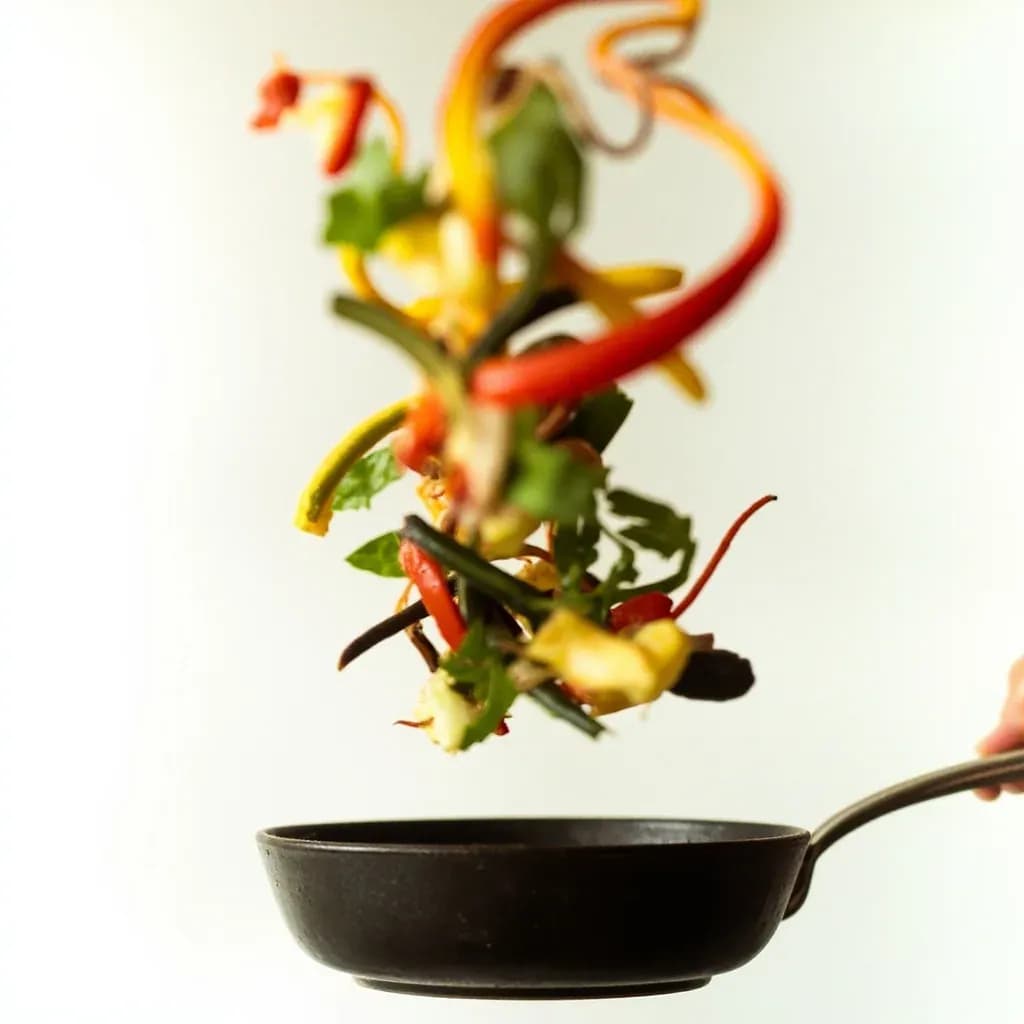
Pan tossing, from the Italian saltare (to jump), uses a sharp forward-and-up flick of the pan to lift and turn food so it cooks evenly without breaking it up with a spoon. It is ideal for sauteing vegetables, coating pasta in sauce and finishing stir-fries. Done over high heat, the motion keeps food moving so it browns without sticking or steaming.
Pan tossing is the wrist-driven motion that flips food through a low arc inside a skillet, sauté pan, or wok, then catches it as it falls. The name captures the visual goal: in Italian, saltare in padella, and in French, sauter, both literally mean 'to jump in the pan,' and a well-executed toss is exactly that — every piece leaves the metal briefly, turns in the air, and lands somewhere new. The technique is the mechanical heart of sautéing and stir-frying, and it exists because moving food through a hot pan with a spatula scrapes, presses, and interrupts the sear, while tossing does none of those things.
The motion is a wrist snap, not an arm lift. Pulling the pan back toward the body loads the food at the far edge; a quick forward flick of the wrist releases it in a controlled arc, peaking just above the rim before gravity returns it. Pan selection, batch size, and food dryness all determine whether the food jumps cleanly or clumps and spills. Done well, tossing is faster than stirring, gentler on the food itself, and the most reliable way to coat pasta, grains, or butter sauces evenly without a utensil mashing the food against the pan.
- Difficulty
- Medium
Types & varieties
The classic French shallow toss — low arc, food jumps just above the pan surface for even browning.
Higher arc, often thrown behind the shoulder; delivers searing heat and aeration that defines wok cooking.
A single upward snap to turn a flat item end-over-end (crêpes, pancakes) — technically a flip, not a continuous toss.
Italian home-style toss for pasta and vegetables, gentler and lower than the wok toss, focused on coating rather than char.
Used with a heavy pan or large batch; the off hand stabilizes the handle base while the dominant wrist snaps.
How to do it
- 1
Choose the Right Pan
Pick a sauté pan, slope-sided skillet, or wok with a long handle and sides no taller than the food's toss arc. The pan should feel balanced in your dominant hand — heavy enough to carry momentum, light enough to snap without tiring the wrist.
- 2
Heat the Pan and Fat
Place the pan over the appropriate heat (medium-high for sauté, high for wok). Add oil or butter and let it shimmer or foam before adding food. A properly heated surface is what lets food release cleanly mid-toss instead of sticking and tearing.
- 3
Add Food Without Overcrowding
Lay food in a single layer, leaving at least the top third of the pan empty. Crowding kills the arc and turns a toss into a stir; it also drops the pan temperature and steams the food instead of searing it.
- 4
Set the Grip
Hold the handle near the pan end with a relaxed, slightly cupped grip. Your wrist, not your elbow or shoulder, is the hinge. A stiff grip transmits stiffness into the food.
- 5
The Pull-Back
Draw the pan back toward your body in a short, controlled motion. This loads the food at the far edge of the pan and stores the momentum that the next step will release.
- 6
The Snap Forward
Flick the wrist forward and slightly up in one quick motion. The food leaves the pan, peaks just above the rim, and falls back in — ideally rotated or repositioned. The arc should be low, not a lob.
- 7
Catch and Assess
Let the food settle flat. Glance at it: is it browning evenly? Is the toss landing where you want? Adjust heat, batch size, or grip before the next toss.
- 8
Repeat as Needed
Toss every 15–30 seconds for sautéing vegetables, more frequently for stir-fries or delicate items like shrimp. Stop tossing once the food is cooked and glossy with sauce — over-tossing breaks fragile pieces and cools the pan.
- 9
Finish Off-Heat
For butter-based pan sauces or pasta, pull the pan off the burner and toss one or two final times. The residual heat emulsifies butter into liquid without breaking the sauce, which direct burner heat would do.
Why Tossing Beats Stirring
A spatula pushes food across the pan in a line; a toss moves every piece through three dimensions at once. That brief flight accomplishes three things a stir cannot: it exposes new surface area to the metal for an even crust, it aerates the food so surface steam escapes and sauces cling rather than pool, and it keeps the cook's hands on the pan so heat and timing stay responsive. Tossing is also faster — one flick repositions a whole pan's worth of food in a fraction of a second — which matters in a stir-fry where the window between raw and overcooked can be under a minute.
- Tossing keeps the food in motion without pressing it into the metal, so a crust can build uniformly.
- Tossing coats pasta, grains, and butter sauces more evenly than tongs or a spoon.
Wok Tossing as a Special Case
The wok toss pushes the same wrist-snap principle to a much higher arc, sometimes behind the shoulder, which is how experienced cooks keep food in the pan despite the dramatic motion — the pan follows the food around and catches it on the descent. The high arc does two things a low sauté toss cannot: it gives each piece a fraction of a second in true air, where surface moisture flashes off and the exterior crisps, and it lets the cook feed food into the pan in a continuous stream at the front while the toss carries it back. That continuous motion, combined with a jet of flame up the wok walls, is what produces wok hei — the smoky, charred aroma unique to high-heat wok cooking — and it is the reason wok tossing looks theatrical while still being the most efficient way to cook over a jet burner.
Common uses
Tips & pitfalls
- Use sloped or straight-sided pans — high-walled saucepans trap food instead of letting it jump out cleanly.
- Pull the pan back toward you first, then snap forward; the back-pull loads the momentum, the snap releases it.
- Keep your wrist loose. A stiff arm flails and spills; a relaxed wrist snaps the food in a tight arc.
- Never fill the pan more than one-third full. Tossing needs room to breathe; overfilled pans turn tosses into spills.
- Dry the food thoroughly before it goes in. Surface moisture causes clumping and makes a clean flip impossible.
- For long pasta or strands, lift with tongs first and then toss; tossing alone tangles long pieces into a knot.
- Practice with a cup of dried beans before risking a full pan of food — the beans mimic the weight and movement of diced vegetables.
- Match pan weight to batch size: too light and food bounces out, too heavy and the wrist tires after two or three tosses.
Good to know
- Italian Name
- Saltare (in padella) — 'to jump (in the pan)'
- French Connection
- French 'sauter' (to jump) is the root of the English word 'sauté'
- Primary Equipment
- Sloped-sided sauté pan, skillet, or wok with a long handle
- Motion Type
- Wrist snap (not arm lift); pull-back loads momentum, forward flick releases the arc
- Skill Level
- Moderate; requires practice to keep food inside the pan
- Best For
- Small, uniform pieces — diced vegetables, pasta, shrimp, cutlets, grains
- Not Suitable For
- Large roasts, whole fish, very wet or delicate foods
- Practice Drill
- Dry beans or rice in a pan, repeated wrist flicks until the motion is automatic
Also called
sauteing · tossing · saltare
Dishes that rely on it
Related

Sear
Blast the surface hot for a deep-browned, savory crust

Sauté
Cook quickly in a little fat over lively heat, tossing as you go

Stir-Fry
Toss bite-sized pieces over roaring heat for fast, smoky cooking

Pan-Fry
Crisp food in a shallow layer of hot fat, turning once or twice

Deep-Fry
Submerge in hot oil for an all-over crackling crust

Roast
Cook uncovered in dry oven heat for browned edges and tender centers

Bake
Cook with steady, surrounding oven heat — the soul of bread and pastry

Broil
Hit food from directly above with fierce overhead heat