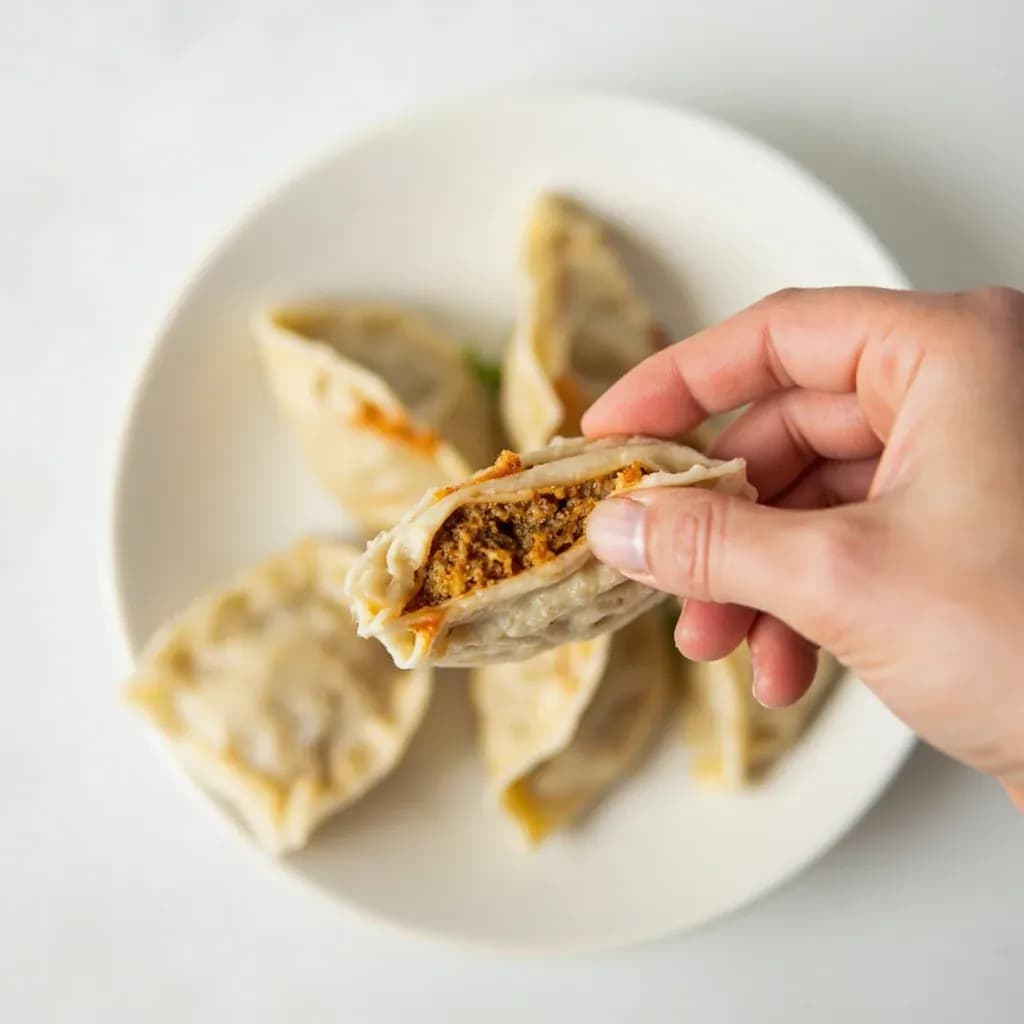
Prep & Assembly
Pleating Dumplings
Folding and crimping dumpling wrappers to seal the filling decoratively.
Pleating dumplings folds the edge of a filled wrapper into a series of crimps to seal in the filling and shape the dumpling. Each tradition has its own style, from the rosette top of khinkali to the crescent crimp of pelmeni, varenyky, and tortellini. A tight, well-sealed pleat keeps the wrapper from bursting during boiling or steaming, and a touch of water helps the dough stick.
Pleating is the handwork that turns a flat circle of dough and a spoonful of filling into a sealed, structured dumpling. The pleats do real structural work: they lock the filling inside, distribute wall thickness so heat penetrates evenly, and in steamed and soup-filled styles they trap pockets of air or broth that keep the dumpling tender and buoyant. The number and tightness of the pleats also signal skill — a tight, even twist of eighteen tiny folds is the calling card of a dim sum cook who has shaped the same dumpling ten thousand times.
The technique is shared across East and Central Asia, where the same hand motions produce Chinese jiaozi, Japanese gyoza, Korean mandu, Nepali momo, and Central Asian manti. What changes between traditions is the finished shape (half-moon, ingot, purse, triangle), the wrapper (wheat, wheat-starch, or hot-water dough), and the number of pleats. What does not change is the underlying principle: a dampened rim, light pressure from the pad of the thumb rather than the nail, and continuous rotation of the wrapper between folds so the seam stays even.
Dough elasticity sets the practical limit. A high-gluten flour wrapper will hold fine, tight pleats without tearing, while a delicate wheat-starch wrapper for har gow demands a gentler touch and fewer folds. Working time scales with ambition — a simple two-pleat half-moon takes about thirty seconds, while a full xiao long bao twist runs a minute or more of careful rotation.
- Difficulty
- Hard
Types & varieties
Single fold with one or two center pinches; the simplest jiaozi style, common in northern China.
Half-moon with 5–7 small pleats along one side; traditional for northern Chinese dumplings served at Lunar New Year.
Pleats gathered and pinched at the top to resemble a Chinese gold ingot; symbolic of wealth.
Gathered-top style with 5–8 pleats meeting at the center, used for soup dumplings and certain filled buns.
Many tiny, even pleats (traditionally 18) twisted at the top; requires thinner, more elastic hot-water dough.
Pleated half-moon made with translucent wheat-starch wrapper that shows the pink shrimp filling.
Japanese adaptation of jiaozi with 3–5 pleats gathered toward the center of the half-moon.
Korean dumpling using similar pleated half-moon or purse shapes depending on filling and region.
Continuous pleating across a triangular wrapper; common in Central Asian manti and Indian-style dumplings.
How to do it
- 1
Prepare wrapper and filling
Roll wrappers 2–3 mm thick if making from scratch, or separate store-bought wrappers and keep them covered with a barely damp cloth so they do not dry out. Portion the filling into roughly 8–15 g balls, or scoop it with a small spoon so each dumpling gets a consistent amount.
- 2
Position the wrapper
Lay a round wrapper flat in the palm of your non-dominant hand or on a clean work surface. Set a small mound of filling in the center, offset slightly toward the edge nearest your dominant hand — this offset is what lets the pleats fold evenly across the top.
- 3
Make the initial fold
Fold the wrapper in half over the filling to form a half-moon (or, for ingot and purse shapes, cup your hand around the filling to gather the sides upward). Press gently along the seam to anchor it before you begin pleating; if the seam is loose, later pleats will pull it open.
- 4
Form the first pleat
Starting at one end of the seam, use the thumb and index finger of your dominant hand to pinch a small section of the near edge, fold it over toward the filling, and press it against the far edge. One pleat should be about 5 mm wide — smaller for xiao long bao, larger for a rustic jiaozi.
- 5
Repeat and rotate
Working toward the opposite end, pinch, fold, and press each successive pleat in the same direction while turning the wrapper slightly in your supporting hand. Keep tension light and even; the wrapper should pucker gently toward the filling, not stretch taut.
- 6
Seal the dumpling
At the final end, pinch firmly to close any gap. For xiao long bao, twist the top closed with several tiny final pleats and a half-turn. For half-moon styles, press the two ends together so the dumpling stands upright with the pleats facing up.
- 7
Set and hold
Place the finished dumpling on a floured, parchment-lined, or cabbage-leaf-lined tray. Keep pleated sides up for half-moons and flat sides down for ingot shapes. Cover with a dry or barely damp cloth until cooking — too much moisture makes the wrappers stick to each other and tear when separated.
Wrapper and dough considerations
The pleat count a wrapper can carry is a direct function of its gluten development and thickness. Each fold stresses the dough along a narrow line, so a wrapper that tears after three pleats simply lacks the elasticity for eight. Three families of wrapper dominate the technique, and each behaves differently under the thumb.
- High-gluten wheat wrappers (jiaozi, gyoza, mandu): developed with cold water and rested 20–30 minutes, these stretch without springing back and carry 5–7 pleats easily. Resting is non-negotiable — unrelaxed gluten tears the moment you fold it.
- Hot-water wheat-starch wrappers (har gow, crystal dumplings): starch is gelatinized with boiling water, producing a translucent, tender sheet. They show off a pink shrimp or green chive filling but only hold 3–5 shallow pleats before they split.
- Hot-water dough wrappers (xiao long bao): a small amount of flour mixed with very hot water and worked warm produces an elastic, almost rubbery skin that can be rolled paper-thin and twisted into 18 or more fine pleats without tearing. The dough must stay warm; cold dough loses its stretch.
Common uses
Tips & pitfalls
- Keep wrapper edges dry until the moment of sealing; wet only the rim you are about to pinch, or the whole disc becomes sticky and hard to handle.
- Place filling slightly off-center toward you so pleats fold evenly across the top rather than bunching on one side.
- Overfilling is the most common cause of torn wrappers — leave at least 1 cm of clear border all around the filling.
- Rest homemade dough 20–30 minutes before rolling so gluten relaxes and wrappers stretch without springing back during folding.
- Use the pad of the thumb, not the nail, to make pleats; nail pressure cuts the dough and creates leaks during cooking.
- For xiao long bao, rotate the wrapper continuously between pleats; pinching in one spot creates uneven sides and a lopsided top.
- Cover finished dumplings with a barely damp towel, not a wet one; too much moisture makes them stick together and the outer wrapper gummy.
- Practice on simple half-moon folds before attempting ingot or multi-pleat styles — the hand motion is the same, only the geometry changes.
Good to know
- Origin
- China, with parallel traditions across East and Central Asia (jiaozi, gyoza, mandu, momo, manti, xiao long bao)
- Primary purpose
- Seal filling inside wrapper while distributing wall thickness and, in soup styles, trapping broth
- Typical pleat count
- 3–6 for everyday jiaozi and gyoza; 12–18+ for xiao long bao
- Filling per piece
- Roughly 1–2 teaspoons (8–15 g), placed slightly off-center
- Wrapper hydration
- Edges dampened with water or egg wash to activate gluten and seal
- Working time
- 30–60 seconds per dumpling for simple folds; 1–2 minutes for multi-pleat styles
- Skill levels
- Beginner (basic half-moon), intermediate (pleated half-moon), advanced (xiao long bao)
Also called
Khinkali Pleating · Momo Pleating · Folding Pelmeni · Crimping & Sealing · Folding Tortellini
Related

Whisk
Beat ingredients smooth and aerated with a looping wire motion

Sift
Pass dry ingredients through mesh to aerate and remove lumps

Strain
Pour through mesh to separate solids from liquid for a smooth result

Filter
Pass liquid through fine material to clarify out the smallest particles

Rice
Press cooked potatoes through small holes for fluffy, lump-free texture

Mash
Crush soft cooked food into a rustic, creamy purée

Grind
Crush food into a coarse to fine texture, from spices to meat

Grate
Shred food into fine bits against a sharp-toothed surface