Prep & Assembly
Rolling Fresh Pasta
Stretching pasta dough into thin sheets or strands by hand or machine for fresh noodles.
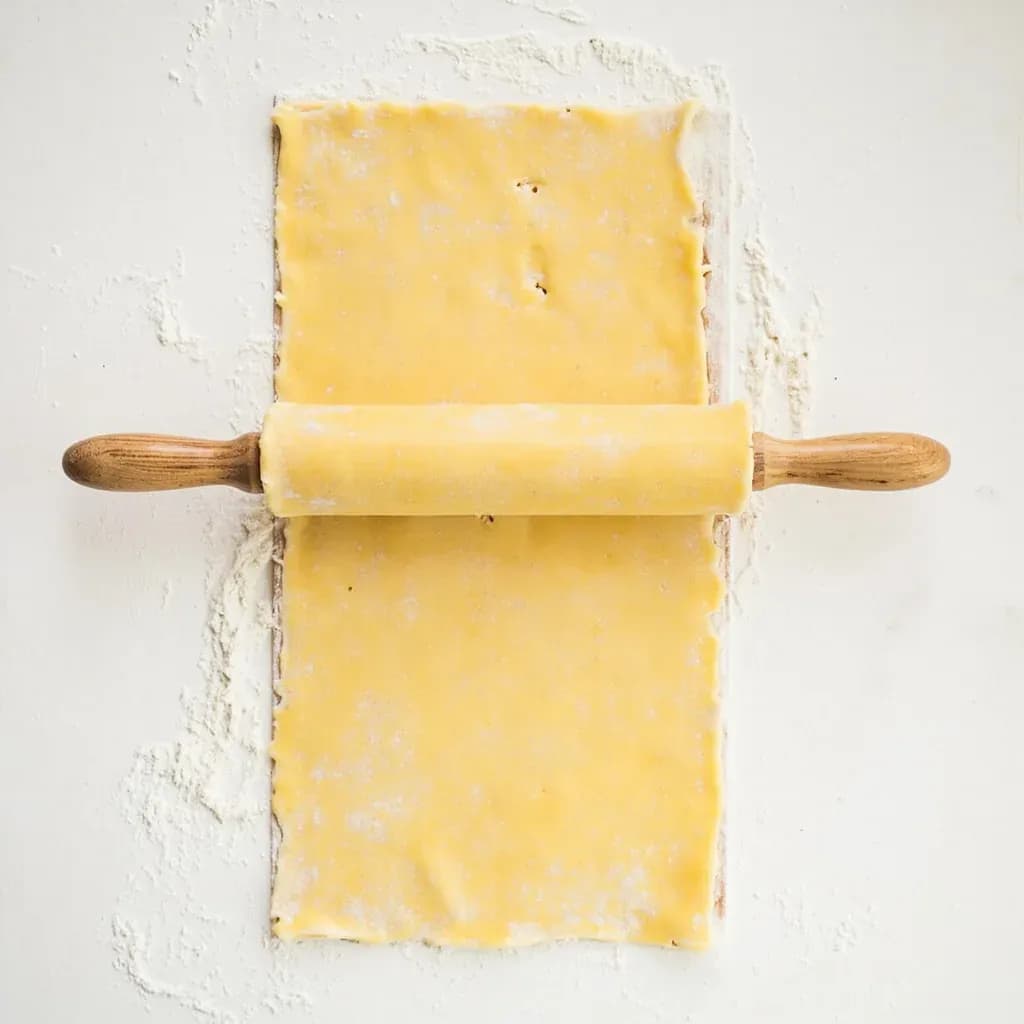
Rolling fresh pasta works rested dough into thin sheets or shapes, by hand with a pin or through a pasta machine's narrowing rollers. The technique ranges from hand-rolling Tuscan pici strands to stretching wide sfoglia sheets, and shares mechanics with laminating croissant dough. Even thickness ensures the pasta cooks uniformly and holds sauce. A well-rested, properly hydrated dough rolls without tearing or springing back.
Rolling fresh pasta is the act of pressing an egg-and-flour dough into thin, even sheets — by hand with a long, slender pin called a mattarello, or, more commonly today, through the steel rollers of a hand-cranked pasta machine. It is the bridge between a kneaded dough and the ribbons, sheets, and filled shapes that define Italian fresh pasta, and it is the stage where the dough's final character is decided. Rolled well, the sheets are supple and faintly translucent, with a satiny surface that sauce clings to; rolled poorly, the pasta turns tough, gummy, or unevenly cooked.
The work is less about strength than rhythm and patience. A rested dough yields to pressure; an unrested one fights back, springing at every pass. The first passes through a machine — at the widest setting, with the dough folded over itself like a letter — do something no plain rolling can: they laminate the dough into the smooth, layered texture that makes northern Italian pasta all'uovo so prized. As the settings tighten, the sheet lengthens, thins, and becomes workable for any shape the cook has in mind.
How thin is thin enough? It depends entirely on what the pasta will become. A sheet destined for ravioli must be thin and even so the edges seal cleanly and the filling cooks through; tagliatelle wants a slightly thicker ribbon that still bends without breaking; lasagna sheets can afford more body, since they will absorb sauce across multiple layers. Reading the dough — supple, never sticky, with the hand faintly visible through a well-rolled sheet — is the skill that separates acceptable fresh pasta from memorable fresh pasta.
- Difficulty
- Medium
Types & varieties
Long, flat ribbons about 6–8 mm wide, rolled to setting 6–7 on a Marcato and folded for cutting
Slightly narrower ribbons, around 5 mm, cut from the same thin sheet as tagliatelle
Wide rustic ribbons, 2–3 cm across, often from a slightly thicker sheet (setting 5)
Thin strands about 3 mm wide, rolled one setting thinner than tagliatelle
Rectangular sheets roughly 10×15 cm, rolled thicker (1.5–2 mm) and often briefly boiled before layering
Same sheet as lasagna, cut and either blanched or pan-cooked before stuffing and rolling
Filled shapes; the rolled sheet must be thin and even, with no translucent weak spots, so pressed edges seal cleanly
Irregular off-cut shapes left over from sheet trimming, prized for rustic broths and pan sauces
Traditional method using a long, dowel-like pin; demands more strength and skill and gives a slightly thicker, more rustic sheet
Standard two-roller hand-cranked machine that allows precise, repeatable thickness and the repeated folding that creates a laminated, silky texture
How to do it
- 1
Rest the dough
After kneading, wrap the dough ball tightly in plastic and let it rest at room temperature for 30–60 minutes. This relaxes the gluten so the dough will roll out instead of springing back. Skipping or shortening this step is the most common cause of frustration.
- 2
Divide and cover
Cut the rested dough into 3 or 4 equal pieces. Keep the pieces you are not working on covered with plastic or an overturned bowl so the surface does not form a skin.
- 3
Flatten into a disc
Take one piece and press it with the heel of your hand or a rolling pin into a rough oval or disc about 1–1.5 cm thick. This makes the first machine pass possible without jamming the rollers.
- 4
Set up the machine at widest setting
On a Marcato-style machine, set the rollers to 0 (the widest opening). If hand-rolling, position the mattarello on a lightly semolina-dusted marble slab or wooden board.
- 5
First passes — laminate the dough
Pass the disc through the rollers. Fold the resulting strip into thirds like a letter, feed it through again, fold again, and repeat 3–4 times at the widest setting. This folding step is what gives fresh egg pasta its smooth, layered texture.
- 6
Reduce thickness gradually
Lower the machine one setting at a time and pass the dough through without folding. Rotate the sheet 90° if one side starts to pull or stretch longer than the other. Continue until you reach the desired thinness — typically setting 6–7 for tagliatelle/fettuccine, 4–5 for lasagna, 7–8 for very thin cappelli.
- 7
Dust and stack
Lay the finished sheet on a lightly semolina-dusted surface, dust the top, and either stack with parchment between layers or hang over a dowel. Keep sheets covered with a clean cloth while you roll the remaining dough.
- 8
Cut or fill immediately
Cut into ribbons with the machine's cutter attachment or a sharp knife, or use the sheet directly for ravioli and tortellini. Cut pasta is best used within 1–2 hours; otherwise, dry it thoroughly on a rack before storing.
Laminating: the secret of silky egg pasta
The single most important habit in machine-rolling fresh pasta is the initial series of passes at the widest setting. Take a flattened disc of rested dough, run it through the rollers, fold the resulting strip into thirds (like folding a letter), and pass it through again — three or four times at the widest opening, with no thinning in between. This folds layers of dough over each other the way a baker laminates dough for croissants, building the smooth, almost satiny texture prized in egg pasta from Emilia-Romagna. After this laminating phase, you stop folding and begin lowering the settings one notch at a time, feeding the sheet through without folding until you reach the desired thinness. Skip the folding and you get a serviceable sheet; do the folding and you get the kind of pasta that drapes over a fork and holds sauce in its surface.
- Fold in thirds, not halves — thirds create more distinct layers.
- Do all folding at the widest setting (0 on a Marcato); never fold at thinner settings or you risk trapping air and creating bubbles.
- After laminating, pass the sheet through without folding; rotating 90° between passes if one side starts to pull.
- The dough should feel cool and pliable throughout; if it warms and softens, return it to the refrigerator for 10 minutes.
Common uses
Tips & pitfalls
- Rest the dough properly — under-rested dough snaps back at every pass and will wear you out before it wears in.
- Do the initial folding-and-rolling passes at the widest setting (folding the sheet in thirds like a letter, 3–4 times) before reducing thickness; this laminates the dough into the silky texture prized in egg pasta.
- Keep the dough covered with plastic or a damp cloth between passes; an exposed surface dries in minutes and will crack at the edges.
- Use semolina rimacinata for dusting, not all-purpose flour — AP absorbs into the dough and toughens it, while semolina's coarse grains resist absorption and keep sheets dry.
- Feed the dough into the rollers at the same point each pass (using the notch on the roller housing as a guide), not at random angles — this keeps the sheet moving straight and prevents wrinkles.
- Flour the sheets lightly after the final pass and let them rest flat or hang over a dowel for 10–15 minutes before cutting — too-wet dough sticks; too-dry dough cracks at the edges.
- For ravioli and tortellini, stop one setting thicker than you would for plain ribbons; the dough firms when the filling is sealed and dried, and an over-thinned sheet tears around the filling.
- Rotate the dough a quarter turn on every pass when hand-rolling, and push from the center outward, to keep the sheet round and even.
- Cut immediately after rolling rather than letting cut pasta sit in a heap — it sticks and tears within minutes.
- Cook fresh pasta within 1–2 hours of cutting, or dry it thoroughly on a rack; refrigerated, it keeps about 2 days; frozen on a sheet pan then bagged, 4–6 weeks.
Good to know
- Primary equipment
- Long thin rolling pin (Italian mattarello) or a hand-cranked pasta machine such as the Marcato Atlas or Imperia; stand-mixer roller attachments also work
- Traditional flour
- Italian "00" (very finely milled soft wheat), though plain all-purpose flour works
- Egg-to-flour ratio
- Classic northern-Italian ratio is 1 large egg (≈50 g) per 100 g flour; richer doughs use 1 whole egg plus 1 yolk per 100 g
- Resting time
- 30–60 minutes at room temperature, wrapped in plastic; up to 2 hours in the refrigerator
- Dusting flour
- Semolina rimacinata (fine semolina) is preferred over all-purpose; its coarse grains resist absorption and keep sheets dry
- Machine settings (Marcato Atlas)
- 0 (widest) through 9 (thinnest); tagliatelle/fettuccine finish at 6–7, lasagna at 4–5, very thin for cappelli at 8
- Sheet thickness
- Roughly 1.0–1.5 mm for tagliatelle, 1.5–2 mm for lasagna, ~1 mm for ravioli
- Yield guidance
- 100 g flour plus 1 egg serves one person as a primo (first course)
- Origin of machine
- Hand-cranked sheet-rolling pasta machines emerged in late-19th-century Italy; major modern makers Marcato (founded 1930, Campodarsego) and Imperia (founded 1932, Imperia) still dominate
Also called
Hand-Rolling Pici · Fresh Pasta Sheet Rolling (Sfoglia) · Croissant Rolling & Shaping
Related

Whisk
Beat ingredients smooth and aerated with a looping wire motion

Sift
Pass dry ingredients through mesh to aerate and remove lumps

Strain
Pour through mesh to separate solids from liquid for a smooth result

Filter
Pass liquid through fine material to clarify out the smallest particles

Rice
Press cooked potatoes through small holes for fluffy, lump-free texture

Mash
Crush soft cooked food into a rustic, creamy purée

Grind
Crush food into a coarse to fine texture, from spices to meat

Grate
Shred food into fine bits against a sharp-toothed surface