Heat & Fire
Rotisserie / Spit-Roasting
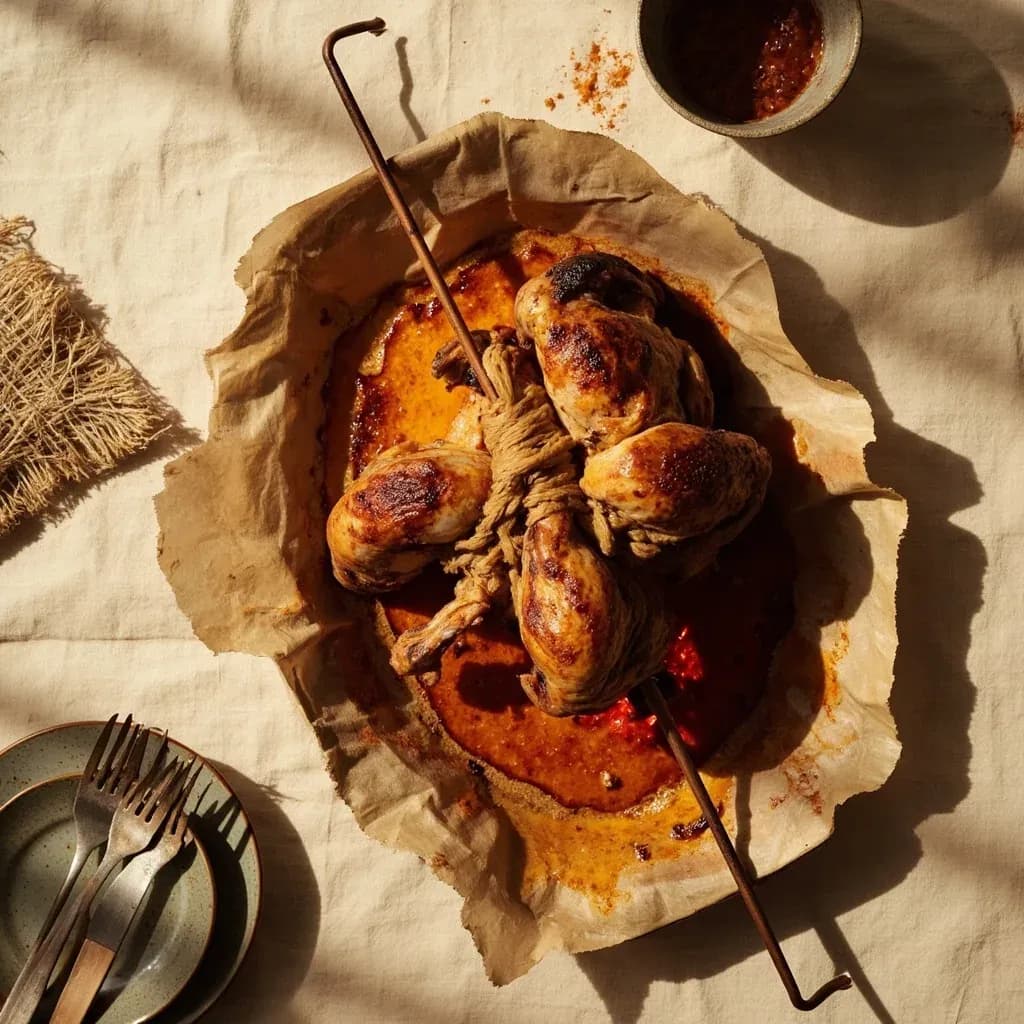
Roasting meat on a slowly turning spit before the heat so it self-bastes in its rendering fat, giving evenly browned, crisp-skinned results.
Spit-roasting is one of the oldest documented cooking techniques, recorded in ancient Egypt, Greece, and Rome: a whole, trussed piece of meat is mounted on a rod and turned slowly in front of a radiant heat source so that every surface is cooked and browned in turn. The constant rotation — typically four to six revolutions per minute — is the key. No single patch of skin ever sits long enough in the hottest zone to scorch, so the exterior dries and crisps uniformly through the Maillard reaction rather than in charred streaks. At the same time, the interior cooks gently and evenly because the meat is never parked next to the heat source; rendered fat drips off into a pan below rather than running back over the surface, which is precisely what allows the skin to dry and crisp in the first place.
The technique is fundamentally dry-heat, and that has consequences. There is no surrounding liquid to temper the heat, no lid to trap steam — only the radiant glow of coals, gas, or an electric element, and the steady drip of fat into a pan below. That drip pan is not optional: it is the source of a continuous, self-made jus or schmaltz that would otherwise be lost. Whole cuts are forgiving on a rotisserie because rotation passes them through hot and cooler zones naturally, but lean birds and large joints still benefit from brining or salting ahead of time, and a probe thermometer is the only reliable way to confirm doneness.
What separates a good rotisserie roast from a great one is preparation: tight trussing, proper centering on the spit, and correct distance from the heat. Get those right and the machine does the rest. Get them wrong — a flapping wing, an unbalanced load, a spit parked too close to the coals — and the technique punishes you with charred outsides and raw centers. The vertical and box-style variants (al pastor, shawarma, Caja China) all apply the same physics of continuous rotation, but they have evolved around different traditions of marination, slicing, and serving.
- Difficulty
- Moderate
Types & varieties
Classic French and European setup; spit lies parallel to the heat, fat drips down into a pan. Used for chickens, rib roasts, and lamb.
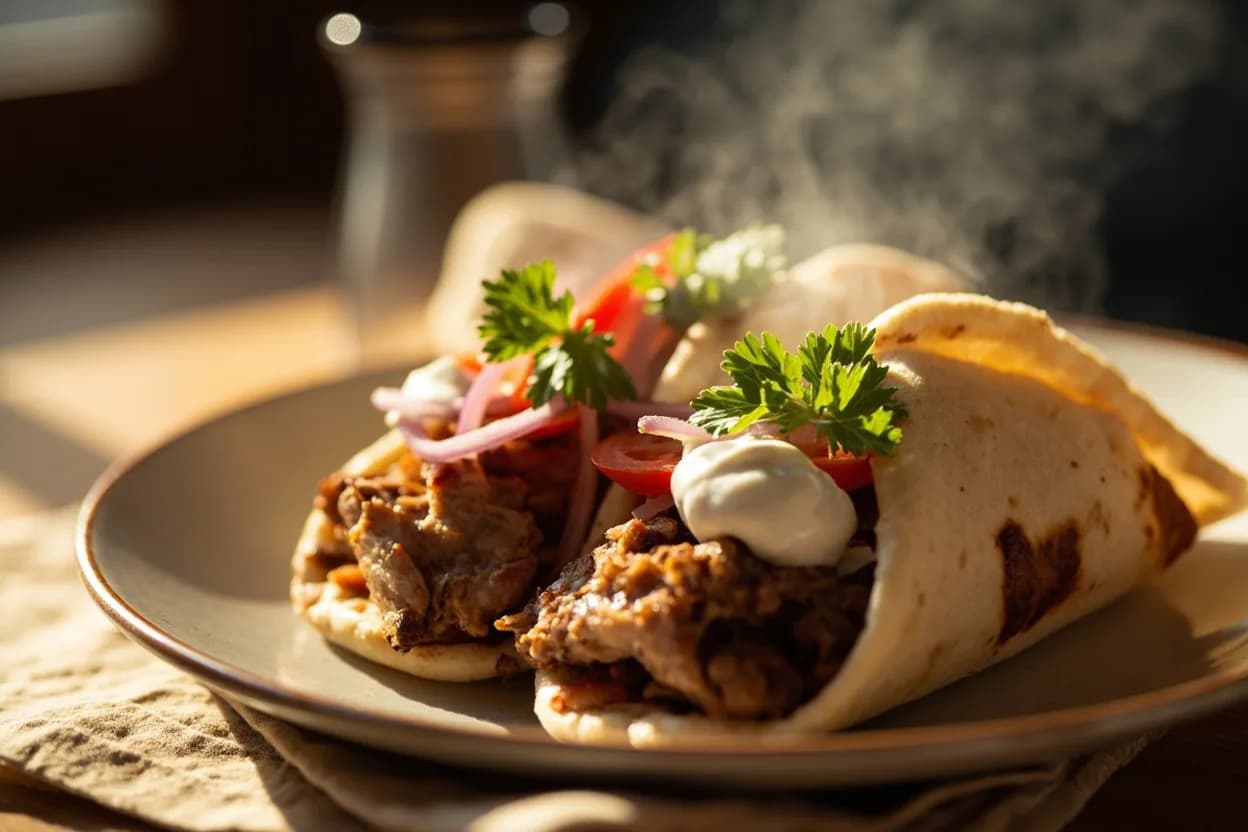
Meat is stacked on an upright spit with heat to the side; surface is shaved off in slices as it cooks. Mexican al pastor uses pork marinated in chiles and pineapple; Levantine shawarma uses lamb, chicken, or beef; Greek gyros use pork or chicken with herb marinade.
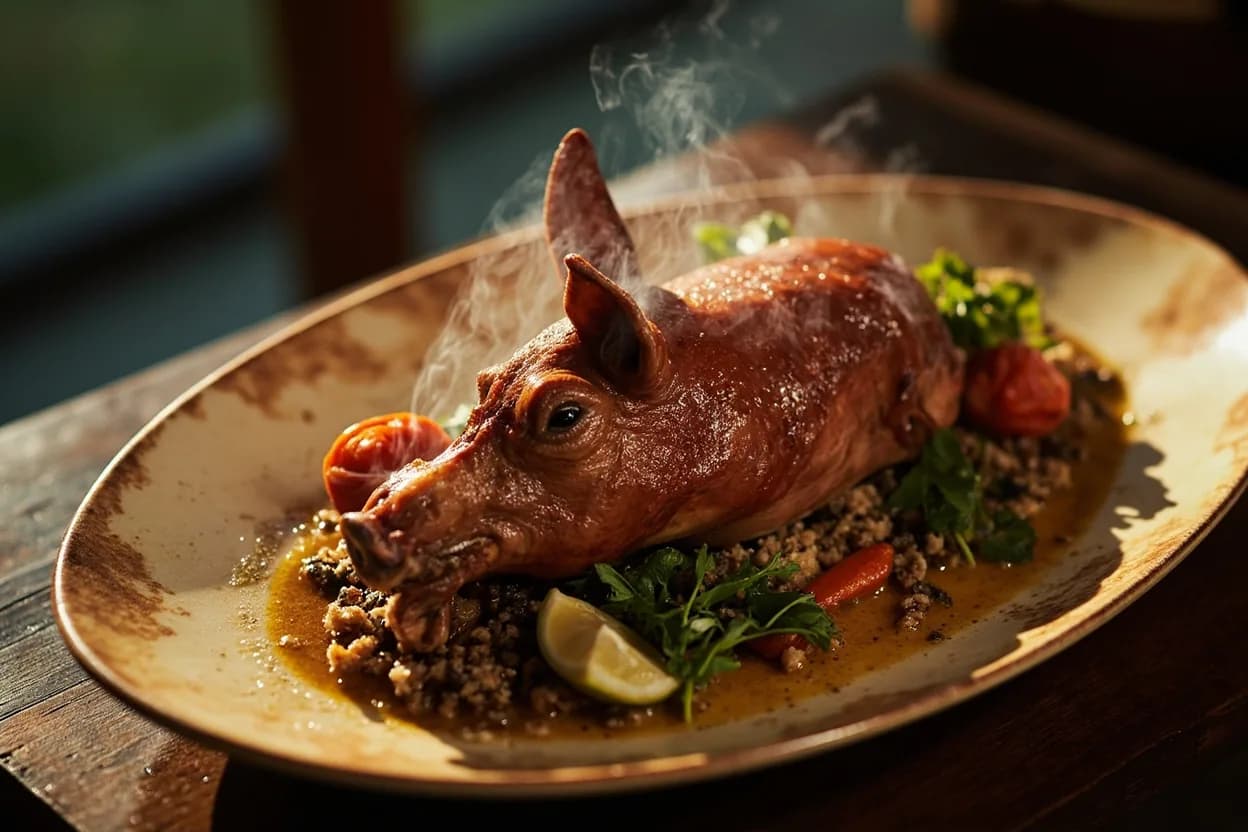
Cuban box-style pig roaster; the pig lies on a grate above a drip pan and is covered by a wooden box holding hot coals on top, functioning like a horizontal rotisserie with reflected heat from above.
Whole pig roasted on a spit over hot coals or lava rocks, often underground, with frequent manual turning.
Large cuts such as picanha, leg of lamb, and chicken hearts skewered on long spits over open wood fires, rotated by hand or mechanically.
Clay-oven variant from the Indian subcontinent; chickens or kebabs threaded horizontally inside a cylindrical clay oven.
Whole lamb roasted on a horizontal spit over an open fire or in a clay oven; sometimes buried in embers.
Rib racks and whole carcasses lashed to a cross-shaped frame (asador) and angled slowly over wood embers.
Compact electric or gas units for home kitchens; cylindrical glass or metal chamber with a turning basket or spit.
Premium home ranges with a rear infrared burner and motorized spit inside the oven cavity.
How to do it
- 1
Choose and prepare the protein
Select a uniform, whole cut — typically 2 to 5 kg for a home machine. Trim excess loose fat and silverskin, pat the skin dry, and season or brine according to the recipe. For poultry, season the cavity as well as the skin.
- 2
Truss for tight rotation
Tie the wings close to the body with wingtips tucked behind the shoulders, bind the drumsticks together, and tuck any loose skin or fat so nothing flops. For roasts, butcher's-tie the meat into an even cylinder so the surface stays consistent.
- 3
Skewer and secure
Slide the spit rod through the center of mass of the protein. Push the pronged forks or U-clips into the meat at both ends and tighten the thumbscrews so the load cannot slide. For very long or heavy items, use a second support bracket.
- 4
Balance the load
Hold the spit between your palms like a barbell and let it roll; the heavy side should rotate to the bottom. Shift the meat on the rod, or slide the prongs, until the rod stays put in any position. A balanced load prevents motor wear and uneven cooking.
- 5
Preheat the heat source
Bring the grill, fire, or rotisserie burner up to working temperature — usually a medium radiant heat with coals glowing, gas at medium, or the electric element glowing red — before the food goes in. Position a drip pan filled with water, stock, or aromatics directly under the meat.
- 6
Mount and start rotation
Slot the spit into the motor, lock it in place, and confirm the rotation is smooth and silent. The food should sit centered in front of the heat, with 10–15 cm (4–6 in) of clearance from the hottest element to prevent flare-ups.
- 7
Cook and monitor
Close the lid if applicable and let the rotation do the work. Resist the urge to open constantly; every peek loses heat. Begin checking internal temperature after the estimated halfway point, inserting a probe into the thickest part of the muscle and avoiding bone.
- 8
Adjust and finish
If browning is uneven, rotate the spit manually a quarter turn and reposition closer to or further from the heat. If skin needs extra crisping, raise the heat for the final 10–15 minutes.
- 9
Rest, then carve
Pull the meat off the spit, tent loosely with foil, and rest 10–20 minutes depending on size. Carry-over heat will raise the internal temperature by roughly 5°F. Carve against the grain and spoon the pan drippings over the slices.
The physics of even browning
Rotisserie works by balancing two effects of continuous rotation: the drying of the skin and the even cooking of the muscle. As the spit turns, each patch of skin spends part of the rotation facing the heat and part facing away. The 'away' phase is long enough for surface moisture to evaporate and for the skin to dry out — a prerequisite for Maillard browning and for the crisp crackle that defines a great roast chicken or suckling pig. The interior cooks gently and evenly because no part of the roast is ever parked next to the heat source for long. Rendered fat runs off into the drip pan rather than back over the meat, which is what allows the skin to dry and crisp. The result is a uniformly bronzed exterior and a moist interior, achieved with no intervention beyond trussing and positioning.
Drippings and pan management
The drip pan is a working ingredient, not a cleanup accessory. Position it directly under the meat and fill it with water, stock, wine, or aromatics (onions, garlic, herbs, citrus peel) so the falling fat is captured without smoking. The liquid in the pan becomes the base of a jus, a gravy, or — in the case of a long duck or goose roast — a generous supply of clarified schmaltz suitable for roasting potatoes or frying eggs. Skim and strain the drippings while still warm; cold fat is much harder to separate from the jus beneath it.
Common uses
Tips & pitfalls
- Truss poultry tightly: pinion wings behind the back and tie drumsticks together so flapping pieces don't catch fire or slow the rotation.
- Center the load on the spit and spin it between your palms before lighting — a heavy side will make the motor stutter and cook unevenly.
- Brine or salt lean birds (chicken, turkey, pheasant) 12–24 hours ahead; rotisserie is a dry method, so lean proteins benefit from a moisture buffer.
- Use a drip pan directly under the meat and reserve the fat for roasting potatoes, frying eggs, or making jus — never let it smoke.
- Don't rely on skin color alone — pull the meat when a probe thermometer reads the safe internal temperature (165°F for poultry, 145°F for medium pork or lamb).
- If the skin browns too fast, tent loosely with foil or move the spit further from the heat; if it's pale, raise the heat or shorten the distance.
- Rest the roast off the spit, tented loosely, for 10–20 minutes so juices redistribute before carving.
- Clean prongs, forks, and the spit immediately — dried fat and carbonized drippings are a chore to remove once cold.
Good to know
- Origin
- Documented in ancient Egypt, Greece, and Rome; the word 'rotisserie' comes from French rôtisserie, from rôtir (to roast).
- Heat source
- Wood, charcoal, gas, or electric; radiant or convective heat in front of, around, or above the food.
- Spit rotation
- Typically 4–6 revolutions per minute — slow enough to baste continuously without throwing rendered fat off the meat.
- Surface temperature
- 275–350°F (135–175°C) at the meat surface; hotter for short browning, lower for long, even roasts.
- Best for
- Whole poultry, suckling pig, lamb shoulder or leg, pork loin, prime rib, duck, game birds, and dense vegetables or fruit.
- Yield bonus
- Drippings collected in the pan below are continuous, self-made jus or schmaltz — never wasted.
- Difficulty
- Moderate; the equipment does the work, but balancing and trussing take practice.
- Time range
- From about 45 minutes for a small chicken to 8–10 hours for a whole suckling pig.
- Food safety
- A probe thermometer is essential; whole cuts are forgiving, but internal temperature must be confirmed (165°F poultry, 145°F medium pork or lamb).
Also called
spit-roasting · rotisserie roasting · rotissoire