Knife Skills
Slabbing & Cutting
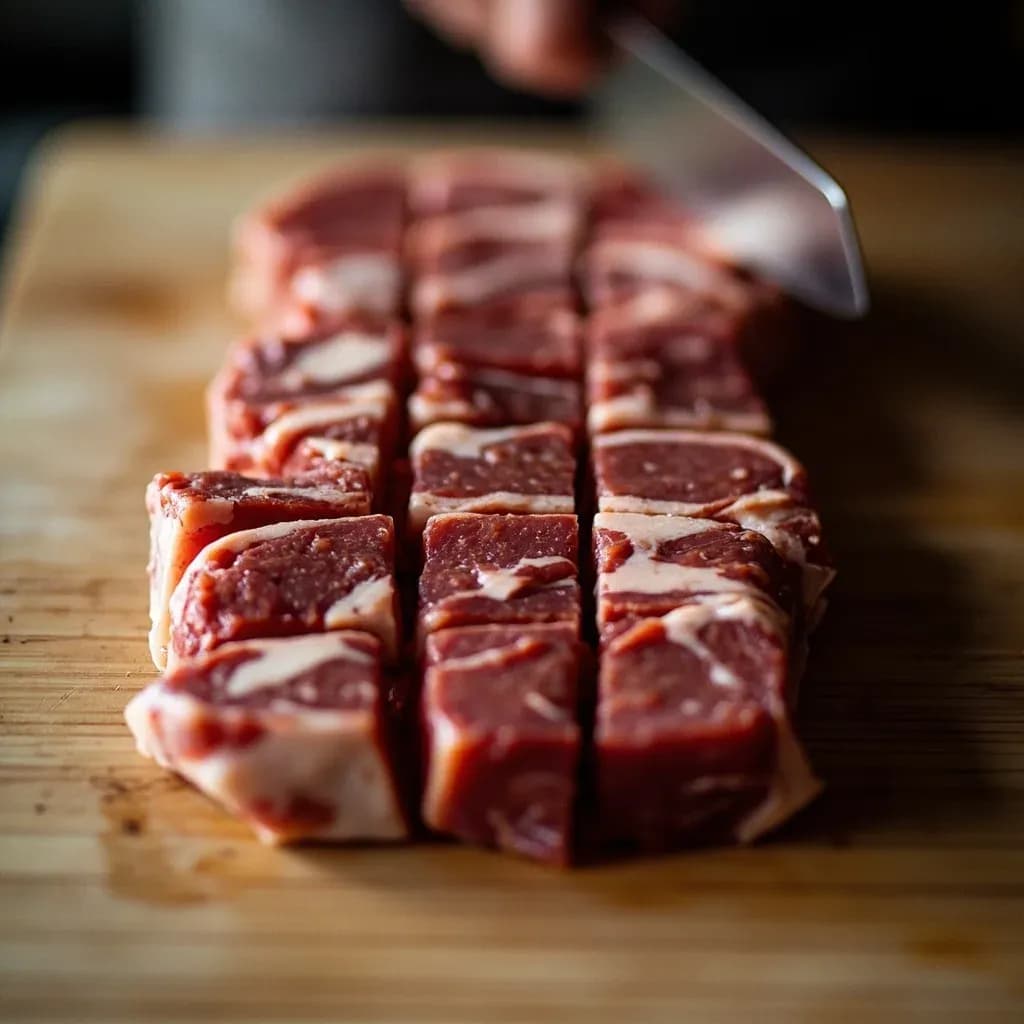
Cutting a large mass into flat slabs as the first step toward smaller, uniform pieces.
Slabbing and cutting first divides a large block of food, like a side of meat, a wheel of fudge, or a tray of confection, into flat slabs, then cuts those slabs into uniform pieces. Starting with even slabs makes the final dicing or portioning consistent and efficient. It is a foundational butchery and confectionery move that brings order before precise cutting.
Slabbing is the foundational breakdown cut in professional and home kitchens: reducing a large, irregular mass into flat, parallel-faced pieces of uniform thickness. It is almost never the final cut. Instead, it sets the geometry for every step that follows — the strips, dice, steaks, cutlets, or portioned blocks all inherit the thickness of the original slab. Get the slab right, and the rest of the breakdown is mechanical. Get it wrong, and the error compounds: a tapered slab produces tapered strips, which produce a dice with two or three different sizes and a pan of food that cooks unevenly.
The technique relies less on speed and more on stability and consistency. A heavy, sharp knife is drawn through the food in a long, even stroke while the guiding hand holds the item firmly against the board. Most failures are not about sharpness or strength — they are about rocking items, undersized boards, or a guide hand that drifts mid-cut. Because the slab is the reference surface for the next cut, the first slice is the most important: it establishes the standard thickness that every subsequent piece must match.
In practice, slabbing is the opening move of nearly every serious butchery and vegetable breakdown, from a whole salmon side reduced to portioned blocks, to a 15-pound pork shoulder broken down for braising, and from a butternut squash destined for roasting to a wheel of cheese portioned for service. The same logic applies across ingredients because the principle is universal: control the first cut, and the rest of the work becomes predictable.
- Difficulty
- Medium
Types & varieties
One or two flat pieces cut from a larger item, such as halving a chicken breast horizontally or splitting a pork loin into two cutlets.
Successive cuts producing several slabs of equal thickness — the standard approach for brisket, salmon sides, roast beef, or cabbage.
Horizontal slabbing nearly all the way through so the item opens like a book, used to even thickness for stuffing or quicker cooking.
Shallow slab cuts that do not go all the way through, used to guide further cutting, tenderize, or help heat penetration (scoring ham fat, scoring squid).
How to do it
- 1
Stabilize the item
Place the item on a large, non-slip board. If it rocks, slice a thin 'face' piece off the bottom or one side with a single straight cut to create a flat, stable base. A rocking item guarantees tapered slabs.
- 2
Choose the slab thickness
Decide the final thickness based on the downstream cut: roughly 4–5 cm for steaks or cutlets, 1.5–2 cm for a dice or further pounding. The thickness you choose now is the dimension of every piece that follows.
- 3
Mark with a guide cut
Make the first full slab as your reference. Measure or eyeball against a ruler or finger-widths; this piece sets the standard for every slab after it, so do not rush it.
- 4
Position the knife and guiding hand
Hold the knife perpendicular to the board with a pinch grip on the bolster. Place your guiding hand in a claw, knuckles against the blade's flat, with the item tucked into the curled fingers — never fingertips.
- 5
Slice with a long, even stroke
Draw the knife through in one smooth, horizontal motion for proteins; use a slow, weighted push-cut for dense vegetables like squash. Keep the blade flat against the previous slab so the new slab mirrors its thickness exactly.
- 6
Continue in sequence
Lay each slab flat, then line up the next piece against the established reference surface and slice, ensuring every slab matches the first in thickness.
- 7
Check and adjust
After 2–3 slabs, stop and check that thicknesses match. Adjust your guide-hand position or knife angle before any inconsistency compounds through the rest of the item.
The slab–strip–dice progression
Almost every classical knife breakdown follows the same sequence. The mass is first reduced to slabs, the slabs are stacked and cut into strips, and the strips are crosscut into dice, cubes, or julienne. Slabbing is the slowest and most consequential step because it fixes the final dimension of every piece. A 2 cm slab cut into 1 cm strips and then crosscut into 1 cm dice will produce a perfectly uniform 1 cm cube. A slab that tapers from 3 cm to 1.5 cm will produce dice that range from 1.5 cm to 0.75 cm, and the smaller pieces will overcook long before the larger ones are done.
- Slabs are sized for the end use: thick for steaks and roasts, thin for stir-fry, medium for cutlets and portioned fish.
- The first slab is the reference slab — measure it before cutting the second.
- Stacking slabs before cutting strips is faster and more accurate than cutting strips from a single thick slab.
Choosing slab thickness for the end use
Slab thickness is not arbitrary; it is dictated by what comes next. A 4–5 cm slab is appropriate when the goal is steaks, cutlets, or portioned blocks of fish that will be cooked as individual pieces. A 1.5–2 cm slab suits a downstream dice or pounding, or items that will be stuffed. Thinner slabs of about 1 cm are right for cabbage destined for slaw or stir-fry, and for vegetables that will be roasted quickly at high heat.
- Proteins bound for portioning: 3–5 cm so each piece is a serving.
- Proteins bound for stir-fry or quick sauté: 1–2 cm for fast, even cooking.
- Dense squash and root vegetables: 2–4 cm so they hold their shape and cook through without disintegrating.
Common uses
Tips & pitfalls
- Square off the item first with a face cut to create a flat, stable base so it cannot rock or roll during slicing.
- Use the claw grip on your guiding hand, knuckles against the side of the blade — never fingertips — to keep fingers safe and the item stable.
- Use a long slicing motion and let the knife's weight do the work; sawing stretches fibers and crushes delicate proteins like fish or herbs.
- Make the first slab deliberately and use it as the reference for every slab that follows; the first cut sets the standard for the entire breakdown.
- For very long items such as a whole salmon side or a brisket, stand the knife up and use a long pull-stroke rather than a downward chop to keep slices even.
- Chill proteins 15–30 minutes before slabbing — a slightly firm exterior resists compression and yields cleaner, sharper edges.
- Common mistake: rushing and producing tapered slabs that are thick on one end and thin on the other. These cook unevenly and refuse to dice or roll into uniform shapes.
- Common mistake: trying to push through bone with a chef's knife. Switch to a cleaver or boning knife, or work around the bone rather than forcing it.
- Common mistake: cutting on a board that is too small so the slab overhangs and tears at the edge, leaving a ragged face. Switch to a larger board or work in stages.
- Wipe the blade between slabs when working with slippery items like fish or squid to keep contact safe and the cut face clean.
Good to know
- Skill family
- Primary breakdown cut / foundational knife skill
- Also called
- Slabbing; sometimes 'slicing into portions' in butcher's terms
- Typical thickness
- 1.5–5 cm (½–2 in), depending on the intended downstream cut
- Best knife
- 10–12 in (25–30 cm) chef's knife or slicer for proteins; heavy chef's knife or cleaver for dense vegetables and squash
- Difficulty
- Beginner to intermediate — relies on stability and consistent thickness more than speed
- Primary purpose
- Convert an irregular mass into flat, parallel-faced pieces of uniform thickness for even cooking and accurate portioning
- Position in breakdown
- First step in the classic 'slab → strip → dice/cube' progression
- Cutting surface
- Large, stable board (wood or poly), ideally with a damp towel beneath to prevent slip
Also called
Slabbing · Slab Cutting
Related

Chop
Cut into rough, irregular pieces — the everyday workhorse cut

Dice
Cut into uniform cubes for even cooking and a tidy look

Mince
Cut as fine as possible so flavor melts evenly into the dish

Slice
Cut into even, flat pieces for consistent cooking and presentation

Julienne
Cut into thin matchsticks for fast cooking and elegant garnish

Brunoise
Cut into tiny, precise cubes — the finest dice in the kitchen

Chiffonade
Roll and slice leafy greens into delicate ribbons

Batonnet
Cut into tidy sticks, thicker than julienne — think classic fries