Water & Steam
Slow-Simmering Ragù (Pippiare)
Holding a meat sauce at a barely-bubbling simmer for hours so it thickens and deepens.
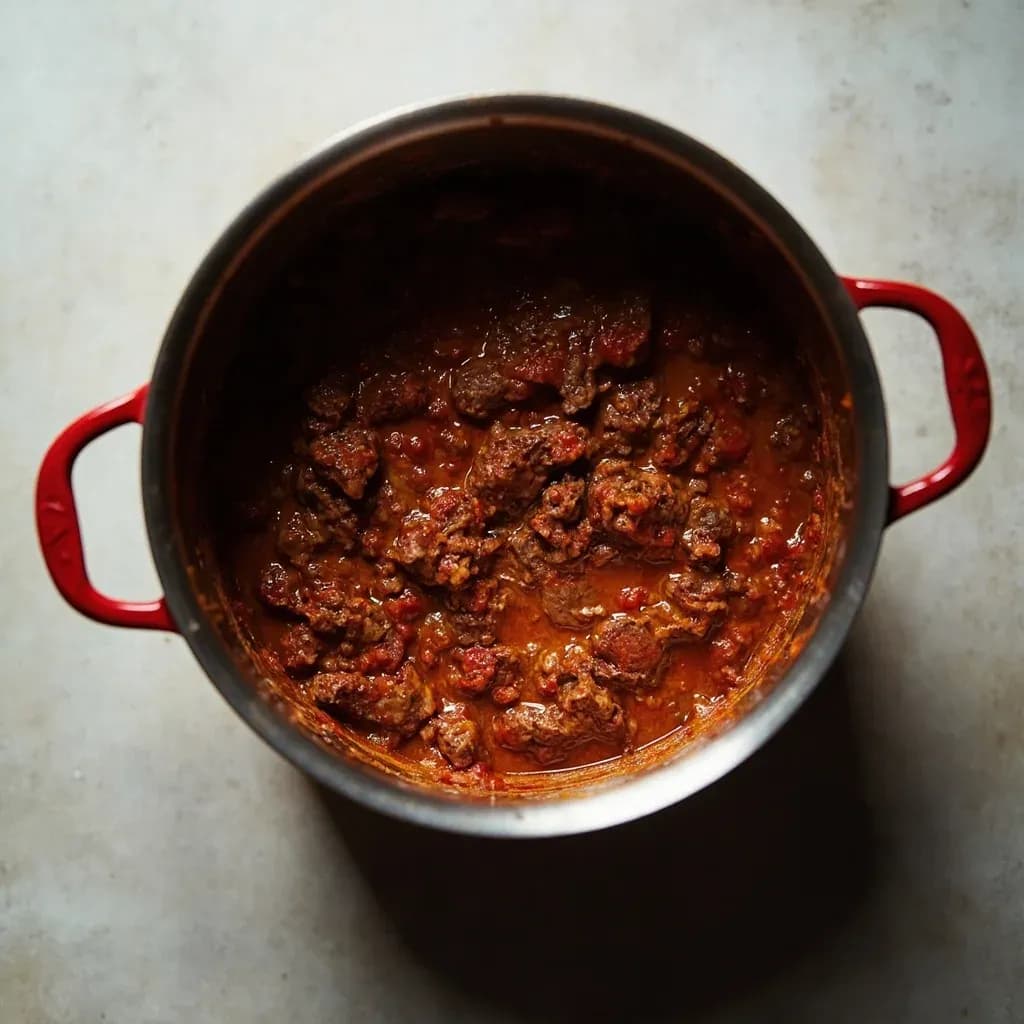
Pippiare is the Neapolitan word for the lazy, intermittent blip of a ragù held at the gentlest possible simmer for many hours. The slow, barely-moving heat melts the meat and connective tissue and reduces the tomato into a dark, glossy, deeply concentrated sauce. The pot is left mostly undisturbed and stirred only occasionally, and the unmistakable slow plop of the surface is the cook's cue that the simmer is set correctly.
Pippiare is the Tuscan verb for what Italians consider the soul of a great ragù: holding a pot at the gentlest possible simmer, where only the smallest bubble — a pippia — breaks the surface every few seconds. The liquid sits between roughly 85 and 95 °C / 185–203 °F, well below a true boil, and the surface shows no rolling motion and almost no steam. It is a far cry from the hard bubbling most English speakers imagine when they hear "simmer," and it is the single variable that separates a thin, sharp, meaty sauce from one that tastes deep, glossy, and rounded.
The technique works because long, gentle heat gives two things time: connective tissue to break down into gelatin, and water to evaporate and concentrate flavor. At pippiare, proteins in the meat do not seize and squeeze out their juices the way they do at a rolling boil; instead they stay tender and gradually release a silky body into the sauce. Tomato paste caramelizes slowly in the fat instead of scorching. Wine loses its raw alcohol bite and folds into the background. The fond that forms on the bottom of the pot lifts easily on the next stir, so nothing burns and nothing is wasted. After four or five hours the sauce has lost a substantial share of its starting volume but gained the dark, almost meaty intensity that defines a proper ragù.
The practical payoff is a sauce that is remarkably forgiving once the heat is correctly set. There is no sautéing at the end, no blitzing, no rescue seasoning — the work is done by time and a steady, barely-visible bubble. What the cook has to give up is patience and attention: a quick glance every twenty minutes to skim fat, scrape the fond, and confirm that the bubble rate has not crept up or died away.
- Difficulty
- Medium
Types & varieties
The canonical version: soffritto + mixed ground/cut beef and pork + tomato paste + milk + wine + a small amount of passata; the long pippiare is essential to its character.
Larger pieces of beef and pork (often including braciole rolled with pine nuts, raisins, and pecorino) and abundant tomato; traditionally pippiare for 4–6 hours.
No tomato; built on milk, white wine, and a touch of butter or flour; typical of northern Italy for stuffed pastas like tortellini.
Despite the name, a Neapolitan ragù of beef (often with pork) cooked with a very large quantity of onions for 6–8 hours until the onions disappear into the sauce.
Wild boar ragù built with juniper, bay, and a generous measure of red wine; needs 4+ hours of pippiare to tenderize the lean, strongly flavored meat.
Vegetarian mushroom 'ragù' built on porcini plus mixed cultivated mushrooms; a much shorter pippiare of 45–90 minutes is enough.
Fish or seafood ragù; pippiare is intentionally short (20–40 minutes total) to keep the delicate proteins tender.
How to do it
- 1
Render the base fat and build the soffritto
In a heavy pot over low-medium heat, melt diced pancetta (if using) in a mix of olive oil and butter. Add finely diced onion, carrot, and celery and cook 8–12 minutes until soft, translucent, and pale gold — not brown.
- 2
Brown the meat in batches
Add the meat (ground and/or cut into bite-size pieces — beef, pork, veal, or a mix) in small batches, leaving each batch undisturbed for 1–2 minutes to develop a crust, then turning. Remove each batch to a plate once browned. Deglaze the pot with a splash of wine between batches if fond builds up.
- 3
Cook the tomato paste
Return all the meat to the pot. Add tomato paste (concentrato doppio) and stir to coat. Cook 4–6 minutes, stirring often, until the paste darkens to a brick-rust color and smells caramelized rather than raw.
- 4
Deglaze and add liquids
Pour in wine (red for tomato ragù, white for ragù bianco) and let it reduce by half, scraping up all the fond. Add milk (for Bolognese-style) and let it fully absorb. Then add passata, stock, or water so the liquid covers the meat by roughly a finger's width.
- 5
Bring to a boil, then drop to pippiare
Raise the heat just until a true boil is reached, then immediately lower it to the smallest setting that keeps the liquid at a barely-visible shimmer. The correct pippiare shows only a tiny bubble or two every few seconds — no rolling surface, no steam plume.
- 6
Skim, stir, and maintain
Skim surface fat every 30–45 minutes. Stir gently every 20–30 minutes, scraping the bottom. If the level drops below the meat before the meat is fully tender, add small splashes of stock or water. Keep the lid off or only partially ajar. Adjust the heat to keep the bubble rate constant.
- 7
Cook through the full simmer
Hold at pippiare for at least 2 hours, 4–6 hours for traditional Bolognese or Napoletano, and up to 6–8 hours for Genovese or wild boar. The meat should be fork-tender and the sauce should coat a spoon thickly, with rendered fat glistening on top.
- 8
Finish and adjust
Taste for salt and pepper only at the end. For pasta sauces, remove from heat and stir in a small knob of cold butter and/or a handful of grated Parmigiano-Reggiano for a glossy mantecatura. The finished ragù should be thick enough to cling to pasta without pooling at the bottom of the plate.
Reading the simmer
The single skill that makes or breaks a pippiare is the cook's eye for the bubble rate. Italian cooks describe it as 'speaking but not shouting' — the pot is awake, but barely. Use these cues to find the right setting on your stove and to recalibrate every time you stir.
- A true pippiare produces one small bubble somewhere on the surface every 3–6 seconds. Two bubbles at once is borderline; three or more means you have crossed into a true simmer or boil.
- Steam should be a thin wisp at the lip of the pot, not a plume. If the kitchen windows fog, the heat is too high.
- Listen for a faint, intermittent blip, not a continuous hiss. A rolling boil roars.
- The surface fat should glisten and part slowly between bubbles; if it skitters across the surface, drop the heat by a quarter turn.
- Every stove is different. On a strong gas burner the right setting is often the smallest possible flame; on induction it may be the second- or third-lowest level. Plan on recalibrating the first time you make a new ragù in a new pot.
Common uses
Tips & pitfalls
- Use a heavy, wide pot — evaporation is your ally; a tall narrow pot steams rather than reduces and you will fight the heat all afternoon.
- Reach a true boil only briefly at the start; once ingredients are combined, drop to the smallest setting that keeps the liquid at a barely-visible shimmer. A common mistake is cooking at a rolling boil — the proteins seize, fat emulsifies harshly, and the finished sauce tastes flat and greasy.
- Build the soffritto patiently to soft, translucent, and pale gold rather than browned; this gives the sauce a sweet aromatic base rather than a bitter one.
- Brown the meat in small batches. Crowded meat steams and never develops fond, which is where most of the sauce's depth comes from.
- Cook tomato paste in the fat for several minutes until it darkens to a brick-rust color. This caramelizes its sugars and removes the raw, metallic taste that ruins a quick ragù.
- For Bolognese-style ragù, add milk early and let it fully absorb; the milk tenderizes the proteins and balances the acidity of wine and tomato.
- Skim surface fat periodically with a ladle rather than draining, and stir every 20–30 minutes, scraping the bottom — the fond is concentrated flavor, but only if it is lifted before it scorches.
- Season only at the end — long cooking concentrates salt unevenly. A common mistake is reaching for sugar to 'fix' acidity; long pippiare and properly cooked tomato paste do this naturally, and sugar masks flavor.
- Common mistake: undercooking. A ragù pulled at 90 minutes is thin, sharp, and meaty; the pippiare time is what produces depth and roundness, and short-changing it is the most common reason a homemade ragù disappoints.
Good to know
- Italian term
- Pippiare — chiefly Tuscan and Central Italian dialectal verb for holding a pot at the gentlest possible simmer, where only tiny pippie (small bubbles) break the surface from time to time.
- Heat range
- Roughly 85–95 °C / 185–203 °F, well below a true boil (100 °C / 212 °F).
- Cook time
- 2–3 hours for a simple ragù; 4–6 hours for traditional Bolognese and Napoletano; 6–8 hours for Genovese and wild-boar versions.
- Italian codification
- Pellegrino Artusi, La scienza in cucina e l'arte di mangiar bene (1891).
- Reference recipe
- Ragù alla Bolognese, officially 'depositato' at the Accademia Italiana della Cucina on behalf of the Bologna Chamber of Commerce in 1982.
- Typical pot
- Heavy-bottomed copper, cast iron, or thick enameled cast iron; wide and shallow rather than tall and narrow, to favor evaporation over steaming.
- Final texture
- Thick enough to coat a wooden spoon, glossy, with rendered fat glistening on the surface but no pooled grease; meat should be fork-tender.
- Aromatic base
- Soffritto of finely diced onion, carrot, and celery, sometimes joined by garlic, pancetta, or celery leaves.
Also called
pippiare · slow-simmered ragu
Related

Boil
Cook in vigorously bubbling liquid at full rolling heat

Simmer
Hold liquid at a gentle shimmer for tender, unhurried cooking

Poach
Cook gently in barely-trembling liquid for silky, tender results

Steam
Cook in rising vapor to keep color, nutrients, and shape intact

Blanch
Plunge briefly in boiling water, then shock cold to lock color

Braise
Sear, then cook slow in a little liquid until fall-apart tender

Stew
Simmer bite-sized pieces fully submerged into a rich, unified pot

Sous-Vide
Seal and cook in precise warm water for edge-to-edge doneness