Knife Skills
Spear Cutting
Cutting produce lengthwise into long pointed wedges or spears for roasting, grilling, or dipping.
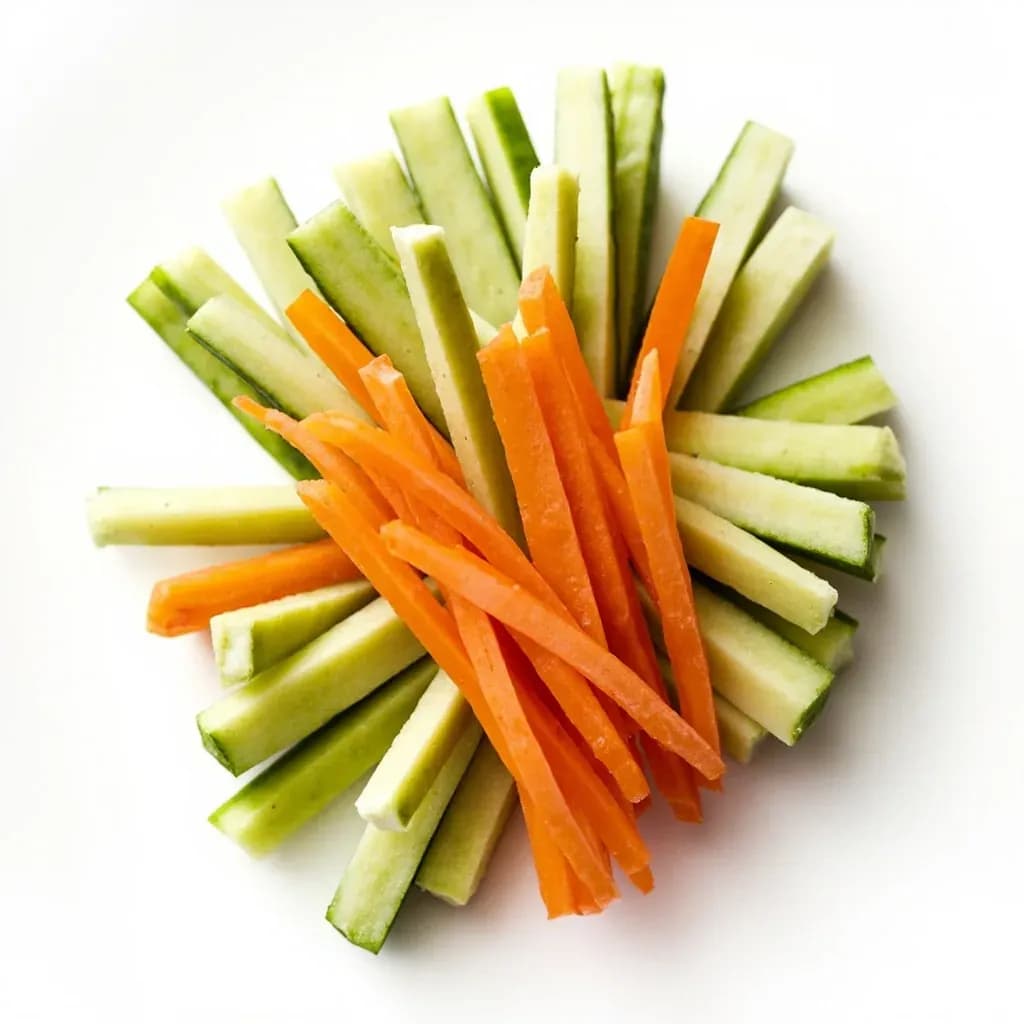
Spear cutting slices a vegetable or fruit lengthwise into elongated tapered pieces, like potato wedges, carrot or cucumber spears, and pineapple sticks. The long shape gives plenty of surface area for browning while keeping a tender interior, and the elongated form is easy to hand-hold for dipping or grilling. The food is typically halved or quartered first, then each section cut into spears.
Spear cutting is a lengthwise wedge cut that turns a cylindrical or oblong vegetable into a long, tapered piece with a single pointed tip. It is the shape you see on a crudité tray, on a sheet pan of roasted root vegetables, and on grilled zucchini and sweet potatoes at a cookout, and it works because it strikes a useful balance: thick enough at the base to hold its identity over heat, and pointed enough at the tip to brown quickly and feel natural to pick up and dip.
Unlike a batonnet, which is square and untapered, the spear is triangular in cross-section and gets thinner as you work down the blade. That taper is the whole point — it gives the cook more control over the final texture, since the thin tip crisps and chars first while the wide base softens and sweetens, so a single piece finishes with contrast in a single bite. It is also one of the most forgiving cuts a home cook can learn, because small variations in width get absorbed by the taper and the pointed end hides inconsistencies.
The right thickness depends entirely on what you are doing with the spear, and that relationship between shape and use is what makes the cut worth knowing as its own technique. A 1/2-inch spear is ideal for raw dipping and quick sautés, while a 3/4-inch or thicker spear is needed to survive a hot grill grate without collapsing into the fire. Once you understand that the cut is a shape with a purpose, you can adjust the dimensions to match the dish rather than chasing a single exact measurement.
- Difficulty
- Easy
Types & varieties
Long pointed wedge, the default shape for crudités and sheet-pan roasting
Cut closer to 1 inch at the base so the piece holds its shape over direct grill heat and chars rather than steaming
Cut to roughly 1/2 inch at the base for raw crudités and lighter sautés; easier to eat in one bite
Knife held at a steep angle to lengthen the spear and increase surface area for browning; common for carrots and parsnips
Same long rectangular shape but without the point; sometimes grouped with spears because it serves the same roasting and grilling role
Long pointed wedge cut from cylindrical root vegetables; the European term that overlaps with the spear cut
How to do it
- 1
Select and square the produce
Choose produce that is straight and roughly the same diameter from end to end so the spears come out even. Trim off the stem and root ends. If the vegetable is very rounded, like a fat sweet potato or a peeled butternut, cut a thin lengthwise slice from one side so it sits flat on the board and does not rock.
- 2
Halve lengthwise
Stand the produce on end or lay it on the board and slice it straight down its long axis into two even halves. This is the key step that locks in the spear shape; cutting crosswise first will give you rounds, not spears.
- 3
Lay halves flat-side down
Place each half cut-side down on the board. The flat side keeps the half from rocking and gives you a clean sight line down the middle for the next cuts.
- 4
Cut into spears
Slice each half lengthwise into wedges of the target thickness. For a standard spear, aim for 1/2 to 3/4 inch at the wide end. Let the knife do the work in a single smooth pull; the tip stays on the board and produces the clean point.
- 5
Check for uniformity
Hold two or three spears side by side and adjust your aim on the remaining pieces so widths match. Uniform spears finish cooking at the same time, which matters most for grilling and sheet-pan roasting.
- 6
Use or store
Use immediately, or hold raw spears in ice water for up to 1 hour to crisp them for crudités. For cooked applications, toss with oil and salt just before cooking rather than in advance, especially for eggplant and zucchini, which release water and turn slick.
Matching thickness to cooking method
Because the spear is a shape rather than a fixed dimension, the thickness you choose should be dictated by the heat it will meet. Thin spears dehydrate and char quickly, which is what you want for dipping and roasting, but they will collapse on a hot grill. Thick spears survive direct grilling and benefit from a long roast, but feel heavy in a raw crudité and can be awkward to eat in a single bite. The guidelines below hold for most produce; very dense roots like parsnip and large carrot can take a slightly thicker cut than soft squash.
- 1/2 inch at the base: raw crudités, quick sautés, stir-fry add-ins, air-fryer vegetable fries
- 3/4 inch at the base: the everyday workhorse for sheet-pan roasting at 425°F and above
- 3/4 to 1 inch at the base: direct grilling on grates or in a grill basket, where thinner pieces would fall through or steam
- Bias cut (knife at 30 to 45 degrees): used to lengthen the spear and add browning surface on dense roots like carrot and parsnip
How the spear differs from its close relatives
Spear cutting is best understood in the company of the cuts it grew out of. Knowing the difference keeps you from reaching for the wrong shape when the dish calls for something specific.
- Batonnet: a square stick, typically 1/4 by 1/4 by 2 to 2 1/2 inches, with no taper. Use it when you want uniform, slow-cooking pieces in a stew or for evenly sized garnishes.
- Julienne: a matchstick cut, 1/8 by 1/8 by 2 inches. Use it for quick-cooking applications and as a finishing garnish, never for grilling.
- Plank: a long flat rectangle, often cut from a halved vegetable. Use it for grilling or roasting when you want maximum flat surface for browning and no pointed tip to overcook.
- Quartier: the French name for a long wedge cut from a cylindrical vegetable, essentially the spear cut as taught in classical European kitchens.
Common uses
Tips & pitfalls
- Square the produce first by trimming a thin slice from one side so it lies flat and the cuts stay even.
- If the produce is very wide (a large sweet potato or peeled butternut), cut a plank first and then cut the plank into spears so the tapers match.
- Stagger spears by eye so the thick ends face the same direction; this makes plating, tossing with oil, and salting much faster.
- Keep the tip of the knife on the board and rock the blade through with a single even pull rather than sawing, which crushes the tip of the spear.
- Match the thickness of the spear to the cooking method: 3/4 inch or thicker for grilling, closer to 1/2 inch for roasting or raw dipping.
- Finish the cut with the tip of the knife still in contact with the board rather than lifting mid-stroke, which gives the cleanest point.
- Soak sturdy raw spears such as carrot, parsnip, and sweet potato in ice water for 15 to 30 minutes before serving to crisp them up for crudités.
- Common mistake: making spears too short, which turns the cut into a wedge and shortens the cooking window.
- Common mistake: pressing straight down with a dull knife, which flattens the tip and can split the spear along its length.
- Common mistake: inconsistent widths, which leaves thin pieces charred or mushy while thick ones stay underdone on the same pan.
Good to know
- Cut type
- Tapered, elongated wedge cut lengthwise from cylindrical or oblong produce
- Typical dimensions
- About 2 to 3 inches long, roughly 1/2 to 3/4 inch wide at the thick end, tapering to a point
- Orientation
- Always cut lengthwise (longitudinally), parallel to the long axis of the produce
- Profile
- Triangular or wedge-shaped with one pointed tip, unlike a square batonnet or rectangular plank
- Common produce
- Carrots, zucchini, yellow squash, sweet potatoes, parsnips, cucumbers, eggplant, bell pepper panels, peeled butternut or acorn squash
- Primary equipment
- 8- to 10-inch chef's knife; paring knife for small or curved items; sturdy wooden or plastic cutting board
- Skill level
- Beginner to intermediate; requires a straight, even pull rather than a heavy chop
- Related classical cuts
- Batonnet (square, untapered), julienne (matchstick), and the French quartier (long pointed wedge) are the closest relatives
Also called
Spear Cutting · Wedge Spears · Batons
Dishes that rely on it
Related

Chop
Cut into rough, irregular pieces — the everyday workhorse cut

Dice
Cut into uniform cubes for even cooking and a tidy look

Mince
Cut as fine as possible so flavor melts evenly into the dish

Slice
Cut into even, flat pieces for consistent cooking and presentation

Julienne
Cut into thin matchsticks for fast cooking and elegant garnish

Brunoise
Cut into tiny, precise cubes — the finest dice in the kitchen

Chiffonade
Roll and slice leafy greens into delicate ribbons

Batonnet
Cut into tidy sticks, thicker than julienne — think classic fries