Transform & Preserve
Straining Yogurt (Labneh)
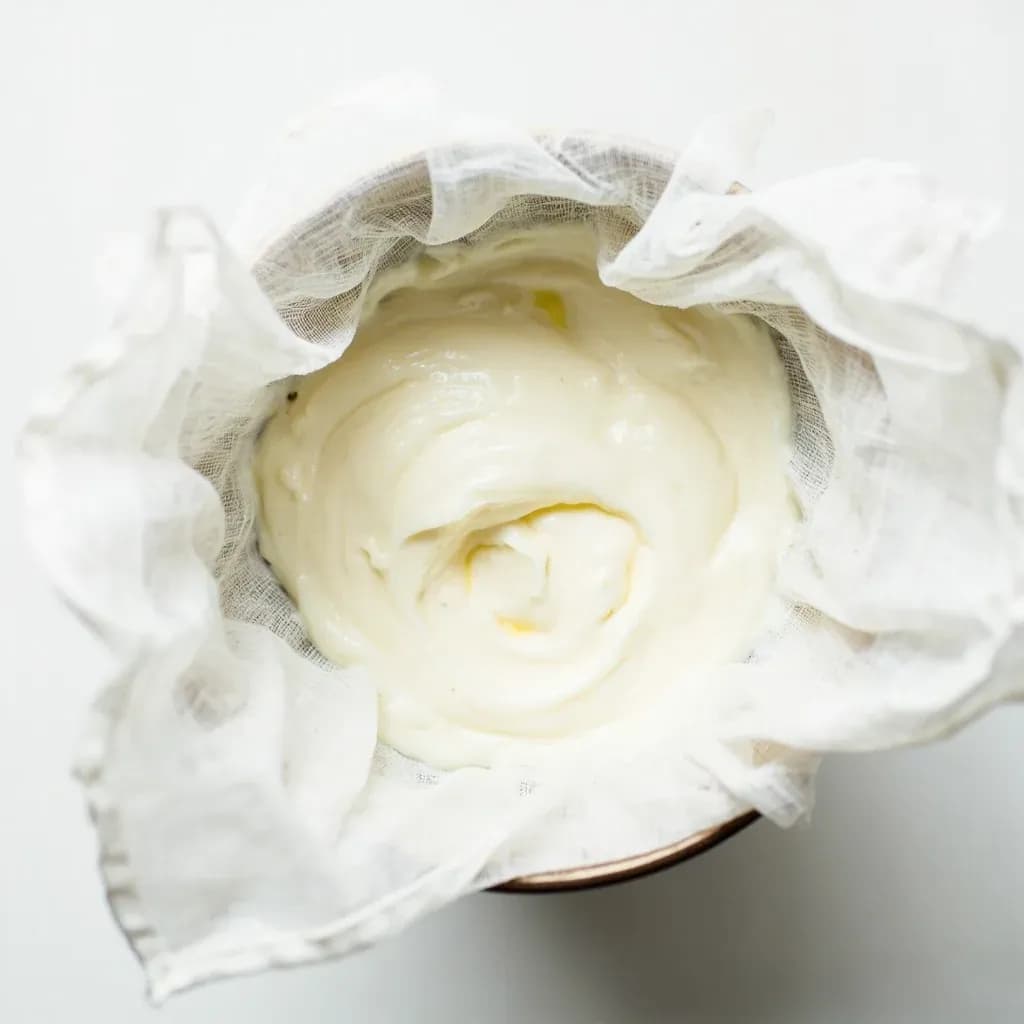
Draining whey from yogurt through cloth to thicken it into labneh or fresh cheese.
Straining yogurt hangs or rests it in cheesecloth so the watery whey drips away, leaving a thick, tangy concentrate. A short strain gives Greek-style yogurt while a longer one yields the spreadable Middle Eastern cheese labneh. The same draining principle thickens homemade yogurt and produces fresh cheeses like ricotta when curds are separated from whey.
Straining yogurt is the simple, mostly passive technique that turns ordinary yogurt into labneh — and, taken further, into a sliceable fresh cheese or aged labneh balls preserved in oil. The principle is straightforward: yogurt is a fragile gel of casein proteins suspended in whey (water, lactose, and milk minerals). Suspend that gel over a bowl in a porous cloth, and gravity pulls whey out drop by drop while the protein network tightens. The result is a denser, fattier, more concentrated product with less of the sharp lactic bite of the starting yogurt, because some of the lactic acid and a good deal of the lactose leave with the whey, and the higher relative fat content softens the perception of acidity.
The same quart of yogurt can become a soft, spoonable dip in four to six hours, a classic spreadable labneh in twelve to eighteen, or something approaching a fresh goat cheese after a full day. Push further and the drained labneh can be rolled into balls, dried, and aged in olive oil — a form of preservation that has kept Levantine and North African kitchens supplied through seasons without refrigeration. The technique also yields whey, a genuinely useful byproduct, and underpins strained yogurts and fresh cheeses from across the world.
A few variables govern the outcome: the fat content of the starting yogurt, the fineness of the cloth, the temperature of straining, and most of all, time. Master those, and you can make labneh that suits exactly what you want to do with it — from a poolable dip for za'atar to a sturdy filling for pastries.
- Difficulty
- Easy
Types & varieties
Drained only 4–8 hours; spoonable, often served as a dip with olive oil and za'atar.
Drained 12–18 hours; the classic consistency for spreading on flatbread, stuffing pastries, or finishing soups.
Hand-rolled from well-drained labneh, then packed in olive oil with herbs, Aleppo pepper, or za'atar — a traditional Levantine preserve.
Sun- or air-dried for several days before oiling; the surface firms and the flavor sharpens, approaching a fresh cheese.
Same principle; commercial versions frequently use added milk solids or hydrocolloids (pectin, gelatin) to thicken rather than pure straining.
Icelandic strained yogurt-cheese; traditionally drained through cloth after culturing skim milk, giving a very high-protein result.
Indian strained yogurt (chakkah) used to make shrikhand by sweetening and flavoring with cardamom, saffron, and nuts.
Moroccan aged, salted, fermented dairy made by burying salted, aged labneh balls for months, developing a pungent, almost cheese-rind-like flavor used to season tagines and couscous.
Turkish and Kurdish fresh cheeses that share the drain-the-whey principle; the curd is then salted and brined rather than eaten soft.
How to do it
- 1
Choose and prep the yogurt
Start with plain, full-fat yogurt — whole cow's, sheep's, or goat's all work well. Store-bought cultured yogurt labeled 'plain' is fine, as is homemade. If you plan to salt, stir in ½ to 1 teaspoon fine sea salt per 2 cups of yogurt now; salt firms the curds, deepens flavor, and extends shelf life. Skip the salt if you want a neutral base for sweet applications.
- 2
Set up the straining rig
Place a fine-mesh sieve or colander over a deep bowl with at least 2 inches of clearance below. Line the strainer with two layers of cheesecloth, a square of unbleached muslin, or set the yogurt inside a nut-milk bag resting in the strainer. Make sure the cloth drapes well over the edges so it can be gathered without spilling.
- 3
Pour and gather
Spoon the yogurt into the cloth-lined strainer. Gather the corners of the cloth loosely into a bundle and tie them with twine, or twist the top of a nut-milk bag and secure with a clip. The bundle should hang freely — do not squeeze or press it at this stage.
- 4
Choose hanging or set method
For a thicker, faster result, suspend the tied bundle over a tall jar or pitcher placed in the refrigerator so the dripping yogurt never sits in pooled whey. For a gentler, more hands-off approach, leave the yogurt in the lined strainer over the bowl, also in the refrigerator. Both work; hanging just drains more efficiently.
- 5
Refrigerate and wait
Plan 4 to 6 hours for a soft, spoonable labneh, 12 to 18 hours for a classic spreadable consistency, and 18 to 24 hours for a thick, cream-cheese-like result. Do not strain at room temperature unless you specifically want a sharply sour cheese — warmth lets the cultures keep fermenting as whey drains out.
- 6
Check consistency
Unwrap or lift the cloth at the low end of your target time. The labneh should hold its shape, feel smooth and dense, and spread easily with a knife. If it is still loose and yogurt-like, re-wrap and return to the fridge for another few hours. If you have gone too far, whisk in a tablespoon or two of reserved whey or plain yogurt to loosen it back up.
- 7
Transfer, season, and store
Spoon the labneh into a bowl or storage container and smooth the top. Either cover it with a ½-inch layer of olive oil to seal it from air (the traditional method, also protects against surface mold) or fold in minced garlic, chopped herbs, za'atar, harissa, or a glug of olive oil at this point. Reserve the drained whey in a jar. Refrigerate in a sealed container for 2 to 3 weeks. Labneh does not freeze particularly well — thawed texture tends to weep — but it can be whisked back to a usable spread if needed.
The Whey Question
A quart of yogurt yields roughly two cups of pale, slightly yellow-green whey — the most commonly wasted ingredient in any kitchen that strains yogurt. It is mildly acidic, around 4–5% lactose, and rich in milk proteins and minerals, which makes it useful in several directions. Most cooks reach for it in baking first: substitute whey for some of the water or milk in a bread dough, and you get a tangier crumb, more browning, and a more open structure. It works just as well in pancake and waffle batter, in béchamel-style sauces, and in any soup or stew where a splash of milk is called for.
- Use whey in place of water or milk in bread doughs, pizza doughs, and biscuit recipes for tang and better browning.
- Add a ladle to lentil, squash, or vegetable soups as a creamy, slightly sour finish.
- Blend into smoothies, especially with fruit and a pinch of salt — the acidity brightens flavor.
- Use as a brine for chicken or pork, or as a starter culture liquid for lacto-fermented vegetables.
- Add a splash to cooked grains, risottos, or polenta just before serving for a tangy richness.
Time and Temperature: The Two Levers
Of every variable in this technique, time and temperature matter most. Straining in the refrigerator, between 35 and 40°F, gives a clean, mildly tangy flavor and a smooth texture. Straining at room temperature lets the live cultures keep fermenting as the whey drains, which produces a noticeably sharper, more sour labneh — sometimes desired, often not. As a rule, strain cold unless you are deliberately making a sour cheese. Time is the dial that takes you from yogurt-like to cream-cheese-like: check at 6 hours, then decide, because the change continues smoothly rather than in sudden steps.
Cloth and Equipment
What you strain through shapes the result. A loose-weave cotton towel drains quickly but lets some solids escape, so the labneh is slightly thinner and the whey cloudier. A fine cheesecloth (two layers) or a nut-milk bag gives a tighter strain, a denser product, and a clearer whey. Unbleached muslin sits between the two. Whichever you use, rinse it well, sterilize it between batches, and never squeeze a partly drained bundle — pressure forces fine curds through the weave and leaves the labneh grainy. For the cleanest setup, tie the cloth into a bundle and hang it from a wooden spoon over a tall jar, so the dripping yogurt never sits in pooled whey.
Common uses
Tips & pitfalls
- Use full-fat yogurt. Low-fat versions strain thinner and can turn rubbery once drained.
- Strain in the refrigerator, not on the counter. Room-temperature straining lets the cultures keep working, producing a sharply sour labneh that often reads as off-flavor.
- Salt the yogurt before straining. Salt firms the protein network, deepens flavor, and noticeably extends keeping time in the fridge.
- Resist the urge to squeeze the bag. Early pressure forces fine curds through the cloth and leaves the labneh grainy. Let gravity do the work, especially in the first few hours.
- Check at 6 hours, then decide. The texture moves steadily from yogurt-like to cream-cheese-like — you have a wide window and can stop when you like what you see.
- Reserve the whey. It is mildly acidic, full of lactose and milk proteins, and is one of the most useful byproducts in the kitchen, from bread dough to soup to lacto-fermenting brines.
- Fold flavorings in after straining, never before. Garlic, fresh herbs, and spices will turn muddy and off-flavor during the long drain.
- For labneh balls, drain the labneh until very thick, then let it sit uncovered in the fridge for 2 to 3 days to dry further before rolling in herbs and packing in olive oil.
Good to know
- Also known as
- Labneh, labne, labni, labaneh; strained yogurt; yogurt cheese
- Category
- Straining / fresh cheesemaking (cold, passive)
- Starting yogurt
- Plain, full-fat yogurt (≥5% fat); cow, sheep, or goat milk all work
- Yield
- Roughly 40–50% of starting volume (1 quart yogurt → ~1.5–2 cups labneh)
- Straining time
- 4–6 hours for soft; 12–18 hours for spreadable; 18–24 hours for thick, cream-cheese-like
- Straining temperature
- Refrigerator, 35–40°F / 2–4°C, to prevent over-fermentation
- Final moisture
- Roughly 60–70%, down from yogurt's ~85%
- Storage
- 2–3 weeks refrigerated in a sealed container; traditionally sealed under a layer of olive oil
Also called
Straining Yogurt (for Labneh) · Yogurt Making (Tabkh Laban) · Ricotta Draining and Sweetening · Hanging Yogurt
Dishes that rely on it


Related

Confit
Cook slowly submerged in fat for silky tenderness and keeping

Cure
Draw out moisture with salt and time to preserve and concentrate

Pickle
Steep in acidic brine for bright, tangy, crunchy preservation

Ferment
Let friendly microbes transform food into tangy, complex flavor

Marinate
Soak in a seasoned mix to flavor and tenderize before cooking

Brine
Soak in salt water so meat stays juicy and seasoned throughout

Dehydrate
Slowly dry out moisture to concentrate flavor and extend shelf life

Cold-Smoke
Perfume cured food with smoke without cooking it through