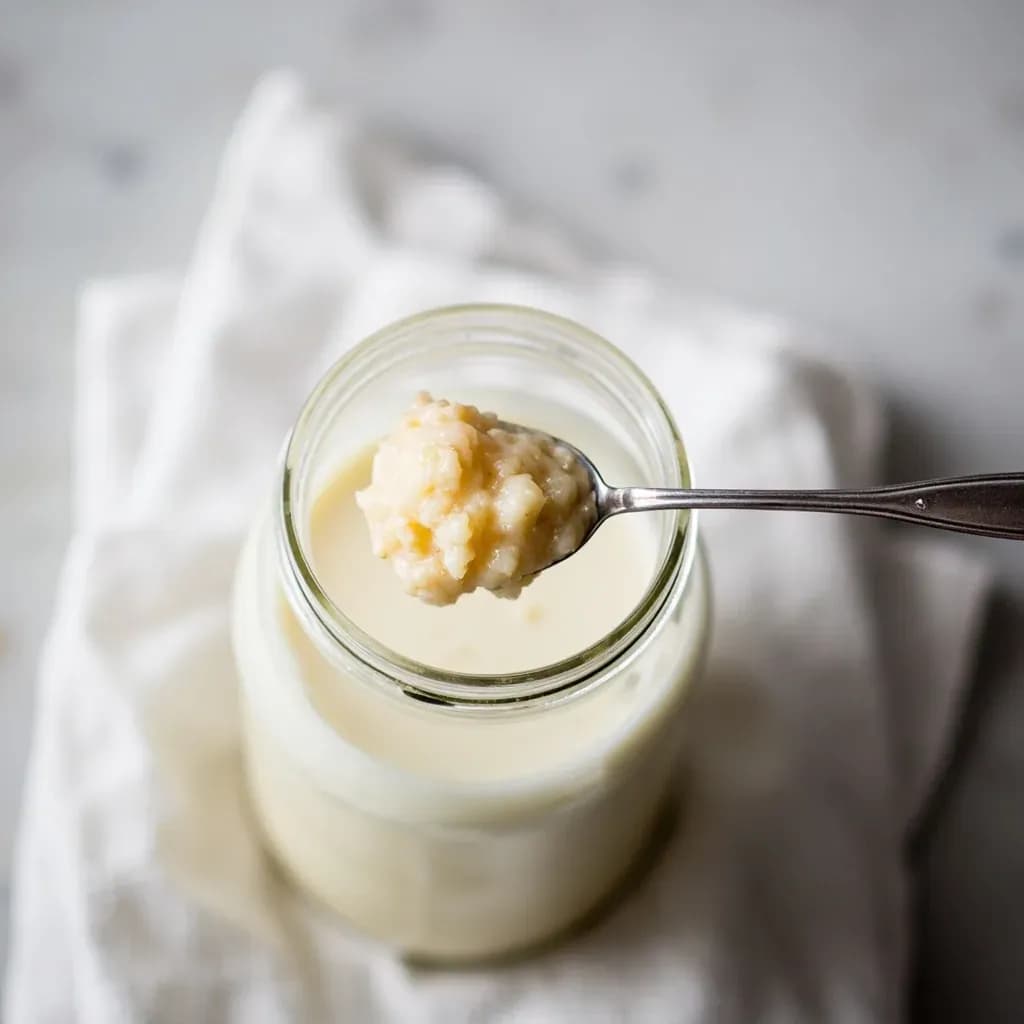
Transform & Preserve
Culturing (Yogurt/Milk)
Adding live cultures to warm milk and holding it warm so it ferments into yogurt or cultured dairy.
Culturing inoculates warm milk with live bacteria, often a spoonful of existing yogurt, then holds it at a steady warm temperature so the cultures ferment the lactose into lactic acid. The acid thickens and tangs the milk into yogurt, kefir, or other cultured dairy over several hours. Maintaining a consistent warm temperature is critical, since too cool stalls the cultures and too hot kills them.
Milk culturing is one of the oldest kitchen transformations and the most rewarding place to begin any exploration of fermentation. A small amount of living bacteria — carried in a spoonful of yesterday's yogurt, a packet of freeze-dried starter, or a handful of kefir grains — is stirred into warm milk and held at a friendly temperature for several hours. The microbes consume the milk's lactose and excrete lactic acid, which does two important things at once: it drops the pH low enough to gel the milk's proteins into a soft set, and it preserves the result against anything that might spoil it. The tang you taste is the acid itself; the body is the protein network that built up around the rising acid level.
Two culture families do nearly all the work a cook will encounter. Thermophilic cultures — Lactobacillus delbrueckii subsp. bulgaricus and Streptococcus thermophilus, the pair that defines yogurt — want steady body heat (108–115°F / 42–46°C) and produce a clean lactic tang and a firm gel. Mesophilic cultures (the blends behind buttermilk, crème fraîche, filmjölk, and viili) ripen at cool room temperature and tend to yield more complex, buttery, or ropy textures; the long strands of Swedish filmjölk and the velvet skin of Finnish viili are both mesophilic signatures. The temperature you can hold steady is the first question to ask when choosing a culture; the flavor and texture you want is the second.
Beyond flavor, culturing extends milk's usable life by a week or more, makes its lactose easier to digest for many people, and produces a genuine byproduct — whey — that ferments vegetables, leavens bread, and seasons soups. The whole setup costs a pot, an accurate thermometer, and patience.
- Difficulty
- Medium
Types & varieties
Set or stirred; thermophilic; tang scales with incubation length.
Yogurt drained through cheesecloth or butter muslin for several hours; thick, high-protein.
Middle-Eastern strained yogurt, often finished with olive oil and za'atar; dense, spreadable, tangy.
Icelandic; strained extensively, very thick and high-protein, mildly tangy.
Long-fermented with Lactobacillus delbrueckii subsp. bulgaricus dominant; sharper, looser set.
Caucasian; uses kefir grains containing bacteria and yeasts; thinner, effervescent, more complex flavor.
Swedish; mesophilic, ropy/stringy texture, mild flavor.
Finnish; mesophilic, surface mold (Geotrichum candidum) gives a velvety skin, mild taste.
Mesophilic; cultured heavy cream; nutty, gentle tang; won't curdle when boiled.
Mesophilic lactic cultures; thin and tangy, distinct from the modern buttermilk made from butter churnings.
How to do it
- 1
Choose your milk
Start with whole or 2% cow's milk for the creamiest set; goat, sheep, and buffalo milk also work and yield distinct flavors. If using raw milk, the existing microflora can fight your starter, so heat it well. Avoid ultra-pasteurized (UHT) milk when possible — it tends to give a soft, sometimes slimy set.
- 2
Heat to denature
Pour the milk into a heavy-bottomed pot and heat slowly to 180°F (82°C), stirring occasionally to prevent scorching. Hold at this temperature for 5–10 minutes. This denatures the whey proteins so they form a fine network that traps water and yields a firm, smooth set rather than a watery one. Skipping this step is the most common reason for soft, weeping yogurt.
- 3
Cool to inoculation temperature
Remove from heat and cool to 108–115°F (42–46°C) for a standard thermophilic yogurt, or to about 70°F (21°C) for a mesophilic culture. An ice bath in the sink cuts cooling time dramatically. Rushing this step is risky: too hot kills the culture and the batch will not set properly; too cold just slows things down.
- 4
Inoculate
Whisk in either 2 tablespoons of live plain yogurt per quart/liter of milk (check the label for 'live and active cultures' — avoid yogurts with added starch, gelatin, or heat-treated cultures) or one packet of freeze-dried yogurt starter. Stir gently but thoroughly so the culture is evenly distributed.
- 5
Incubate undisturbed
Pour into clean jars or keep the milk in the pot. Maintain 108–115°F for 4–12 hours without moving or stirring. Options include an oven with the light on, a cooler filled with 115°F water, an Instant Pot on the yogurt setting, a pre-warmed thermos, or the pot wrapped in a thick towel inside a turned-off oven. Don't peek — every drop in temperature slows the culture, and jostling breaks the forming curd.
- 6
Check the set and chill
At 6 hours, gently tilt the container. The yogurt should hold its shape with a slight jiggle. If you like it mild, stop here; for a tangier Bulgarian-style, go 10–12 hours. Once it tastes right, refrigerate immediately to halt fermentation. The texture will firm up further as it chills.
- 7
Optional: strain for Greek or labneh
Line a fine-mesh sieve with cheesecloth (or a clean, thin cotton kitchen towel) and set it over a bowl. Spoon in the chilled yogurt and refrigerate 2–4 hours for thick Greek-style, 8–12 hours for dense labneh. Reserve the whey — it is excellent for bread dough, soups, or starting a lacto-ferment.
- 8
Store and maintain the culture
Transfer finished yogurt to a clean container, seal, and refrigerate. Use within 10–14 days. If you intend to use it as a starter for the next batch, reserve 2–3 tablespoons in a small jar in the fridge; refresh the chain every 5–7 batches with a fresh commercial yogurt or a new packet of freeze-dried culture, as successive generations gradually lose vigor.
Mesophilic and thermophilic, in practice
The temperature you can hold steady is usually the deciding factor. A kitchen oven with the light on, an Instant Pot on its yogurt setting, or a pot wrapped in a towel inside a turned-off oven will hold a thermophilic 110°F easily; for a mesophilic ferment, set the pot on the counter and forget about it for 18–24 hours. Flavor follows: thermophilic ferments taste sharper and cleaner, mesophilic ferments rounder and more buttery. Texture follows too — filmjölk's long strands, viili's Geotrichum skin, and the soft fizz of kefir (where yeasts ride along with the bacteria) all need their native temperature range to develop. If you're new to culturing, classic yogurt is the most forgiving place to start; once you have a working method, branch into a mesophilic culture for a different flavor profile.
Working with the whey
Straining yogurt gives up roughly half its volume as whey, and that whey is too useful to pour out. At about 0.5% protein and 4–5% lactose, and still rich in live cultures, it slips into bread dough — replace 10–30% of the water for a tender, faintly tangy crumb — into soups and grain porridge, and into the start of any lacto-ferment. Pour it over shredded cabbage as a starter brine, use it to feed a sluggish sourdough, or freeze it in ice cube trays and drop a cube into a pan sauce. It keeps a week refrigerated and several months frozen.
Common uses
Tips & pitfalls
- Heat the milk to 180°F (82°C) and hold 5–10 minutes — this single step is the difference between a firm, spoonable yogurt and a soft, weeping one.
- Cool the milk to under 120°F (49°C) before adding culture; hotter milk can kill the bacteria and the batch will not set reliably.
- Use a digital instant-read thermometer; guessing by touch is the most common reason for failure.
- For a noticeably thicker set without straining, whisk in 2–4 tablespoons of nonfat dry milk per quart of milk before heating.
- Longer incubation means more acid and a tangier result — taste at 6, 8, and 10 hours to find your preference.
- Save 2–3 tablespoons from each batch as starter for the next; successive cultures stay vigorous for about 5–7 batches before weakening.
- Ultra-high-temperature (UHT) milk often sets poorly; if it is your only option, add 1 teaspoon of bloomed gelatin per quart or extra nonfat dry milk to compensate.
- Don't disturb the pot while it is incubating; jostling breaks the curd and yields a loose, grainy texture.
- Refrigerate as soon as the yogurt tastes right — fermentation continues at warm temperatures and will over-acidify the batch.
- The whey drained from strained yogurt is a useful ingredient: stir it into bread dough, soup, or use it as the starter brine for a lacto-ferment.
Good to know
- Core mechanism
- Live bacteria convert lactose into lactic acid, which thickens the milk, drops the pH, and produces the characteristic tang.
- Primary thermophilic cultures
- Lactobacillus delbrueckii subsp. bulgaricus and Streptococcus thermophilus for classic yogurt.
- Incubation temperature
- 108–115°F (42–46°C) for thermophilic yogurt; 68–78°F (20–26°C) for mesophilic cultures like crème fraîche, filmjölk, and viili.
- Incubation time
- 4–12 hours for yogurt; 10–12 hours for sharper Bulgarian-style; 18–24 hours for many mesophilic ferments and kefir.
- Milk heating target
- 180°F (82°C) for 5–10 minutes, to denature whey proteins for a firm set.
- Inoculation rate
- 2 tablespoons of active yogurt, or one packet of freeze-dried starter, per quart/liter of milk.
- Yield
- Roughly 1:1 by volume; straining to Greek-style or labneh yields about half, with whey as a byproduct.
- Storage
- Refrigerated at 40°F (4°C) or below, 7–14 days; frozen 1–2 months.
Also called
Culturing · Ripening the Milk · Setting Yogurt
Dishes that rely on it


Related

Confit
Cook slowly submerged in fat for silky tenderness and keeping

Cure
Draw out moisture with salt and time to preserve and concentrate

Pickle
Steep in acidic brine for bright, tangy, crunchy preservation

Ferment
Let friendly microbes transform food into tangy, complex flavor

Marinate
Soak in a seasoned mix to flavor and tenderize before cooking

Brine
Soak in salt water so meat stays juicy and seasoned throughout

Dehydrate
Slowly dry out moisture to concentrate flavor and extend shelf life

Cold-Smoke
Perfume cured food with smoke without cooking it through