Prep & Assembly
Sweating Aromatics
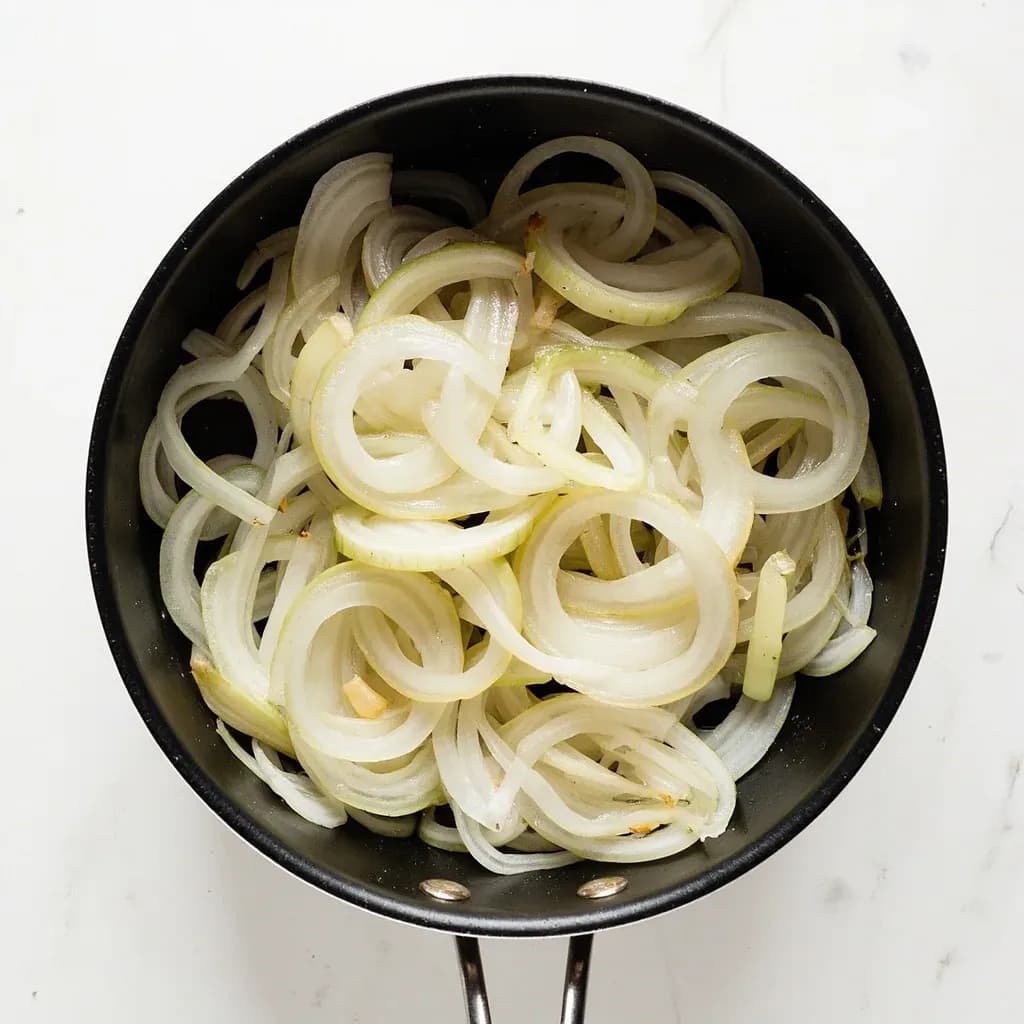
Softening onions and aromatics gently in fat until translucent without coloring.
Sweating aromatics cooks onion, garlic, and other base vegetables slowly over gentle heat, with or without a little fat, until they soften and turn translucent but never brown. It releases their moisture and tempers their raw bite to build a sweet flavor foundation for stews, sauces, and rice dishes. A lid or low flame keeps the temperature down so the vegetables steam-soften rather than caramelize.
Sweating aromatics is the gentle softening of onions, carrots, celery, garlic, and similar flavor-builders in a little fat over low heat, until they turn translucent and tender without picking up any color. The point is to extract pure vegetal sweetness and body — not the roasted, nutty notes that come from browning. In practical terms, you are cooking vegetables in their own released moisture, using fat only as a heat-transfer medium and a flavor carrier. Hold a finished piece of onion up to the light and you should be able to see through it; that glassy translucency is the visual signature of a successful sweat.
The technique matters because nearly every long-cooked dish — stocks, soups, stews, braises, curries, pan sauces, risotto — begins with an aromatic base, and the color of that base dictates the color and flavor of everything that follows. Sweat too hot and the Maillard reaction kicks in, locking in browned, bitter notes that cannot be undone. Sweat too cool and the vegetables never collapse, leaving raw edges and a watery pot. The skill is heat discipline: keeping the pan in a narrow band where cellular water releases and pectins soften, but sugars stay below caramelization and amino acids stay below browning.
Behaviorally, salt draws moisture out of the cells, the fat conducts heat evenly, and a partially covered lid traps just enough steam to keep the vegetables from drying out and sticking, while letting excess vapor escape so they sauté rather than boil. The payoff is a sweet, mellow, almost creamy aromatic foundation that blends seamlessly into sauces, broths, and braises — the kind of base a cook can build almost anything on.
- Difficulty
- Easy
Types & varieties
Vegetables in fat with the lid ajar and an occasional splash of water; the standard approach
No added fat; vegetables release and cook in their own water, common for leeks and mushrooms
Butter alone or with oil for richer flavor; watch the milk solids, which color around 150°C
Neutral or olive oil, preferred for longer cooks because of the higher smoke point
2:1:1 onion to carrot to celery by weight, the foundational French aromatic base
Equal parts onion, celery, and bell pepper, the Cajun and Creole equivalent of mirepoix
Onion, garlic, and pepper, often with tomato, cooked gently into a thick flavor base
A splash of liquid added near the end to lift fond and finish softening the vegetables
How to do it
- 1
Prep the aromatics
Peel and dice the onions, carrots, celery, peppers, or other aromatics into a fairly uniform ½ cm (¼-inch) dice so they soften at the same rate. Mince or thinly slice garlic separately and set it aside for the end.
- 2
Heat the fat
Add 1–2 tablespoons of butter, oil, or a mix to a heavy skillet over medium-low heat. Warm until the fat shimmers or the butter just stops foaming. It should not smoke.
- 3
Add the harder vegetables first
Stir in carrots, celery, leek whites, or bell pepper. Cook gently for 2–3 minutes, stirring, until they look glossy and begin to soften.
- 4
Add onions or shallots with salt
Stir in the diced onion and a pinch of salt. The salt draws out moisture and helps the vegetables collapse without sticking to the pan.
- 5
Cover partially and sweat
Set the lid ajar so steam can escape. Drop the heat to low. Cook 8–12 minutes, stirring every couple of minutes, until the onions are fully translucent, soft, and sweet, with no color on them.
- 6
Add delicate aromatics
Stir in garlic, fresh herbs, or chili in the last 1–2 minutes so they cook through and mellow without scorching.
- 7
Adjust and proceed
If the pan looks dry, splash in a tablespoon of water or stock to loosen any stuck bits. Use immediately as a base, or deglaze and continue with your recipe.
The science of a clean sweat
What separates a sweat from a sauté is purely thermal discipline. Vegetable cells are roughly 85–95% water and held together by pectin. At around 70–80°C, cell walls begin to soften and that water escapes as steam. A properly sweated vegetable is essentially poaching in its own moisture, and the fat in the pan is there to conduct heat evenly and carry fat-soluble flavor compounds, not to fry.
Browning only enters the picture above roughly 140–165°C, when sugars begin to caramelize and amino acids react with reducing sugars in the Maillard reaction. The cook's job is to keep the pan below that band — usually by lowering the burner once the vegetables go in, by using a heavy pan that buffers temperature swings, and by leaving the lid ajar so evaporating water carries heat away. Salt accelerates the process by osmosis, pulling water out of the cells faster, which is why a pinch of salt at the start shortens cooking time noticeably.
- Cell walls soften and rupture between 70–80°C, releasing the water that gently cooks the vegetable
- Maillard browning and caramelization begin above ~140–165°C; staying below this band is the entire discipline
- Salt speeds the sweat by drawing water out of cells through osmosis
- A heavy pan buffers hot spots and recovers slowly from heat spikes
Sweating versus its neighbors
Three techniques get confused with sweating, and knowing the differences makes you a better cook. Sautéing uses higher heat to drive off moisture quickly and develop color on the surface; the vegetables brown and the pan builds fond. Caramelizing is the slow, patient version — 30 to 60 minutes or more — in which sugars break down and the vegetables turn deep gold to mahogany, with profound sweetness. Braising, by contrast, is about submerging food partially in liquid for a long, gentle cook, and a sweat is often its opening act.
The practical takeaway: choose sweating when you want a clean, sweet, pale base that will be colored or finished later. Choose sautéing when you want fond and toasted flavor in the same step. Choose caramelizing when onion sweetness is the dish.
- Sweating: 8–15 minutes, low heat, no color, translucent finish
- Sautéing: medium-high heat, quick browning, fond on the pan
- Caramelizing: 30–60+ minutes, deep golden brown, intensely sweet
- Braising: partially submerged, low and slow, usually starts with a sweat or sear
Common uses
Tips & pitfalls
- Dice uniformly so every piece softens at the same rate; mismatched cuts leave you with some pieces raw and others turning to mush.
- Stagger the additions — put carrots, celery, and leek whites in 2–3 minutes before the onions so everything finishes together.
- Hold the garlic for the last 1–2 minutes; garlic burns in seconds and turns acrid before the onions are even close to done.
- Salt early and lightly. It pulls moisture out of the cells, speeds the sweat, and seasons the vegetables all the way through.
- If the pan dries out, add a tablespoon of water rather than turning up the heat. Cranking the burner is the fastest way to cross from sweat into sauté.
- Keep the lid askew, not sealed. A tight lid traps too much steam and the vegetables turn soggy and grey instead of glossy and translucent.
- A common mistake is walking away. A sweat stalls without stirring and then catches; stir every couple of minutes and check the underside of the vegetables for any hint of gold.
- Stop when the vegetables smell sweet and look glassy. Carryover heat will finish them, and a slightly underdone sweat is better than one that has tipped into browning.
Good to know
- Technique type
- Low-moisture, low-heat vegetable softening
- Goal
- Translucent, tender aromatics with no browning
- Typical heat
- Low to medium-low, roughly 120–160°C / 250–325°F pan temperature
- Fat amount
- Enough to coat the pan, usually 1–2 tbsp per 1–2 cups of vegetables
- Pan choice
- Heavy-bottomed skillet, sauté pan, or Dutch oven
- Time
- 8–15 minutes for diced onions; up to 20–25 minutes for mirepoix carrots and celery
- Cover
- Partially covered to trap steam without stewing
- Difference from sautéing
- Sweating avoids browning entirely; sautéing aims for color
- Difference from caramelizing
- Caramelizing runs 30–60+ minutes to develop Maillard and sugar breakdown; sweating stops well before color appears
Also called
Suer · Sofreír · Zpěnění Cibule · Onion Sweating · Softening Aromatics
Dishes that rely on it
Related

Whisk
Beat ingredients smooth and aerated with a looping wire motion

Sift
Pass dry ingredients through mesh to aerate and remove lumps

Strain
Pour through mesh to separate solids from liquid for a smooth result

Filter
Pass liquid through fine material to clarify out the smallest particles

Rice
Press cooked potatoes through small holes for fluffy, lump-free texture

Mash
Crush soft cooked food into a rustic, creamy purée

Grind
Crush food into a coarse to fine texture, from spices to meat

Grate
Shred food into fine bits against a sharp-toothed surface