Knife Skills
Wedging
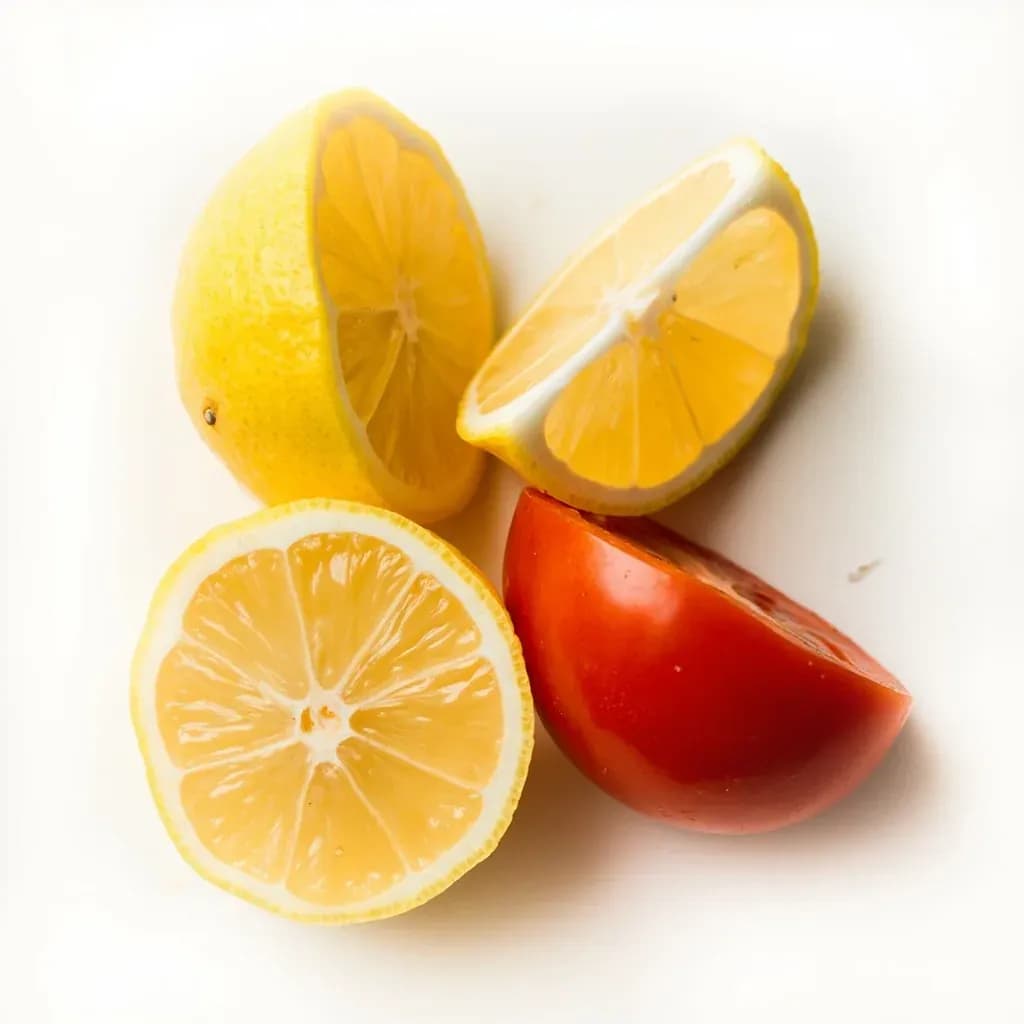
Cutting a round food into triangular wedges by halving and then cutting from the center outward.
Wedging cuts round produce such as lemons, tomatoes, onions, apples, and potatoes into triangular segments by halving the food and then slicing each half from the center outward. The shape is sturdy and uniform, ideal for roasting, garnishing drinks, salads, and serving citrus. For round wheels or larger items the food is first halved through the equator, then radially sliced into even points.
Wedging is the foundational cut for any round food — citrus, tomatoes, apples, shallots, small onions, even cooked potatoes — that needs to be split into manageable, visually appealing triangular pieces. The defining geometry is simple: each wedge tapers from a pointed tip at the food's core to a wider base at the skin or outer edge. That pointed end is what makes a wedge visually distinct from a slice or a chunk, and what makes the cut so well suited to garnishes, crudités, and casual fruit service.
What separates a good wedge from a ragged one is the principle of working from a stable base. Round foods roll under a blade, and the moment a knife meets an unstable surface the cut wanders, juice is squeezed out, or fingers get nicked. The cure is the two-step logic that defines the technique: halve first, then cut from the center of the newly exposed flat face outward. The first cut transforms a rolling sphere into a stable half; every cut after that is performed with the flat face down on the board. Once you internalize this pattern, wedging transfers effortlessly to nearly every round item in the kitchen.
Wedging is the everyday cousin of citrus segmenting (supreming). Where supreming is a meticulous process that strips the membrane away to leave pure flesh, wedging leaves the skin, pith, and membrane in place. That trade-off — speed and structural integrity for membrane-free purity — is why wedging is the default choice for garnishes, drinks, cheese boards, and any context where a little structural heft is welcome.
- Difficulty
- Easy
Types & varieties
Halve the item, set the flat side down, then halve each half again. The standard cut for large grapefruits, halved tomatoes for plating, and large apples.
Halve the item, then cut each half into three equal wedges. The workhorse shape for lemons, limes, and medium tomatoes.
Quarter the item first, then halve each quarter. Used for small citrus, shallots, cocktail garnishes, and any context where a smaller, more refined wedge is wanted.
Halve the item, then cut each half into six narrow wedges. Reserved for very small fruits like kumquats or for fine, decorative garnishes.
For seed-bearing citrus, each finished wedge is sliced in half again lengthwise. This cuts through the central seed column so the seeds can be brushed or picked free in a single pass, much faster than plucking them out of intact wedges.
How to do it
- 1
Stabilize the food
Place the item on the board and steady it with your guiding hand in a claw grip — fingertips curled under, knuckles pressed against the side of the food. For tall, round items like lemons and limes, trim a thin slice off one end first to create a flat base.
- 2
Make the first halving cut
Slice straight down through the center of the item to split it into two equal halves. For citrus, cut across the segments (pole to pole). For apples, pears, and tomatoes, cut through the equator. The blade should pass through the core or center in a single, confident stroke.
- 3
Set the flat side down
Lay each half flat on the board with the cut face down. The flat face now grips the board and prevents rolling for every cut that follows. Reposition your guiding hand so the knuckles guide the blade along the side of the food.
- 4
Cut from the center outward
With the knife tip pointed at the center of the cut face and the heel of the blade at the outer edge, slice downward to separate one wedge. Angle the knife so the tip reaches the center of the food and the heel drops at the far edge; this produces the clean triangular shape with a pointed tip.
- 5
Repeat to reach the desired number of wedges
Rotate the half and make the same center-outward cut as many times as needed. Halve each half once more for four wedges total; cut each half into thirds for six; quarter the item first and then halve each quarter for eight; cut each half into six narrow slices for twelve.
- 6
Transfer or plate
Slide the knife blade under the wedges to lift them, or pick them up by the skin edge. For citrus garnishes, cut a small slit in the flesh of each wedge so it can perch on the rim of a glass, or fan several wedges around the edge of a plate.
Why the first halving matters
Almost every problem a cook has with wedging — a torn tomato skin, a crushed lemon half, a slip and a cut finger — traces back to skipping or rushing the first halving. The moment a knife meets a round surface, two things happen: the food tries to roll, and the blade tends to skate sideways along the curve. Halving solves both at once. The exposed flat face provides a wide, grippy surface that resists rolling, and it gives the knife a definitive target — a line straight across the diameter — rather than a guess at where the equator lies.
- Trim a thin slice off one end first if the item is especially round and tall (lemons, limes, large onions). This creates a stable base so the item sits flat while you make the first halving.
- For citrus, the halving line runs across the segments (pole to pole), not across the stem and blossom ends. Cutting pole-to-pole exposes the maximum number of segments in each wedge.
- A 6- to 8-inch chef's knife is right for grapefruit and large apples; a 3- to 4-inch paring knife gives more control for limes, shallots, and small onions.
Wedging versus supreming
Both cuts begin with a citrus fruit and end with edible pieces, but they diverge sharply in purpose and execution. Wedging leaves the membrane, pith, and skin intact; supreming removes all of them, leaving only the juice vesicles. The wedge is the cut you want when structure, juiciness, and visual identity matter — a lemon wedge on a fish plate, a lime wedge beside a beer, a grapefruit wedge beside a shrimp cocktail. The supreme is the cut you want when pure, membrane-free flesh is the goal — a citrus salad, a segmented garnish that will sit in a vinaigrette without bleeding bitter pith.
- Wedging is fast (under 30 seconds per fruit) and uses a chef's or utility knife. Supreming is slow (1–2 minutes per fruit) and traditionally uses a paring knife.
- Wedges hold their shape on a plate or rim for the length of a meal. Supremes collapse and bleed juice as soon as they are cut.
- Wedging leaves the seed cluster embedded in each piece; the double-halved wedge trick cuts through it afterward. Supreming releases seeds during the segmenting process — they come away with the membrane or are plucked out as each segment is freed.
Wedging non-citrus items
The same logic — halve, lay flat, cut from the center outward — applies to almost any round vegetable or fruit, with a few adjustments. Tomatoes benefit from a serrated blade because their skins resist a straight-edge knife. Apples and pears wedge cleanly but brown quickly once cut, so they should be wedged just before service or dipped in acidulated water. Cooked potatoes can be wedged into rustic steak-fry shapes. Shallots and small onions wedge best with the root end left intact during the first cut, which keeps the layers from separating before you reach the final wedge.
- Tomatoes: use a serrated knife; cut pole-to-pole, not across the stem scar, to expose the most flesh per wedge.
- Apples and pears: dip in lemon water after wedging, or hold off cutting until just before plating.
- Cooked potatoes: let them cool slightly so they hold their shape; a sharp knife is essential — a dull blade will mash the starchy surface rather than slice through it.
- Shallots and small onions: leave the root end intact during the first halving; trim it off only after the wedges are cut.
Common uses
Tips & pitfalls
- Use a sharp knife — a dull blade crushes the flesh and squeezes juice out of citrus before the cut is finished.
- Make the first halving cut and lay the flat side on the board before any further cuts; this kills the rolling and gives you a safe, stable surface for every cut that follows.
- For lemons and limes, cut a thin slice off one end first to create a stable base, then stand the fruit on that flat end to make the initial halve safer and more accurate.
- Angle the knife so the tip points down toward the center and the heel drops at the far edge of the cut; this produces a clean triangular wedge with a sharp point rather than a flat-topped chunk.
- Keep your guiding hand in a claw grip with knuckles against the side of the blade — never curl fingertips over the food or rest the index finger on top of the blade.
- For tomatoes, use a serrated knife to slice through the skin without tearing or dragging it; a straight-edge knife tends to grab and tear.
- For seed-bearing citrus, slice each finished wedge in half again lengthwise to release the seeds in a single pass — far faster than picking them out one by one.
- Cut citrus wedges just before serving; exposed flesh dries out and oxidizes within minutes, leaving a dull, leathery surface.
- For onions and shallots, leave the root end intact during the first halving so the layers hold together while you cut the wedges; trim the root end only after the wedges are separated.
Good to know
- Category
- Knife Skills / Basic Cuts
- Difficulty
- Beginner
- Typical time
- 10–30 seconds per item
- Equipment
- Chef's knife for larger items; paring knife for small items like limes and shallots; serrated knife for tomatoes and other thin-skinned fruits
- Shape produced
- Triangular pieces with a pointed tip at the center and a wider base at the skin or outer edge
- Common foods
- Lemons, limes, oranges, grapefruit, tomatoes, small onions, shallots, apples, pears, plums, cooked potatoes, hard-boiled eggs
- Standard yields
- 4 wedges (halve, then halve again), 6 wedges (halve, then cut each half into thirds), 8 wedges (quarter, then halve each quarter), 12 wedges (halve, then cut each half into six)
- Related cuts
- Slicing, dicing, segmenting (supreming), chopping
- Hand position
- Claw grip on the guiding hand; pinch grip on the knife handle, with the thumb and forefinger clamping the blade just ahead of the bolster
Also called
Wedging (Cutting Wheels) · Wedge Cut · Cutting Wheels
Related

Chop
Cut into rough, irregular pieces — the everyday workhorse cut

Dice
Cut into uniform cubes for even cooking and a tidy look

Mince
Cut as fine as possible so flavor melts evenly into the dish

Slice
Cut into even, flat pieces for consistent cooking and presentation

Julienne
Cut into thin matchsticks for fast cooking and elegant garnish

Brunoise
Cut into tiny, precise cubes — the finest dice in the kitchen

Chiffonade
Roll and slice leafy greens into delicate ribbons

Batonnet
Cut into tidy sticks, thicker than julienne — think classic fries