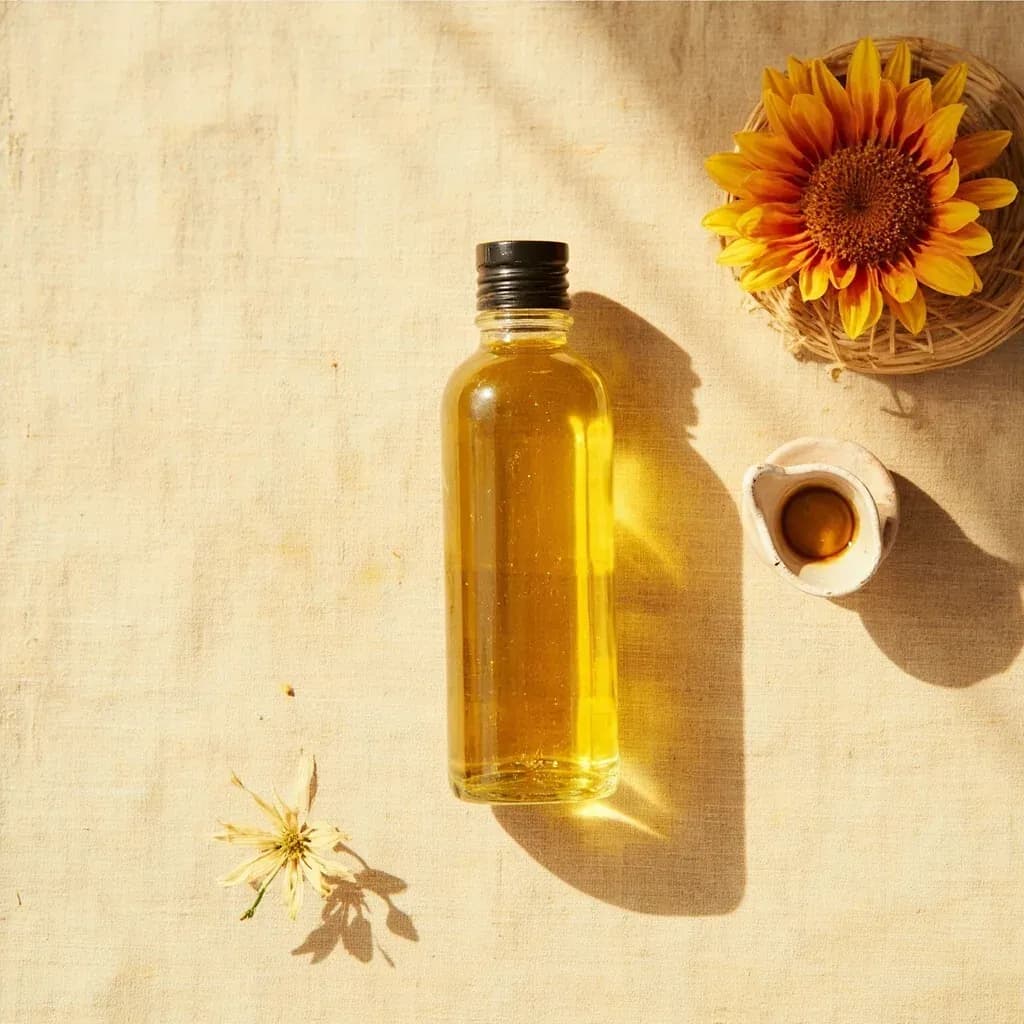
Oils & Fats
Safflower Oil
Very neutral, high-smoke-point oil from safflower seeds — a clean workhorse for deep-frying, roasting, and baking where you want no flavor of its own.
Safflower oil is pressed from the seeds of Carthamus tinctorius, a spiny, thistle-like annual that humans have cultivated for at least 3,500 years — first for the vivid red-orange pigments in its flowers (carthamin, used as a textile dye and food colorant) and only later for its fat. The plant is not related to saffron; the name overlap comes from the long historical practice of using dried safflower petals as an inexpensive saffron substitute, and the confusion still shows up in supplement bottles sold as "saffron oil." What cooks care about is the seed: a pale, oily kernel that yields a clear, light-colored liquid fat with very little of its own personality.
What distinguishes safflower oil from most other culinary oils is its refusal to be noticed. Refined safflower is among the most neutral fats in the pantry — nearly colorless, almost odorless, and a clean canvas that won't fight a vinaigrette, a fry, or a cake batter. That neutrality, paired with a high smoke point in the modern high-oleic hybrid, made it a long-standing workhorse of commercial mayonnaise, margarine, and frying shortenings before it became a familiar supermarket item. In professional kitchens it's valued less for what it brings to a dish than for what it leaves alone.
How it behaves in the pan depends entirely on which type you buy. The traditional high-linoleic variety is dominated by omega-6 polyunsaturates, has a moderate smoke point around 440 °F / 225 °C, and turns rancid faster than most refined oils. The high-oleic hybrid — bred over the last few decades — runs roughly 75–80% monounsaturated oleic acid, tolerates temperatures above 500 °F / 260 °C, and keeps for many months. Unrefined or cold-pressed versions retain their color, a faint nutty character, and more of their native micronutrients, but their smoke point collapses to roughly 225 °F / 107 °C, so they belong in dressings and drizzles, not in a hot skillet.
- Measured in
- ml
- Storage
- Pantry
Find it in
Suits
Types & varieties
Modern hybrid bred for ~75–80% monounsaturated oleic acid. High smoke point (~500 °F / 260 °C), excellent shelf stability, neutral flavor. The default choice for frying, roasting, and commercial kitchens.
The traditional type, dominated by omega-6 linoleic acid. Lower smoke point (~440 °F / 225 °C), shorter fry life, more prone to rancidity. Once marketed as a 'heart-healthy' oil; now mostly displaced by the high-oleic version.
An intermediate hybrid with a roughly even split of linoleic and oleic acid. Less common in retail than the other two.
Standard commercial version — solvent-extracted, bleached, and deodorized for a clean flavor and high heat tolerance.
Mechanically pressed without chemical solvents. Retains more color, a soft nutty note, and some micronutrients, but drops to a low smoke point (~225 °F / 107 °C). Treat as a finishing or salad oil.
Which type should you buy?
For most home cooks, the decision collapses to one question: do you need heat tolerance or raw-oil character? If the bottle is destined for the deep-fryer, the roasting pan, or a 425 °F oven, buy refined high-oleic safflower oil — its monounsaturated-dominant fat profile behaves like a mild sunflower or light olive oil and tolerates temperatures most home cooking throws at it. If the bottle is for salad dressings, herb oils, or drizzling over finished dishes, an unrefined or cold-pressed version (high-linoleic or high-oleic, depending on the producer) gives you a faintly nutty character that disappears the moment the oil is refined away. Avoid buying generic supermarket safflower without checking the label — many older or budget bottles are still the high-linoleic type and will smoke well below what you'd expect.
- Read the front label for 'high-oleic' or check the nutrition panel — high-oleic oils show more monounsaturated than polyunsaturated fat.
- Refined high-oleic is the right pick for frying, roasting, and high-heat baking.
- Unrefined/cold-pressed is for dressings and finishing only — its smoke point is too low for cooking.
- If a bottle smells waxy, paint-like, bitter, or crayon-like, it has oxidized — toss it regardless of type.
Common uses
Tips & pitfalls
- Buy refined high-oleic safflower oil for any high-heat application — the high-linoleic version smokes earlier and degrades faster in the pan.
- Don't confuse safflower with saffron. Saffron is the red stigma of a crocus; safflower is a thistle seed. The names have been muddled for centuries, and supplement bottles labeled 'saffron oil' are usually safflower.
- Refined safflower is nearly flavorless by design — reach for extra-virgin olive, toasted sesame, or nut oils when you actually want the oil to contribute flavor.
- Unrefined or cold-pressed safflower has a low smoke point and a noticeable nutty taste; treat it as a finishing or salad oil, not a cooking fat.
- Store tightly sealed, away from heat and light. Omega-6-rich versions oxidize faster than monounsaturated-dominant oils — if the oil smells waxy, paint-like, or bitter, it has gone rancid and should be discarded.
- In baking, swap it 1:1 for canola or sunflower oil to produce a moist, tender crumb; it lacks the slight 'bean' note some people detect in soy or canola.
- When deep-frying, let the oil return to temperature between batches and skim any loose crumbs — safflower oil breaks down faster than saturated fats once contaminated with food particles, especially the high-linoleic version.
- The old 'high-linoleic is healthier' marketing doesn't hold up well in modern kitchens; omega-6 oils oxidize faster than monounsaturated ones, both in the bottle and in the pan, so don't choose them for frying on the assumption that 'polyunsaturated' automatically means 'better.'
Nutrition
Energy
3699 kJ · per 100 g
Where the calories come from
Protein
0g
0% DV
Carbs
0g
0% DV
Fat
100g
128% DV
Fiber
0g
0% DV
Sugars
0g
of which
Sodium
0mg
0% DV
Source · USDA FoodData Central · Oil, safflower, salad or cooking, high oleic (primary safflower oil of commerce)
View on FDC →In the shops
Matched grocery products
No matched grocery products for Safflower Oil yet.
Good to know
- Source
- Seeds of Carthamus tinctorius, a thistle-like annual in the Asteraceae family
- Smoke point (refined high-oleic)
- Approximately 490–510 °F / 255–265 °C
- Smoke point (refined high-linoleic)
- Approximately 440–450 °F / 225–230 °C
- Smoke point (unrefined / cold-pressed)
- Approximately 225 °F / 107 °C
- Flavor
- Very mild and essentially neutral when refined; faintly nutty when unrefined
- Primary fatty acid (high-oleic)
- Oleic acid ~75–80% (monounsaturated)
- Primary fatty acid (high-linoleic)
- Linoleic acid ~70–75% (omega-6 polyunsaturated)
- Storage
- Sealed, cool, dark pantry — 6–12 months once opened; refrigerate unrefined oil to slow rancidity
- Allergens & diet
- Vegan, gluten-free, no major allergens
- Major producers
- India, Mexico, United States (California and the northern Plains), Argentina, Australia
Substitutes
- High-oleic sunflower oil — The closest 1:1 swap — nearly identical neutral flavor, monounsaturated profile, and high smoke point.
- Canola / rapeseed oil — Neutral, high smoke point, widely available and inexpensive; carries a touch more omega-3 than safflower.
- Refined (light) olive oil — Mild flavor and high smoke point; use when you want a hint more body than a fully neutral oil.
- Refined grapeseed oil — Clean, neutral, and high-heat-tolerant — a good match for sautéing and dressings.
- Peanut oil — Higher smoke point and a subtle nutty note; works in frying but adds flavor you may not want.
- Refined avocado oil — Even higher smoke point and equally neutral, though noticeably pricier.
Pairs with
Also called
high-oleic safflower oil
Related
Olive Oil
Fruity, peppery everyday oil for sautéing, dressing, and finishing
Vegetable Oil
Neutral, high-heat oil for frying and all-purpose cooking
Canola Oil
Light, neutral oil for frying, baking, and dressings

Sunflower Oil
Clean, neutral oil for frying and everyday cooking
Sesame Oil
Toasty, aromatic oil — a finishing splash for Asian dishes
Coconut Oil
Fragrant, solid-at-room-temp fat for baking and frying
Peanut Oil
High-heat oil with a faint nutty note — ideal for frying

Lamb Tail Fat
Rich rendered fat from fat-tailed sheep — used as a cooking fat and flavor base in Central Asian and Middle Eastern dishes.