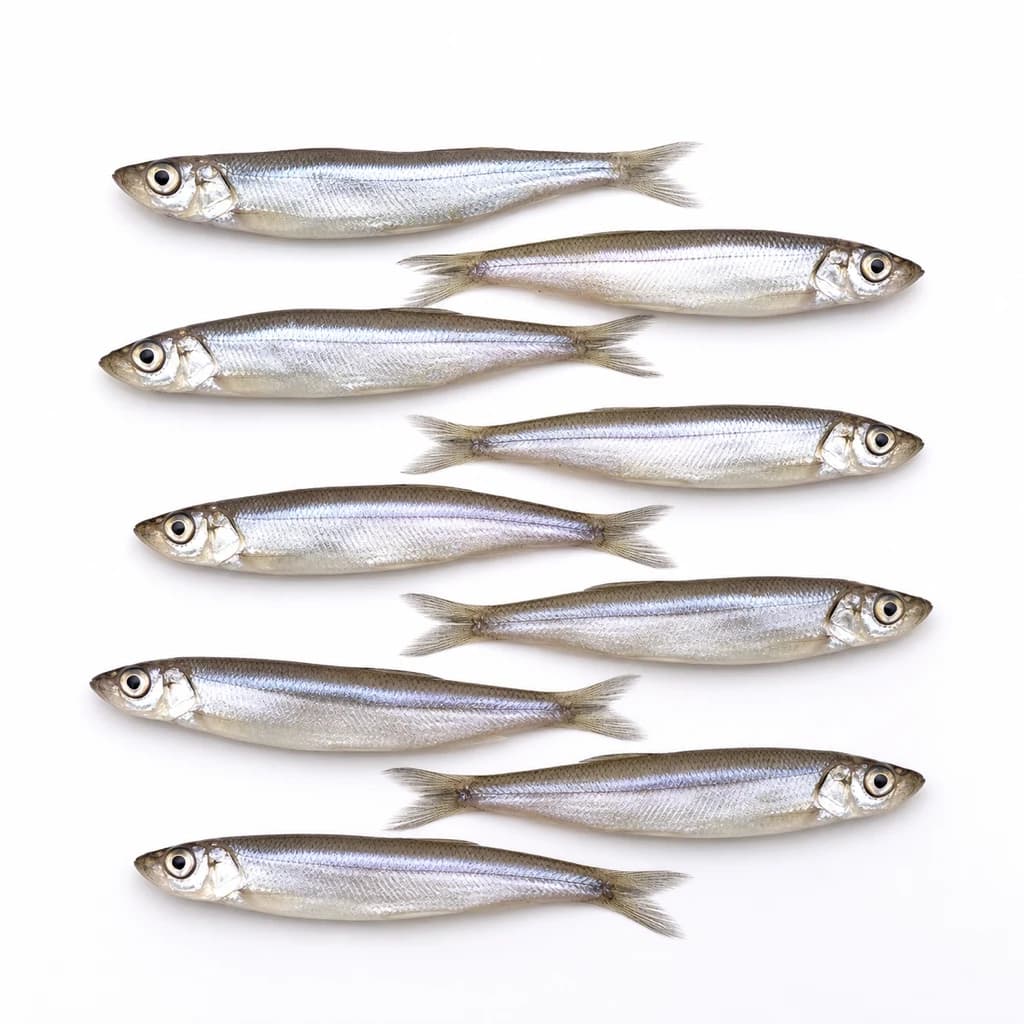
Natural form
Fresh whole vendace: small silver freshwater fish with streamlined body and forked tail.
Shows the fish's distinctive size, coloration, and body shape so readers can identify it on sight.
Proteins
Vendace (Muikku)
Tiny Nordic freshwater whitefish, fried whole and crisp or salted for its prized golden roe.
Vendace is a small silvery freshwater fish from the whitefish family, found in the cold lakes of Finland and Scandinavia. In Finland it is floured and fried whole as muikku, eaten head, bones and all, often with garlic butter. Its delicate orange roe is a celebrated regional delicacy.
Vendace, known in Finnish as muikku, is a small freshwater whitefish native to the cold, clear lakes and rivers of Northern Europe. Rarely exceeding 20 cm, it belongs to the Coregonidae family and is prized for its exceptionally delicate, sweet flesh with a faintly nutty quality and moderate fat content. The fish is almost always cooked whole — head, bones, and all — because the small skeleton softens completely during pan-frying, making every part edible. Beyond the fish itself, the golden-orange roe called muikkunmäti commands equal reverence in Finnish cuisine, commanding premium prices and serving as a seasonal delicacy from September through November when vendace run to spawn.
The texture of vendace is its defining characteristic: soft, fine, and almost creamy when properly cooked, yet capable of developing a shatteringly crisp skin when fried at correct temperature in adequate fat. This combination of tender flesh and crispy exterior is what defines the ideal preparation. The flesh holds together well despite its delicacy, but it turns dry and fibrous if overcooked by even a minute. Vendace is rich in omega-3s and gives the fish its signature richness; preserving this fat during cooking is the difference between a sublime and a disappointing result. The flavor is subtle enough to be overwhelmed by heavy seasoning or aggressive accompaniments, yet substantial enough to stand alongside bold Nordic flavors like rye, dill, and rapeseed oil.
In Finland, vendace is both a cultural icon and a commercial commodity. The annual lake fisheries, particularly on Lake Saimaa, operate under strict quota systems to protect stocks from overharvesting. The British vendace (Coregonus vandesius) found in Cumbrian lakes is a separate, endangered species and plays no role in commercial cooking. Freshness is non-negotiable: vendace deteriorates within hours of death, and even slight delay before cooking produces a fish with dull flavor and mushy texture. When properly handled — ice-dead or alive on the day of catch — vendace rewards simplicity in preparation and restraint in seasoning.
- Measured in
- g
- Storage
- Freezer
Allergens
Types & varieties
European vendace — dominant commercial species in Finnish lakes and the Baltic region. This is the variety you will encounter in markets and restaurants.
British vendace — native to Derwentwater and Bassenthwaite Lake in Cumbria, England. Considered endangered and not commercially harvested; a separate species from the Nordic variety.
Dwarfed, landlocked population endemic to Lake Saimaa, Finland. Smaller in size but produces the same delicate flavor and prized roe; subject to strict quotas.
The Roe: Muikkunmäti
The golden-orange roe of vendace is arguably more celebrated in Finland than the fish itself. Harvested during the autumn spawning run, muikkunmäti commands premium prices and has become a signature ingredient in Nordic fine dining. The roe is sold fresh within days of harvest, lightly salted at 3% by weight to preserve its delicate cellular structure, or frozen for up to three months. Fresh roe has a clean, briny sweetness with a satisfying pop between the teeth; salted roe intensifies the umami while maintaining that characteristic orange-gold color and creamy texture. The roe must be salted within two hours of catch — beyond this window, enzymatic activity breaks down the cellular walls, resulting in a mealy, watery texture that cannot be rescued. Muikkunmäti is traditionally served on buttered rye toast, alongside blinis with crème fraîche, or scattered over boiled potatoes with dill.
- Fresh roe: use within 1–2 days, keep on ice, never freeze — freezing ruptures cells and ruins texture
- Salt within 2 hours at 3% weight; this firms the eggs and extends shelf life to 5 days refrigerated
- Frozen roe: freeze immediately after salting; thaw gently in refrigerator overnight
- Classic serving: on dark rye toast with a drizzle of rapeseed oil and a whisper of dill
Pan-Frying Whole: The Definitive Method
Pan-frying whole is the canonical Finnish preparation and the one against which all others are measured. Success depends on three factors: fish dryness, fat temperature, and restraint in turning. The fish must be absolutely dry — pat with paper towels, season with salt 10 minutes before cooking to draw residual moisture, then pat dry again. Fry in a heavy pan (cast iron is ideal) with at least 1 cm of clarified butter, lard, or a neutral oil with a smoke point above 190°C. Bring the fat to 180–190°C — a drop of flour should sizzle immediately and turn golden in about 30 seconds. Fry skin-side down without moving for 2–3 minutes (longer for larger fish), until the skin is deep golden and releases easily. Turn once only; the second side needs roughly 60–70% of the first side's time. The flesh is done when it turns opaque and releases cleanly from the spine. Serve immediately — vendace does not hold well, and the skin loses crispness within minutes.
- Dry the fish thoroughly: moisture is the enemy of crispy skin
- Fat at 180–190°C: use a thermometer or the flour test
- Turn once only: multiple turns break the skin and cause oil absorption
- Season just before cooking: salt too early draws moisture back to the surface
Common uses
Tips & pitfalls
- Buy alive or ice-dead same day — vendace deteriorates within 24 hours of death. Gills should be bright red; eyes should be clear and convex.
- Pat completely dry before frying. Residual moisture prevents the skin from achieving true crispness.
- Fry in a heavy pan (cast iron) with at least 1 cm of fat at 180–190°C. Do not crowd the pan.
- Turn once only. The second side needs 60–70% of the first side's time to develop even crispness.
- Season simply: fine sea salt 10 minutes before cooking to draw surface moisture, then dust with rye flour or a light wheat dredge.
- For roe: salt within 2 hours of catch at 3% by weight, refrigerate. Do not freeze fresh roe — it loses cellular structure and turns mealy.
- Common mistake: overcooking. Vendace is done when the flesh just turns opaque and releases easily from the spine, roughly 2–3 minutes per side for a 15 cm fish.
- If smoking, keep the temperature at 25–30°C for cold-smoking (12–18 hours) to preserve the delicate oil without cooking the flesh.
- The head and frame make an excellent, mild fish stock for Nordic-style soups.
Nutrition
Energy
410 kJ · per 100 g
Where the calories come from
Protein
19g
38% DV
Carbs
0g
0% DV
Fat
1.9g
2% DV
Fiber
0g
0% DV
Sodium
55mg
2% DV
Source · USDA FoodData Central · approx. Fish, cisco, raw
View on FDC →In the shops
Matched grocery products
No matched grocery products for Vendace (Muikku) yet.
Good to know
- Scientific Name
- Coregonus albula (European vendace)
- Origin
- Northern Europe — lakes and rivers of Finland, Sweden, Russia, the Baltic states, and parts of Scotland
- Family
- Coregonidae (whitefish family)
- Typical Size
- 12–20 cm; rarely exceeds 25 cm
- Peak Season
- Autumn, September–November (spawning run)
- Flavor Profile
- Delicate, sweet, faintly nutty; moderate fat content with soft, fine texture
- Edible Bones
- Small and soft; fully edible when pan-fried whole
- Roe
- Golden-orange muikkunmäti is a prized Finnish delicacy, sold fresh or lightly salted
- Shelf Life
- Best eaten day of catch; keeps 1–2 days on ice; roe freezes well for 3 months
- Yield
- Whole fish yields approximately 40–45% edible flesh when cleaned
Substitutes
- European smelt (Osmerus eperlanus) — Closest substitute — similar size, oily content, and delicate flavor. Fry or grill whole.
- Fresh Atlantic herring (Clupea harengus), small grade — Fattier and stronger-tasting; reduce cooking time slightly. Good for roe-free preparations.
- Lake whitefish (Coregonus clupeaformis) — Same genus; fillet rather than fry whole. Delicate flavor but thicker flesh, so increase cooking time.
- European perch (Perca fluviatilis), small — Different flavor (mildly sweet but more assertive); texture is flakier. Pan-fry whole with skin on.
Pairs with
Also called
Muikku · European Cisco
Appears in these dishes
Related
Egg
The kitchen's everything ingredient — bind, leaven, enrich, or fry
Chicken Breast
Lean, quick-cooking white meat for everyday dinners

Ground Beef
Versatile minced beef for burgers, ragù, tacos, and meatballs
Pork Loin
Lean, tender roasting cut that stays juicy with care
Salmon
Rich, rosy fish that roasts, grills, or cures beautifully

Egg White
Pure protein that whips to airy peaks for meringue and more
Egg Yolk
Rich, golden yolk for custards, mayonnaise, and pasta

Quail Egg
Tiny, speckled eggs for garnishing and elegant bites