Natural form
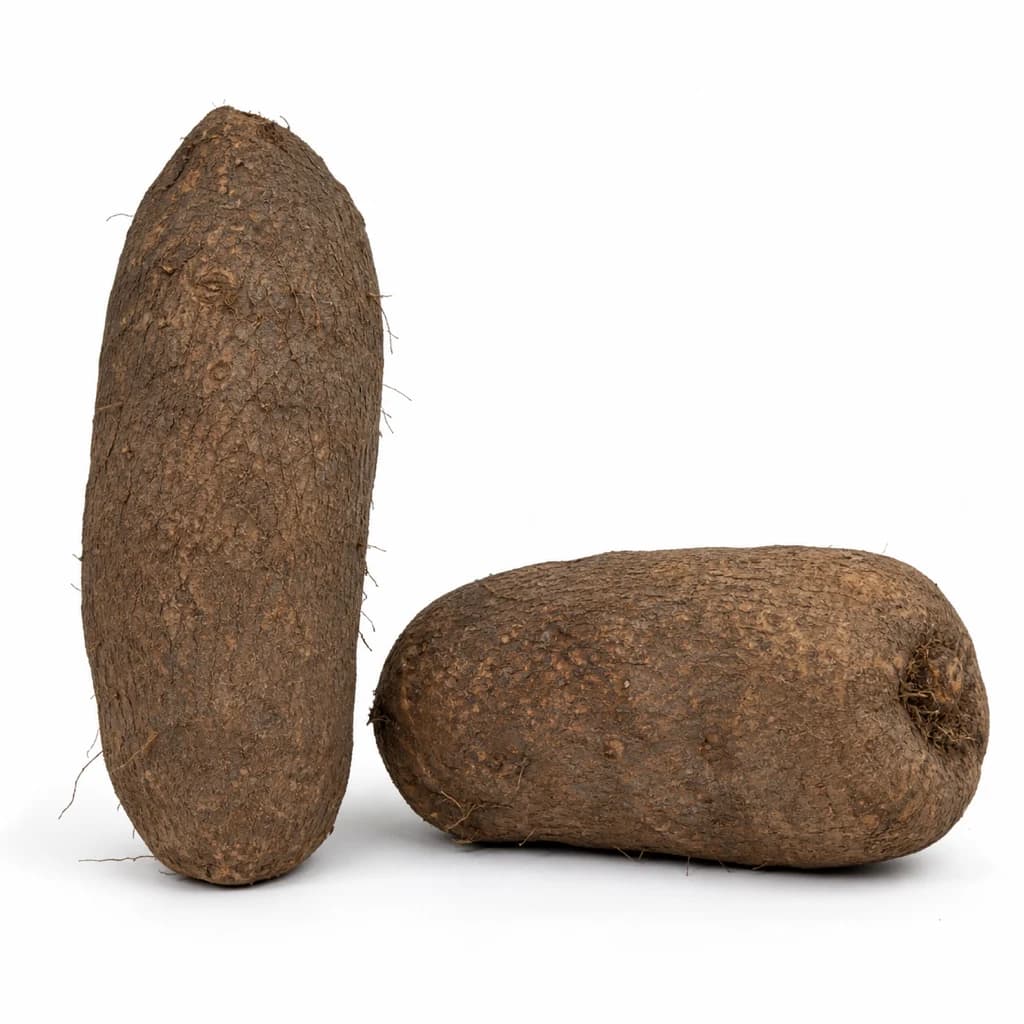
Whole true yam tubers showing rough, bark-like brown skin and large oblong shape.
Shows the defining exterior appearance — large size, irregular knobby form, and dark fibrous bark-like skin — that distinguishes true yam from sweet potato.
Produce
Yam
Large starchy African tuber boiled, pounded or fried; the base of pounded yam and fufu.
True yams are large, rough-skinned starchy tubers with white or off-white flesh, distinct from sweet potatoes. They are boiled, fried, roasted, or pounded into the smooth, stretchy fufu that accompanies West African soups and stews. A staple energy crop, they must be cooked before eating.
True yams (Dioscorea spp.) are ancient starchy tubers that have sustained human populations across West Africa, the Caribbean, and Southeast Asia for thousands of years. Distinct from sweet potatoes despite common market confusion, yams are generally denser, starchier, and lower in moisture, with an earthy, mildly sweet flavor that intensifies when cooked. Their significance goes beyond nutrition — in West Africa, pounded yam is a cultural touchstone, a food of celebration and daily sustenance alike, requiring skill and the right variety to achieve its characteristic smooth, elastic pull. The tuber behaves quite differently from potatoes: it holds its shape well when boiled but transforms into a cohesive dough-like mass when pounded, a property that makes it uniquely suited to fufu and its more refined cousin.
The yam family is vast, with hundreds of cultivated species, but a handful dominate cooking traditions. White yam (Dioscorea rotundata) is the gold standard for pounding — its low moisture and high starch content create the elastic, pillow-soft consistency that swells in savory soups. Yellow yam brings moisture and sweetness, making it better for roasting and porridge. Purple yam (water yam) offers visual drama and works in both savory and sweet preparations. Chinese yam is the outlier — crisp even cooked, it behaves almost like a water chestnut in soups and stir-fries. Understanding which yam you have changes how you cook it: a white yam poundable into silky smoothness will resist pounding and turn gluey if you try the same with a moister yellow variety.
In the kitchen, yams reward patience and respect for their texture. They are forgiving when boiled or fried, but demand precision when cooked for pounding — underdone yam is nearly impossible to work, and cold yam becomes sticky rather than smooth. Storage is critical: yams are sensitive to both cold and ethylene gas, and a single night in the refrigerator can ruin their texture. When properly selected and stored, a yam is one of the most versatile and satisfying tubers in the pantry, bridging savory soups, celebratory pounded dishes, crispy snacks, and rich desserts.
- Measured in
- g
- Storage
- Pantry
Types & varieties
The most cultivated yam in West Africa; smooth skin, white flesh; essential for pounded yam and fufu due to its high starch and low moisture content
Yellow to orange flesh; popular in Jamaica and the Caribbean; slightly sweet with a moister texture; better for roasting than pounding
Purple-tinged skin with white or purple flesh; also called purple yam; versatile for savory dishes and desserts; cooks faster than white yam
Thinner, lighter-colored tubers; uniquely crisp texture even when fully cooked; used in East Asian cuisines for soups, stir-fries, and medicinal preparations
Smallest cultivated yam; native to the Caribbean; tender flesh with excellent flavor; harder to find commercially but prized by chefs
Smaller, rounder tubers; noticeably sweeter than other varieties; common in Southeast Asia and the Pacific for both savory and sweet preparations
Produces edible aerial bulbils in addition to underground tubers; used in West African and Caribbean cooking; slightly bitter and requires thorough cooking
The Yam versus Sweet Potato Confusion
In North American grocery stores, the term 'yam' typically refers to orange-fleshed sweet potatoes (Ipomoea batatas), a completely different plant species. True yams belong to the genus Dioscorea and share neither genetics nor cooking properties with sweet potatoes. The confusion dates to the colonial era when African slaves and merchants brought yams to the Americas, and the term loosely transferred to the more familiar sweet potato. Check the botanical name on labels or the produce section: Dioscorea indicates a true yam. The practical difference matters: true yams are starchier, denser, and lower in moisture, which is why only they can be successfully pounded into fufu and pounded yam. Sweet potatoes lack the starch density and moisture balance to achieve that smooth, elastic consistency.
- True yam: genus Dioscorea — starchy, dense, low moisture, poundable
- Sweet potato: genus Ipomoea — sweeter, moister, not suitable for traditional pounding
- Ube in Filipino cuisine is a true purple yam (Dioscorea alata)
- Japanese 'satoimo' is taro, not yam — another common misidentification
Pounding Yam: Technique and Troubleshooting
Pounding yam into smooth, elastic fufu or pounded yam is a skill that rewards understanding the ingredient's behavior. The yam must be boiled until it is absolutely tender — a fork should slide through with zero resistance. Even slightly undercooked pieces will remain lumpy and fibrous. Cut the cooked yam into chunks while piping hot and transfer immediately to a heavy mortar (a molcajete or carved wooden version works well). The traditional method uses a heavy wooden pestle in a deep mortar, pressing and turning the yam while incorporating steam and working in a circular motion from the edges inward. The goal is a smooth, cohesive dough with no lumps — this typically takes 10–15 minutes of steady pounding. If the yam becomes gluey and sticks to the mortar, it has cooled too much; some cooks add a small amount of hot water or stock to restore workability. If it stays chunky, the yam was undercooked or the variety had too much moisture. Serve immediately — pounded yam stiffens as it cools.
- Boil until fork-tender with zero resistance — undercooked yam cannot be pounded smoothly
- Work quickly while yam is piping hot; cold yam turns sticky and unworkable
- Use a heavy mortar; the weight and momentum do the work efficiently
- Add hot water or stock sparingly if the yam cools and becomes gluey
- Serve immediately; pounded yam stiffens quickly as it cools
Common uses
Tips & pitfalls
- Choose firm, dense yams with no soft spots or mold; heavier yams for their size indicate better quality and less wateriness
- Never refrigerate yams — cold temperatures below 10°C convert starches to sugars and produce a gritty, mealy texture that ruins them for pounding
- Peel with a sturdy vegetable peeler or sharp knife — the skin is tough and fibrous; some cooks leave thin strips of skin on boiled yam for texture
- Add salt to cooking water only after the yam is fully cooked — salting early makes the yam tough and causes it to crack apart unevenly
- For pounding, cook yam until a fork passes through with absolutely no resistance — undercooked yam is nearly impossible to pound smoothly
- Work while the yam is hot and use a heavy mortar and pestle — cold yam becomes gluey and sticks rather than forming a smooth dough
- Cut yam into even pieces before cooking to ensure uniform doneness; large tubers often cook unevenly at the center
- Store away from ethylene-producing fruits (apples, bananas, pears) to prevent premature sprouting and decay
- If a yam has sprouted, the sprouts are edible and can be cooked like leafy greens — peel away from the sprouted areas before preparing the tuber
- For fried yam, soak cut pieces in cold water for 30 minutes before frying to remove excess surface starch and achieve a crispier, less greasy result
- Avoid yams with green discoloration on the skin — this indicates solanine buildup, a toxic compound that develops with light exposure
Nutrition
Energy
494 kJ · per 100 g
Where the calories come from
Protein
1.5g
3% DV
Carbs
27.9g
10% DV
Fat
0.2g
0% DV
Fiber
4.1g
15% DV
Sugars
0.5g
of which
Sodium
9mg
0% DV
Source · USDA FoodData Central · Yam, raw
View on FDC →In the shops
Matched grocery products
No matched grocery products for Yam yet.
Good to know
- Scientific name
- Dioscorea spp. (multiple species)
- Origin
- West Africa and Southeast Asia; cultivated for over 8,000 years
- Peak season
- Late fall through early spring
- Primary growing regions
- Nigeria, Ghana, Ivory Coast, Jamaica, Caribbean, Japan, China, Indonesia
- Flavor
- Mild, neutral starchiness with an earthy, slightly sweet background when cooked
- Key nutrients
- Complex carbohydrates, potassium, vitamin C, fiber, vitamin B6
- Typical size
- 2–8 pounds; some varieties can weigh over 100 pounds
- Flesh color
- White, cream, yellow, or purple depending on variety
- Storage
- Cool, dark, well-ventilated place; 10–15°C (50–59°F); do not refrigerate
- Shelf life
- 2–6 months if stored properly in dry, dark conditions
- Yield
- Approximately 80–85% edible after peeling and trimming
- Difficulty
- Easy to cook; requires care when peeling tough skins
Substitutes
- Sweet potato — Closest flavor and texture match; slightly sweeter; use 1:1 ratio; acceptable in most yam dishes but not traditional for pounding
- Taro root — Similar starchy texture with a nuttier flavor; works for pounded dishes; note that some people experience skin irritation when handling raw taro
- Cassava/yuca — Comparable starchy base; must be cooked thoroughly; different mild flavor; works well for fried preparations
- Plantain — Suitable for fried applications; less starchy, more banana-flavored; not suitable for traditional pounding or porridge
- Potato — Acceptable for boiled or fried preparations; lacks yam's earthy depth; not suitable for traditional pounded dishes
Pairs with
Also called
Ñame · Name · True Yam · African Yam
Appears in these dishes
Related
Tomato
Juicy, sun-sweet fruit for sauces, salads, and slow-cooked depth
Yellow Onion
The aromatic backbone of soups, sofritos, and braises
Garlic
Pungent cloves that perfume nearly every savory dish
Lemon
Bright, acidic citrus that wakes up almost any dish
Potato
Humble, hearty staple — roast, mash, fry, or boil
Carrot
Sweet, crunchy root — raw, roasted, or the base of a sofrito
Cucumber
Cool, crisp, and watery — for salads, pickles, and tzatziki

Lettuce
Crisp leaves for salads, wraps, and a fresh crunch