 Italian
Medium · Hot
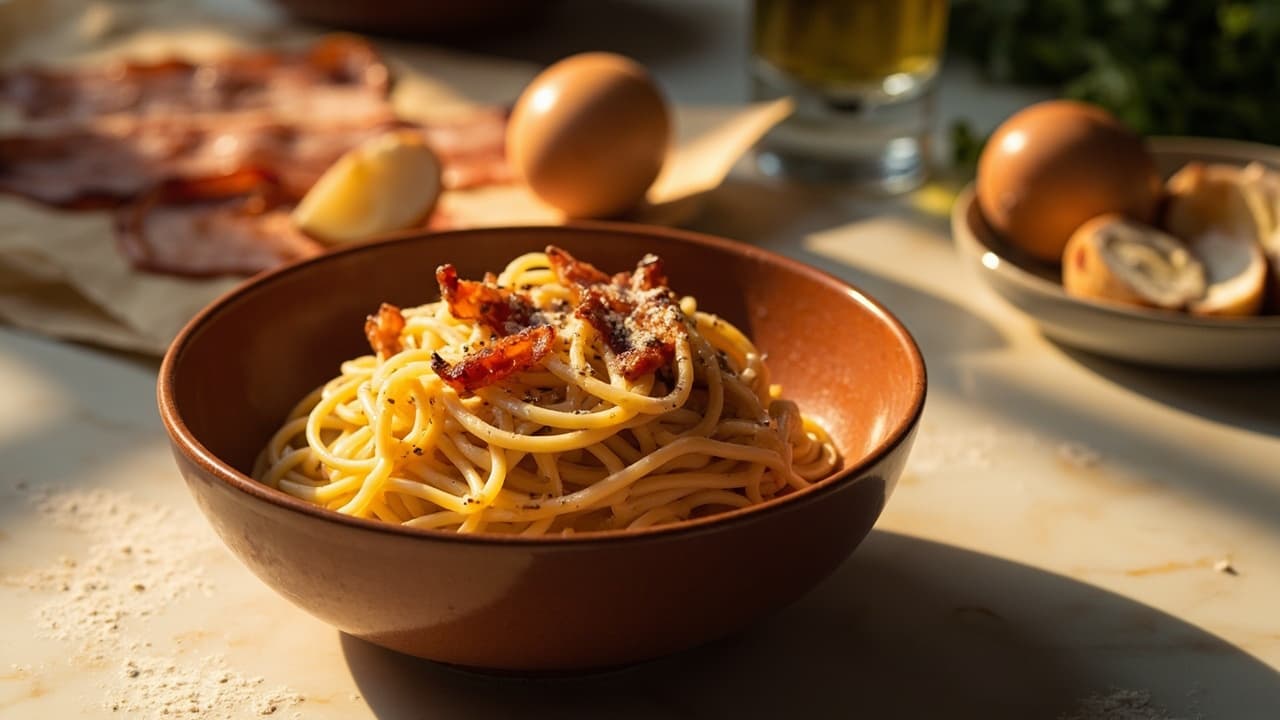
Spaghetti alla Carbonara with Hand-Crisped Bacon and Fresh Egg
A traditional Roman pasta dish transformed into a meditative craft experience — hand-crisped bacon rendered slowly until deeply golden, tossed with al dente spaghetti and a silky emulsion of fresh egg and aged parmesan, finished with an abundant snowfall of black pepper.

Prep
10 min
Cook
25 min
Total
35 min
Method
Render the Bacon Slowly
1
Place the bacon in a cold large skillet. Turn the heat to medium and let the bacon begin to render — this slow start ensures the fat melts fully before the edges crisp, yielding hand-crisped bacon with deeply caramelized edges.
2
Cook the bacon, turning occasionally, until it reaches a mahogany brown and the edges have curled inward with irresistible crispness. Transfer to a paper-lined plate, leaving all the rendered fat in the pan.
Build the Aromatic Foundation
3
Return the skillet with bacon fat to medium-low heat. Add the sliced guanciale or pancetta back to the pan and warm through briefly.
Boil the Pasta
Prepare the Egg Emulsion
5
In a wide mixing bowl, crack the egg and whisk vigorously with a generous portion of freshly grated parmesan. Season with black-pepper. The mixture should be thick and pale — this is your sauce.
Bring Together
6
Add the drained pasta directly to the skillet with the aromatic fat over medium heat. Toss to coat every strand, letting the pasta drink in the rendered bacon essence.
7
Remove the skillet from heat entirely. Working quickly and decisively, pour the egg and parmesan mixture over the hot pasta while tossing constantly with your other hand. The residual heat will gently cook the egg into a silky sauce — add pasta water, splashes at a time, until the consistency flows like molten gold.
8
Return the hand-crisped bacon to the pan, breaking it into rough pieces with your hands. Divide among warm bowls and finish with a snowfall of extra parmesan and a confident crack of black pepper. Serve immediately, as the sauce waits for no one.
D
Nutri-Score
Needs balance
A–E · lower is better · score 12
Calories
906
per serving
High in salt · 2421mgCalorie-dense · 906 kcalHigh in protein · 48gSource of fibre · 10gLow sugar · 6g
Protein
48g
Carbs
83g
Fat
42g
Sat. fat
12g
Fiber
10g
Sugar
6g
Sodium
2421mg
Gluten ContainingDairyEggPorkHigh SodiumLow FiberHeart UnhealthyBalanced MacrosComfort Food
Nutri-Score is a general nutritional-balance guide, not medical or dietary advice.
C
Environmental impact
Moderate impact
A–E · lower is better · includes estimates
kg CO2e
1.7
per serving
CCarbonAEU all-round· carbon sets the grade
Water
0.5m³
Land
64Pt
Runoff
0.2g P
Bacon drives 37% of this recipe’s estimated footprint.
Carbon from Poore & Nemecek 2018; water, land & runoff from Agribalyse — modelled averages for comparing recipes, not a measurement of your groceries.
Flavor Profile
8
Umami
3
Sweet
6
Salty
1
Sour
2
Bitter
5
Spicy
Textures
CrispySilkyTenderChewy
Aromas
SmokySavoryPungentEarthy
Kitchen Equipment
Primary Tool
Large SkilletCounter FootprintMedium
Techniques
Safety & Storage
Cooking Temperature
Remove skillet from heat before adding egg mixture to prevent scrambling. The residual heat should gently cook eggs into a silky sauce without curdling.
Pork products (guanciale/pancetta) must reach internal temperature of 145°F (63°C) for safe consumption. Bacon should reach at least 145°F (63°C) internal temperature. Visual cues alone ('mahogany brown') do not guarantee food-safe doneness.
High Risk Population
This dish contains eggs that are not fully cooked. Young children, elderly, pregnant individuals, and immunocompromised persons should consume only if eggs are heated to 160°F throughout.
Cross Contamination
Do not use the same cutting board or utensils for raw bacon and ready-to-eat foods without thorough sanitization between uses.
Storage
Carbonara does not store well. Egg-based sauces become rubbery and separate when refrigerated. Consume immediately or discard leftovers.
Allergen Warning
Contains eggs, dairy (parmesan), and wheat (spaghetti). Persons with allergies to these ingredients should avoid this dish.
Handling
When tossing pasta with egg mixture off heat, work quickly and decisively. Add pasta water gradually to control consistency and temperature.
Shelf Life
Cooked pasta with egg sauce should be consumed within 2 hours. Do not leave at room temperature for more than 1 hour.
Pro Tips
Technique
Start your bacon in a cold pan over medium heat — this slow render allows the fat to melt completely before the edges caramelize, creating hand-crisped bacon with depths of flavor you cannot achieve any other way.
Remove the pan from heat before adding the egg mixture — the pasta's residual heat will gently cook the eggs into silk without scrambling. Add pasta water gradually, splashing at a time, until the sauce flows like molten gold.
Substitution
If guanciale is unavailable, pancetta makes a fine substitute, though I implore you to never reach for pre-cut vegetables or bouillon — the hand-crafted approach is what transforms this dish into something worth your Sunday afternoon.
From the chef
Carbonara is not a recipe to rush — it is a meditation on patience and timing. I render my bacon slowly from cold, letting each minute deepen the caramelization until it reaches that perfect mahogany, knowing that true flavor cannot be rushed. When I toss the hot pasta with the egg emulsion, I move with intention, creating that silky sauce that flows like molten gold — this is the craft I return to again and again.
TagsClassicComfort FoodEggBaconWeeknight DinnerDairy
AllergensEggsMilkGlutenPork
Source: generated · June 10, 2026