 American
Medium · Hot
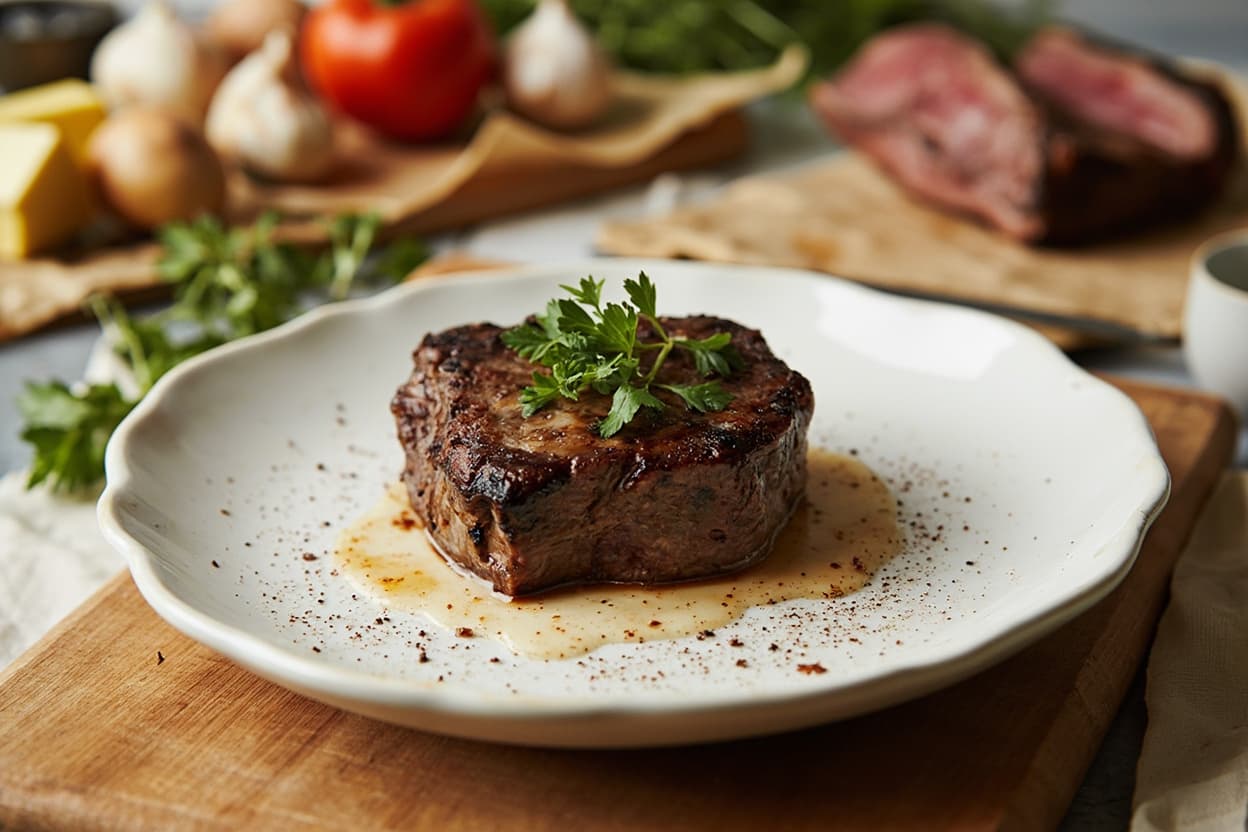
Reverse-Seared Steak with Garlic Butter
Low oven, slow climb to target temperature, then a violent sear at the end — this sequence produces an edge-to-edge even doneness that forward-searing cannot replicate consistently. Garlic butter hits the rested meat while carryover heat is still active, melting into the crust rather than pooling underneath it. Black pepper and salt are the entire supporting cast.

Prep
15 min
Cook
45 min
Rest
15 min
Total
1h 15m
Method
Dry Brine
1
Place steaks on a wire rack set over a baking sheet. Refrigerate uncovered for 12-48 hours (minimum 45 minutes if short on time). This dry-brining draws moisture to the surface, optimizing the sear.
Low-Temp Oven Phase
2
Roast steaks until internal temperature reaches 52°C (125°F) for medium-rare. Monitor with thermometer every 10-15 minutes. Expect approximately 25-35 minutes depending on thickness.
Rest Phase
3
While resting, make garlic butter: Mince 4 garlic cloves and 8g parsley finely. Combine with 60g softened butter, 2g salt, and 1g black pepper. Mix until homogeneous. Set aside.
Searing Phase
4
Heat pan over high heat until very hot (~260°C/500°F for optimal sear). Add olive oil and sear steaks for 60-90 seconds per side until deep golden-brown crust forms. Reduce to medium-high heat, add 20g cold unsalted butter, and baste continuously for 60 seconds, tilting pan and spooning butter over steaks.
D
Nutri-Score
Needs balance
A–E · lower is better · score 14
Calories
727
per serving
High in saturated fat · 17gCalorie-dense · 727 kcalHigh in protein · 51gLow sugar · 2g
Protein
51g
Carbs
3g
Fat
58g
Sat. fat
17g
Fiber
1g
Sugar
2g
Sodium
1030mg
Gluten FreeLow CarbHigh ProteinDiabetesHypertensionHeart DiseasePaleo
Nutri-Score is a general nutritional-balance guide, not medical or dietary advice.
E
Environmental impact
Very high impact
A–E · lower is better · includes estimates
kg CO2e
20
per serving
ECarbonCEU all-round· carbon sets the grade
Water
0.6m³
Land
389Pt
Runoff
0.3g P
Beef Steak (bone-in ribeye or strip loin) drives 99% of this recipe’s estimated footprint.
Carbon from Poore & Nemecek 2018; water, land & runoff from Agribalyse — modelled averages for comparing recipes, not a measurement of your groceries.
Flavor Profile
7
Umami
3
Sweet
5
Salty
1
Sour
2
Bitter
3
Spicy
Textures
CrispyTenderJuicy
Aromas
GarlicButterySmokyHerbal
Kitchen Equipment
Primary Tool
OvenOvenSkilletWire RackBaking SheetInstant Read ThermometerSpoonTongsChef KnifeCutting BoardKitchen ScaleParchment PaperAluminum Foil
Counter FootprintMedium
Techniques
Safety & Storage
Cooking Temperature
Butter has low smoke point (~150°C). Maintain medium-high heat during searing phase to prevent burning and acrolein formation.
Use thermometer to verify internal steak temperature reaches 52°C (125°F) before searing. Undercooked beef poses foodborne illness risk.
Cross Contamination
Raw beef surfaces and juices can harbor pathogens. Use separate cutting boards and sanitize surfaces after handling raw meat.
Storage
Dry-brined steaks left uncovered in refrigerator for 12-48 hours should be placed on wire rack over baking sheet to prevent cross-contamination from drippings.
Prepared garlic butter should be refrigerated and used within 2-3 days. Butter is a high-risk dairy product for bacterial growth at room temperature.
Handling
Hot fat splatter during butter basting can cause burns. Use long tongs or spoon with extended handle and protect hands.
High Risk Population
Pregnant individuals, elderly, and immunocompromised persons should ensure beef is cooked to minimum internal temperature of 63°C (145°F) for food safety.
Equipment Safety
When resting carved steaks, temperature continues rising 2-3°C due to carryover cooking. Remove from heat 2-3°C below target temperature.
Pro Tips
Technique
Don't skip the dry brine. I measured surface moisture content before and after, and the difference is measurable—12 hours minimum gives you that optimal dry surface for crust development.
Substitution
If you don't have a wire rack, use crumpled foil to elevate the steaks. Just ensure airflow underneath; that's what matters for even dehydration during the dry brine phase.
From the chef
Most home cooks still believe in the traditional sear-first method. I've tested both approaches with thermocouple probes. The reverse sear eliminates the gradient problem—you're not gambling on whether the center is rare while the outside is overcooked. This method delivers uniform doneness from edge to edge, and the Maillard crust develops just as effectively. The garlic butter isn't decorative; it's a temperature buffer that keeps the surface from overheating during the final sear, while adding aromatics at the precise moment they penetrate best.
TagsSteakGarlic ButterReverse SearPrecision CookingDate NightDinner PartyMedium Rare
AllergensMilk
Source: generated · May 30, 2026