Transform & Preserve
Air-Drying Meat
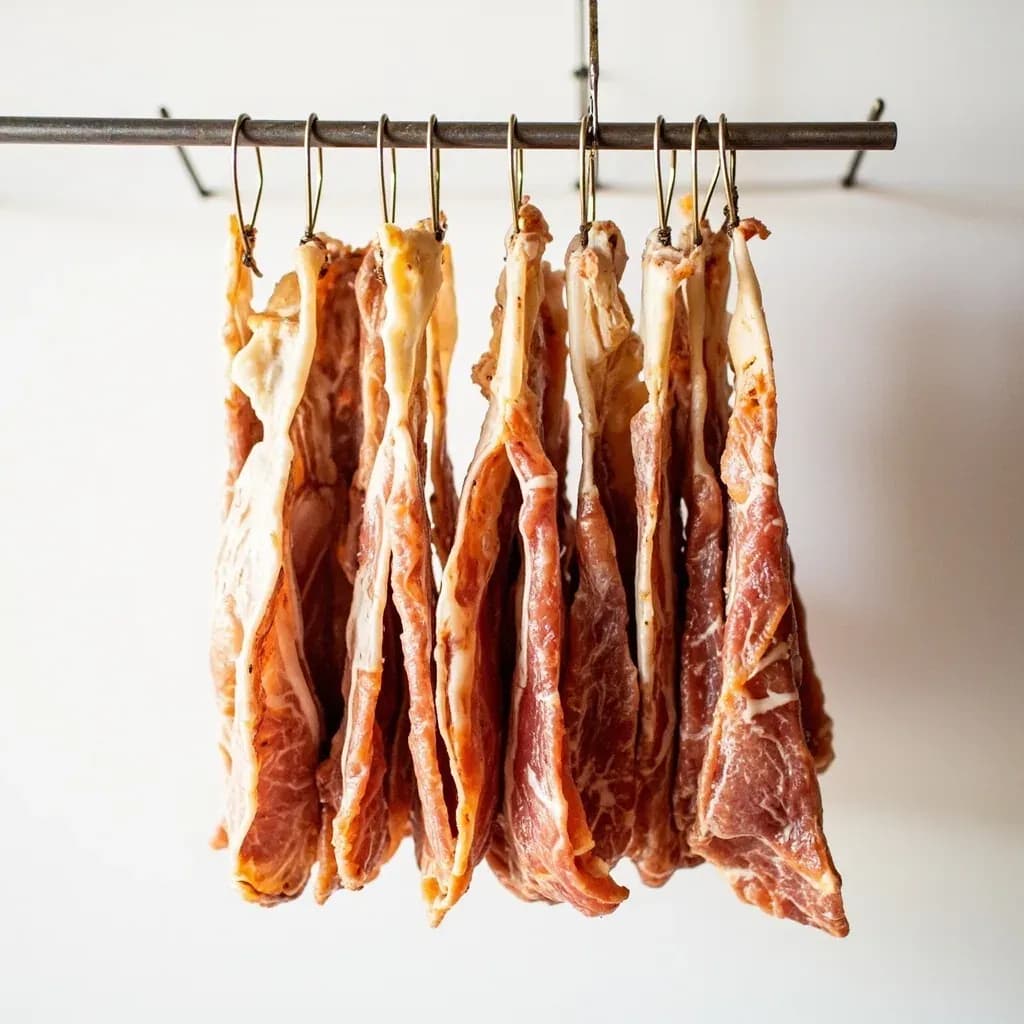
Hanging salted meat in cool, dry air to cure and preserve it, as in Mongolian borts.
Air-drying preserves meat by hanging salted strips in cool, dry, well-ventilated air until moisture leaves and the flesh firms. It is a traditional method for products like Mongolian borts and Central Asian kazy, often combined with curing. Removing water concentrates flavor and inhibits spoilage organisms. Steady airflow and low humidity are critical to dry the meat before it can rot.
Air-drying meat is one of humanity's oldest preservation techniques, predating refrigeration by several thousand years. At its core, the method exploits two straightforward realities: salt draws moisture out of muscle tissue, and cool, moving air at low relative humidity carries that moisture away before spoilage organisms can use it. The result is a product with drastically reduced water activity (typically a_w of 0.70–0.90, depending on the product), a level at which most spoilage and pathogenic bacteria cannot grow. Whole-muscle air-dried meats like prosciutto, bresaola, and borts can therefore sit for months or years without refrigeration, provided the cure was done correctly.
The technique behaves quite differently from smoking or cooking. There is no thermal kill of microorganisms; rather, the meat is stabilized by removing the water those organisms need. This is why lean, well-trimmed cuts are non-negotiable — fat oxidizes and turns rancid long before it dries, and pockets of fat or connective tissue trap moisture that becomes a reservoir for spoilage. The two variables a cook is really managing across the entire process are time and the ratio of salt to water, with temperature and humidity as the levers that determine how quickly the system reaches equilibrium.
For the home cook, air-drying sits at the more demanding end of preservation work. It rewards patience and consistency: a wine fridge outfitted with a small fan and a humidity controller will outperform a damp basement or a sunny porch every time. The payoff is access to flavors — concentrated, savory, sometimes funky, often nutty — that simply cannot be bought, and to a tangible link with traditions from the Mongolian steppe to the Italian Alps.
- Difficulty
- Hard
Types & varieties
Mongolian air-dried beef, yak, or horse hung in sub-freezing, arid winter air; traditionally little or no salt; stores for years and is rehydrated in stews or eaten in strips.
Salt- and spice-cured, air-dried beef eye round from Valtellina, Italy, aged 2–3 months; sliced paper-thin and dressed with olive oil, lemon, and pepper.
Pressed, air-dried beef coated in çemen — a paste of fenugreek, paprika, garlic, and warm spices; aged 2–4 weeks after pressing.
Salt-cured, air-dried beef (sometimes horse) from León, Spain, lightly smoked or unsmoked; protected EU geographical indication.
Whole pork loin marinated in paprika, garlic, and oregano, then air-dried 1–2 months.
South African air-dried, coriander-and-spice sausage of beef and mutton, hung 2–4 weeks in cool, dry air.
Thin strips of llama, alpaca, or beef sun- and air-dried in the Andes; historical precursor to modern jerky.
South African vinegar-brined, air-dried beef strips; marinated rather than dry-salted, distinguishing it from bresaola.
Whole pork legs salt-cured and air-dried 9–36+ months; the longest European air-drying traditions (Parma, San Daniele, Ibérico, Serrano).
Alto Adige pork leg that is lightly cold-smoked and then air-dried 6–9 months.
How to do it
- 1
Choose and trim the cut
Select a very lean whole muscle — eye of round, top round, pork loin, or whole leg are the classics. Trim external fat to under 5 mm and remove silverskin and any obvious connective tissue. Weigh the trimmed piece; you'll need that number to calculate salt.
- 2
Salt and season
Mix 2.5–3% of the meat's weight in fine sea salt or kosher salt with any aromatics (pepper, juniper, garlic, rosemary, bay) and, for long cures, Prague powder #2 at the manufacturer's rate. Rub evenly over every surface. For traditional borts, skip the salt and rely on dry winter air alone.
- 3
Cure under salt
Place the meat in a non-reactive tray, cover, and refrigerate for roughly 1 day per kilogram — typically 3 to 7 days for a whole-muscle piece. Turn daily and pour off any liquid that pools; that liquid is water leaving the meat, and you want it gone.
- 4
Rinse and form a pellicle
Rinse off the salt under cold water, pat dry with a clean cloth, and rest the meat uncovered on a rack in the refrigerator for 12–24 hours. The surface should feel tacky and dry — this pellicle discourages mold and helps the meat accept smoke if you plan to add it.
- 5
Set up the drying environment
Prepare a space that holds 10–15°C with 60–75% relative humidity and slow, continuous airflow. A converted wine fridge with a small computer fan, a humidifier, and a dehumidifier is the most reliable home setup. For borts, hang outdoors in the cold, dry Mongolian or Central Asian winter.
- 6
Hang the meat
Tie butcher's twine around the meat or thread stainless hooks through it. Hang so each piece is fully exposed on all sides, at least 5–7 cm from walls and other pieces. Drape cheesecloth loosely over the meat to keep flies, cheese skippers, and ham beetles off the surface.
- 7
Monitor and age
Check daily for the first week, then weekly. Weigh and date each piece at hanging and track weight loss. Expect bresaola-style cures to finish at 2–3 months, prosciutto-style at 12–36 months, and jerky-style strips at 1–3 weeks. The surface should darken and firm; light, white surface mold is normal and can be wiped off, but black or green fuzzy growth means the humidity is too high.
- 8
Test for doneness
The piece should feel firm and dense with no soft spots. The interior should be deep red or mahogany rather than pink. The smell should be concentrated and savory — never sour, ammoniac, or barnyard. Cut a thin slice and taste; the texture should be dry but not chalky, and the salt should be balanced, not sharp.
- 9
Store and serve
Wrap whole pieces in cheesecloth or unbleached butcher paper and keep in a cool cellar or refrigerator at 12–15°C. Slice just before serving with a long, sharp slicing knife held almost flat against the grain — a chef's knife will shatter well-dried meat rather than slice it.
How Air-Drying Differs from Smoking and Curing
The terms overlap and are often used loosely, but they refer to distinct processes. Air-drying is defined by exposure to cool, moving, low-humidity air; smoking adds combustion products that flavor the surface and add a light antimicrobial coating; and curing is the salting phase that precedes either. Bresaola and pastirma are air-dried without smoke. American jerky is usually both smoked and air-dried. Speck is lightly smoked, then air-dried. Borts is air-dried alone, with no smoke and often no salt. The defining trait of true air-drying is air, not smoke.
Safety Notes for Long, Uncooked Cures
Whole-muscle air-drying that lasts months at refrigerator-like temperatures is borderline-safe at best without chemical insurance. The two real risks are rancidity (from residual fat) and botulism (from anaerobic conditions in the moist interior during the early stages of drying, before the cure has fully penetrated). Salt concentration, low fat, and consistent cool temperatures handle most of it; for any cure longer than a couple of weeks, curing salt (Prague powder #2) is the standard safeguard. Borts sidesteps botulism by drying at sub-freezing temperatures, which a home cook cannot reliably reproduce.
- Use Prague powder #2 (sodium nitrite/nitrate) for any whole-muscle cure over 2 weeks
- Keep meat thickness consistent so the cure penetrates before the surface dries
- Reject any piece with soft spots, sour or ammoniac smells, or slippery surfaces
- Salt concentration should be calculated as a percentage of meat weight, not guessed
Common uses
Tips & pitfalls
- Choose very lean meat — eye round, top round, loin, or whole leg — because fat oxidizes and goes rancid long before it dries.
- Trim silverskin and connective tissue before curing; they don't dry properly and shelter moisture that can spoil.
- Use curing salt (Prague powder #2) for any whole-muscle cure lasting more than a couple of weeks to prevent botulism and stabilize color.
- Keep humidity in the 60–75% range for European-style cures; too dry causes case-hardening (a dry crust that traps moisture inside), too wet invites surface mold and spoilage.
- Make sure airflow reaches all sides — hang pieces at least 5–7 cm apart in a space with slow, steady air exchange.
- Avoid direct sunlight: it causes uneven drying, surface cracking, and accelerated fat rancidity.
- Cover with cheesecloth to keep flies and ham beetles off the meat — both lay eggs in exposed cures and ruin them quickly.
- Weigh and date each piece at hanging and track weight loss weekly; most whole-muscle cures are ready at 30–40% weight loss, prosciutto at 35–45%.
- Don't try to speed-dry by cutting pieces thin — that makes jerky, not bresaola. They are different products built for different time scales.
Good to know
- Also called
- Air-curing, dry-curing, wind-drying
- Preservation principle
- Lowers water activity (a_w) through salt and evaporation; inhibits microbial growth and slows enzymatic breakdown
- Ideal temperature
- 10–15°C (50–60°F); borts uses winter air well below freezing
- Ideal humidity
- 60–75% RH for European-style cures; borts relies on very dry winter air, often under 30% RH
- Time range
- 1–3 weeks for jerky-style strips up to 2–3 years for prosciutto di Parma and jamón ibérico de bellota
- Yield loss
- Whole-muscle pieces lose 30–50% of starting weight; thin strips lose around 60%
- Curing agents
- Sea salt or kosher salt is the base; long whole-muscle cures typically add Prague powder #2 (sodium nitrite/nitrate)
- Difficulty
- Moderate to advanced — requires consistent temperature, humidity, airflow, and food-safety awareness
Also called
Air-Drying Meat (Borts) · Salting & Curing (Kazy)
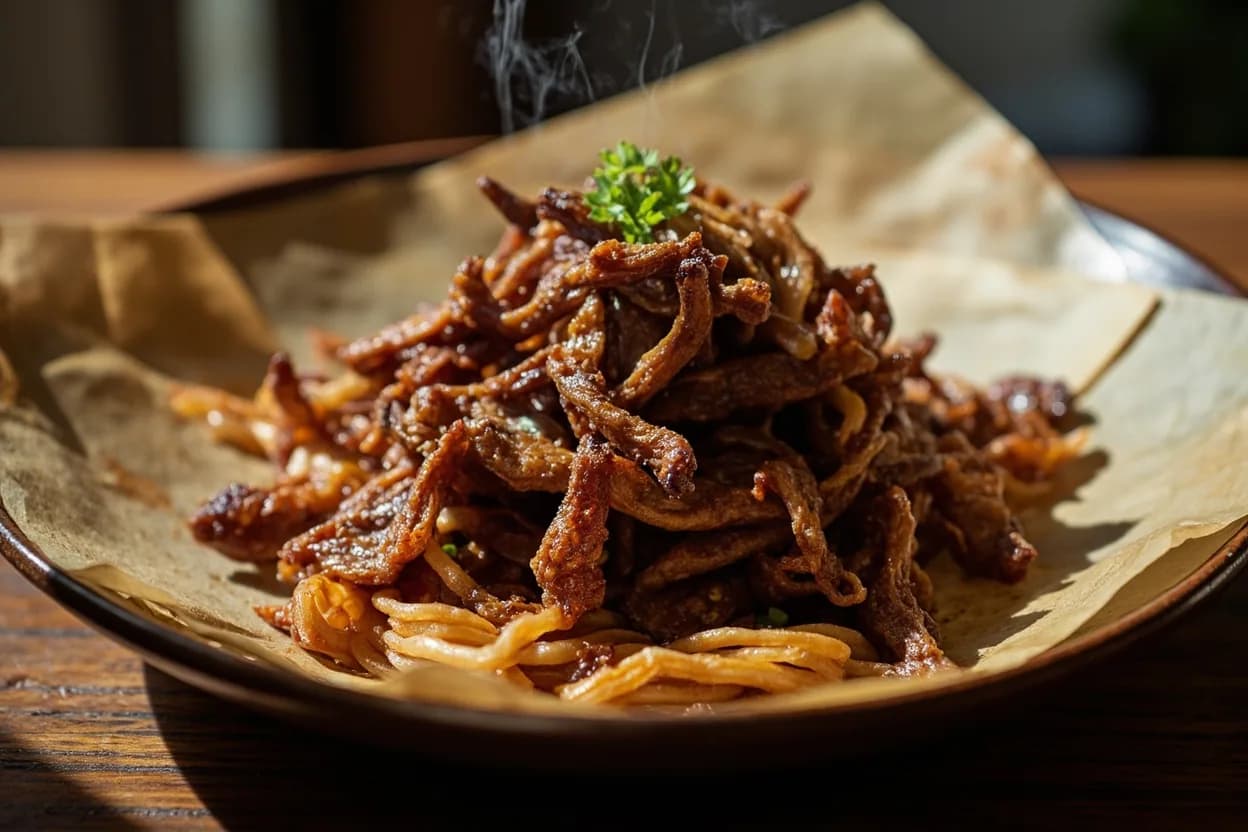
Dishes that rely on it
Related

Confit
Cook slowly submerged in fat for silky tenderness and keeping

Cure
Draw out moisture with salt and time to preserve and concentrate

Pickle
Steep in acidic brine for bright, tangy, crunchy preservation

Ferment
Let friendly microbes transform food into tangy, complex flavor

Marinate
Soak in a seasoned mix to flavor and tenderize before cooking

Brine
Soak in salt water so meat stays juicy and seasoned throughout

Dehydrate
Slowly dry out moisture to concentrate flavor and extend shelf life

Cold-Smoke
Perfume cured food with smoke without cooking it through