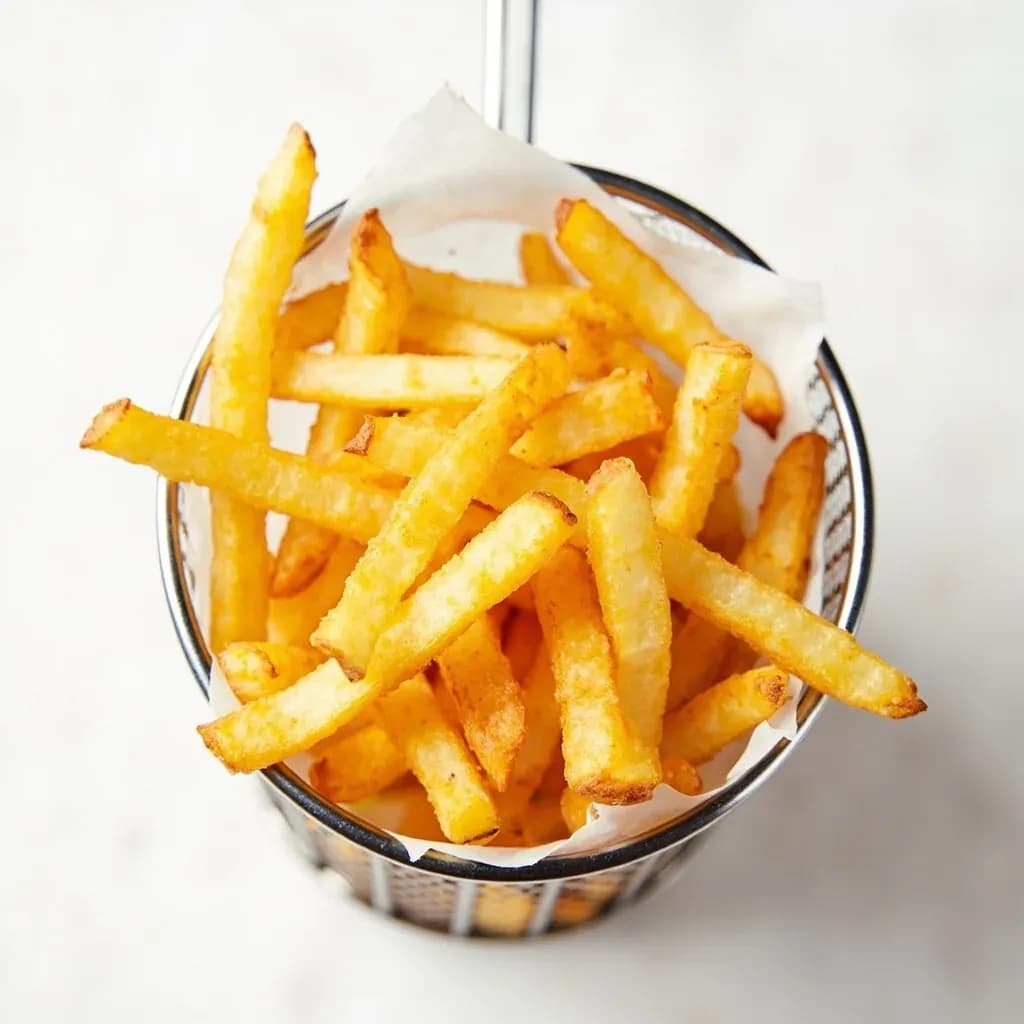
Heat & Fire
Air Frying
Circulating very hot air around food for a fried-like crisp using little or no oil.
Air frying uses a small convection chamber to blast superheated air around food at high speed, crisping the exterior much like deep-frying but with a fraction of the oil. It works well for chips, breaded cutlets, wings, and reheating leftovers to a crunchy finish. Because moisture evaporates fast in the rapid airflow, foods brown quickly, so cooks often shake the basket midway for even results.
Air frying is a countertop convection technique in which a high-velocity fan drives superheated air (typically 175–400 °F / 80–200 °C) through a small, enclosed cavity and across the food. The fast-moving air strips surface moisture quickly, raises the surface temperature into the Maillard range, and produces a dry, browned crust that reads, to most palates, as fried. Because the heat transfer is air, not oil, the technique uses only a teaspoon or two of oil per serving rather than the quarts a deep fryer demands, and the cook never deals with a pot of hot fat.
The reason it works is the same reason a convection oven works, but compressed. A wall oven moves a relatively large volume of air across a large cavity at moderate speed; an air fryer moves a smaller volume of air at much higher speed across food arranged close to the heating element. That combination is what lets it brown a chicken wing in 22 minutes or re-crisp a slice of pizza in four, with results that an ordinary oven can't match in the same time. The trade-off is that air-fried food is not deep-fried food. The crust is closer to a well-roasted, crisp-tipped result than to the uniform, oil-puffed crust of a tempura or a beer-battered fish. For dry-coated or pre-fried items — which is most of what people actually deep-fry at home — the gap is small. For wet batters, it is unbridgeable.
In a working kitchen, the air fryer earns its place as a re-crisping station, a frozen-snack finisher, and a weeknight workhorse for vegetables and small proteins. It will not replace a deep fryer, a grill, or a roasting pan. Used for what it does well, it is one of the most useful small appliances to arrive in home kitchens in a generation.
- Difficulty
- Easy
Types & varieties
The original Philips form factor: pull-out drawer with a perforated basket. Best for small batches and re-crisping; food sits close to the top element.
Larger cavity with a door, wire rack, or tray. More versatile — toasts, bakes, rotisseries, and dehydrates. Better circulation around each piece.
Pioneered by the T-fal Actifry; a rotating paddle stirs the food during cooking, removing the need to shake the basket. Best for fries, nuts, and loose pieces.
Two independent drawers with separate temperatures and timers. Lets you cook a main and a side at different settings at the same time.
Pressure cookers (Instant Pot, Ninja Foodi) with an air-fry lid. Combines pressure cooking and crisping in one unit.
A high-fan convection setting on a full-size or wall oven marketed as 'air fry'. Same principle, but lower air velocity and a larger cavity than a dedicated countertop unit.
How to do it
- 1
Preheat the air fryer
Run the unit empty at the target temperature for 3–5 minutes. Preheating stabilizes the cook and keeps the first batch from losing heat to a cold chamber.
- 2
Prep the food
Pat proteins and vegetables dry with paper towels. Season, then mist or toss with a small amount of oil (1–2 tsp per serving) for lean items. For breaded foods, dredge in seasoned flour, egg, and crumbs, then let the coating set on a rack for a few minutes so it adheres.
- 3
Load the basket
Arrange food in a single layer, cut sides down, with at least a centimeter of space between pieces. Work in batches rather than stacking or piling — crowded food steams, and steamed food will never crisp.
- 4
Set temperature and time
Most foods cook best at 375–400 °F (190–200 °C). Frozen fries: 12–18 min. Bone-in chicken wings: 22–25 min. Vegetables: 8–15 min. Thicker cuts: start lower (325–350 °F) so the heat reaches the center before the outside over-browns.
- 5
Turn or shake halfway through
Pause at the midpoint, pull the basket, and shake it two or three times — or flip individual pieces with tongs. This is what exposes new surface area to the hot air and prevents one-sided browning.
- 6
Check doneness
Use an instant-read thermometer: 165 °F for poultry, 145 °F for fish and pork, 160 °F for ground meats. Visual cues alone mislead with convection, because the outside colors faster than the inside cooks.
- 7
Rest and serve
Let thicker pieces (whole chicken thighs, drumsticks) rest 2–3 minutes before serving — carryover heat finishes the center and juices redistribute. Salt and finish with acid or fresh herbs at this stage.
Why it works
Crispness in any cooking method is a contest between two things: how fast the surface dries and browns, and how fast the interior cooks. Deep-frying wins because oil at 350–375 °F transfers heat so quickly that the surface dehydrates and the Maillard reaction kicks in before the interior overcooks. An air fryer is an attempt to win the same contest with hot gas instead of hot liquid. The fan's job is to keep the boundary layer of cooler, humid air from clinging to the food — once that layer is stripped away, evaporation accelerates, the surface temperature climbs, and the browning reactions that make a crust "fried" get going.
Two practical consequences follow. First, anything that slows evaporation — a wet batter, a glaze, a crowded basket — defeats the technique, because the air never gets a chance to do its work. Second, the crust is thinner and drier than a deep-fried crust, because there is no oil to soak in and gelatinize the coating. That is the gap the technique cannot close, and the reason no air fryer will ever make a passable tempura.
- The hot air is the heat transfer medium, not oil — every recipe decision flows from that.
- Surface dryness and airflow are the two variables the cook controls; everything else is hardware.
- Maillard browning needs ~285 °F surface temperature and dry conditions; the air fryer provides both in minutes.
Where it falls short
Air frying is a poor substitute for deep-frying when the original product depends on wet batter, a delicate crust, or oil-driven puffing. Tempura, beer-battered fish, fritters, and anything dipped in a liquid coating will drip through the perforations, fail to set, or steam rather than fry. The technique also struggles with anything that needs to sit in fat — confit, doughnuts, churros — for the same reason. For those, use a deep fryer or a heavy pot of oil.
It is also a slow substitute for a grill, a smoker, or a proper roast. The Maillard crust is real, but the flavor compounds produced by fat rendering into dripping-hot oil, by wood smoke, or by long dry-heat roasting are not. Treat the air fryer as a specialist tool for crispness, not as a universal heat source.
- Wet batters and tempura will not work — use dredges, dry coatings, or thin commercial batters only.
- Don't substitute for long roasts, smoked meats, or anything where rendered fat and drippings are part of the flavor.
- Smaller pieces cook more evenly than large ones; whole chickens and big roasts are better suited to a convection oven.
Common uses
Tips & pitfalls
- Preheat for 3–5 minutes; cold-starting throws off timing on most recipes and gives the first batch a slow start.
- Pat food bone-dry before seasoning — surface moisture is the single biggest enemy of crispness.
- Cook in a single layer with breathing room around each piece; overcrowding steams food and produces limp, pale results.
- Shake or flip halfway through; the air does not reach the underside on its own, and skipping the turn is the most common reason for one-sided browning.
- Mist lean items (vegetables, white-meat chicken, tofu) with 1–2 teaspoons of oil from a refillable sprayer before cooking; a thin, even coat dramatically improves browning.
- Salt AFTER cooking — salt drawn out by heat pulls moisture to the surface and softens the crust you just built.
- Avoid aerosol non-stick sprays (PAM and similar) on non-stick baskets; the lecithin and propellant leave a residue that builds up and smokes. Use a refillable oil mister instead.
- Use perforated parchment or silicone liners for sticky or cheesy items — never line the basket with solid paper, which blocks airflow and can fly up into the heating element.
- Empty the grease from the drawer between batches; accumulated fat smokes and taints flavor.
- Use an instant-read thermometer for poultry and thicker cuts; air-fried food browns fast on the outside and can look done well before the center catches up.
Good to know
- Invented
- 2010, by Philips in the Netherlands; Fred van der Weij is credited with the rapid-air technology behind it.
- Principle
- Rapid convection — a high-velocity fan circulates superheated air around food, driving off surface moisture and triggering the Maillard reaction for browning and crispness.
- Oil required
- Roughly 1–2 teaspoons per serving, versus several cups for deep-frying; high-fat foods like bacon or chicken thighs need none.
- Preheating time
- 3–5 minutes.
- Common cook times
- Frozen fries 12–18 min; chicken wings 20–25 min; vegetables 8–15 min; bacon 8–12 min — all near 375–400 °F.
- Typical wattage
- 800–1,800 W for basket models; larger oven-style units run higher.
- Capacity
- 2–6 quarts for basket air fryers; oven-style and dual-basket units go to 10–25 quarts.
- Power source
- Electric only.
- Difficulty
- Beginner-friendly; the trickiest variable is loading density.
- Basket material
- Typically non-stick-coated metal or stainless steel; metal utensils scratch the coating — use silicone or wood.
Also called
Hot-Air Frying · Convection Frying
Related

Sear
Blast the surface hot for a deep-browned, savory crust

Sauté
Cook quickly in a little fat over lively heat, tossing as you go

Stir-Fry
Toss bite-sized pieces over roaring heat for fast, smoky cooking

Pan-Fry
Crisp food in a shallow layer of hot fat, turning once or twice

Deep-Fry
Submerge in hot oil for an all-over crackling crust

Roast
Cook uncovered in dry oven heat for browned edges and tender centers

Bake
Cook with steady, surrounding oven heat — the soul of bread and pastry

Broil
Hit food from directly above with fierce overhead heat