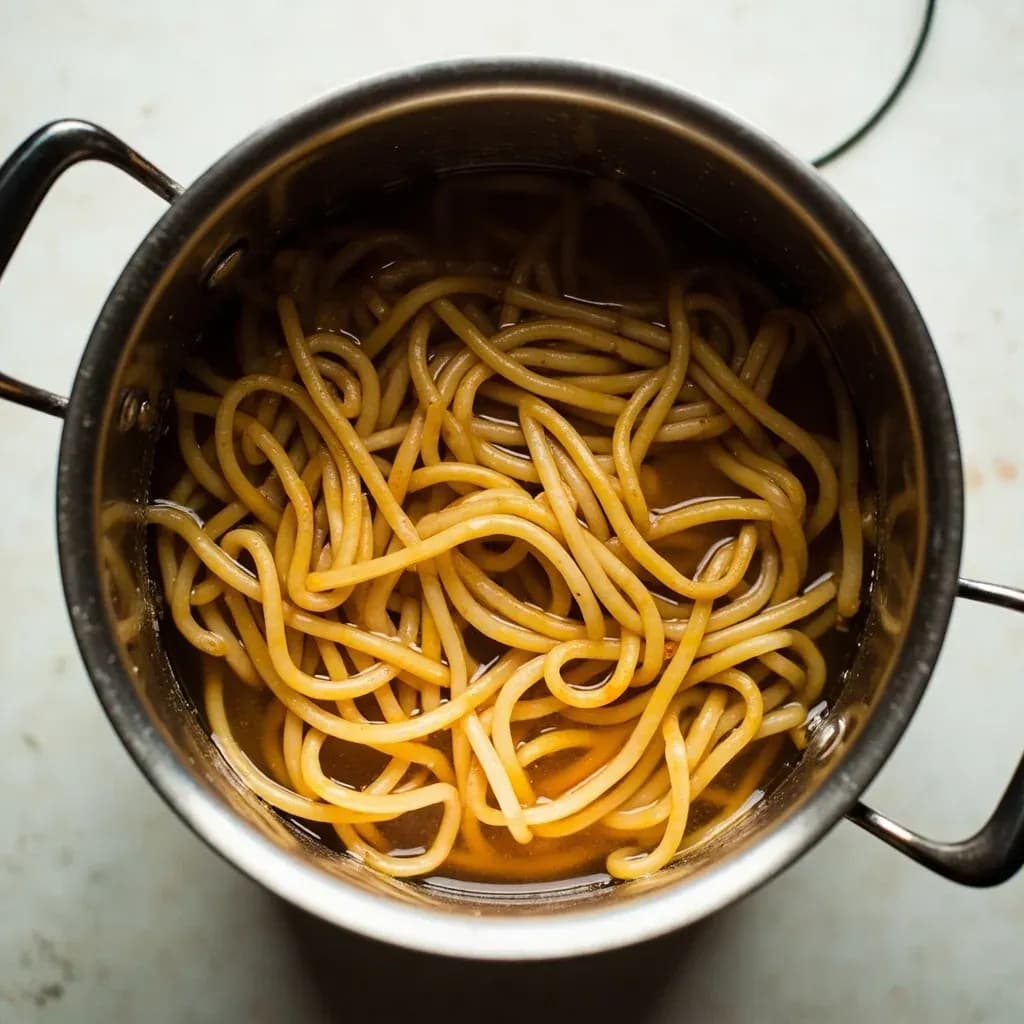
Water & Steam
Boiling Noodles
Cooking noodles in plenty of boiling water to the right tenderness.
Boiling noodles cooks fresh or dried noodles in a large pot of rapidly boiling water, stirring early to keep them from clumping. Cooking times vary by noodle type and thickness, and they are often shocked in cold water or tossed with sauce immediately to stop overcooking. Plenty of water keeps the temperature stable so the noodles cook evenly.
Boiling noodles is the most fundamental technique in the pasta-and-noodle cook's repertoire, and also one of the most routinely botched. The mechanics are simple — a rolling boil, plenty of salted water, noodles added at full heat, drained when tender — but every variable in that sentence is a dial the cook can turn. The size of the pot, the salt level, when you stir, how you finish the noodles, and whether (or not) you save the cooking water all change the final dish. Get them right and the noodles arrive at the table properly seasoned, with a tender-chewy bite and a surface that grips sauce instead of shedding it. Get them wrong and you serve starchy, bland, slick strands sitting in a puddle.
The principle holds across cuisines, from Italian dried durum pasta to fresh egg tagliatelle, Japanese udon and soba, Vietnamese rice sticks, and cellophane mung-bean threads. Wheat noodles of all kinds want the same treatment: abundant water, a hard boil, salt, immediate stirring, and a finish in the sauce. The notable exceptions are the cold-noodle family — somen, soba, rice vermicelli — which is rinsed or shocked to halt the cook and wash off surface starch. Rice and cellophane noodles follow the same rinse-to-stop principle once cooked or soaked. Treat the package's suggested time as a ceiling, not a target, and remember that al dente is a texture you feel between your teeth, not a number on a clock.
- Difficulty
- Easy
Types & varieties
Spaghetti, penne, rigatoni, fusilli; 8–12 min; holds shape and chews firm.
Tagliatelle, pappardelle, ravioli, tortellini; 1–4 min; delicate, cooks very fast.
Ramen, udon, lo mein, somen; 2 min (somen) to 6–8 min (thick udon).
100% buckwheat or blended; 4–5 min; rinse after cooking for cold service, add directly to broth for hot dishes.
Often soaked in warm water until pliable, or briefly boiled 2–5 min; rinse to stop the cook and remove surface starch.
Mung-bean or sweet-potato starch; 3–5 min, or simply soak in hot water and rinse to remove surface gum.
Pre-fried or air-dried blocks; typically 2–3 min; seasoning goes into the cooking or serving water.
Pulled 2–3 minutes before package time so the pasta finishes in the oven without going mushy.
How to do it
- 1
Choose the pot and water
Pick a pot large enough that the noodles move freely — roughly 4–6 quarts (4–6 L) of water per pound (450 g) of dried pasta. Fill, cover, and bring to a full rolling boil uncovered.
- 2
Salt the water
Once the water is at a hard boil, add about 1 tablespoon (≈15 g) of coarse kosher or sea salt per gallon (4 L). It should taste distinctly of the sea; this is your only chance to season the pasta itself.
- 3
Add the noodles
Drop dried pasta in gradually — fan long strands as they soften so they sink in even arcs — or set fresh nests in carefully. Never add to water below a boil; the temperature drop is what makes noodles gummy and stuck together.
- 4
Stir to separate
Give the noodles an immediate, thorough stir with a long fork or pasta tongs, especially in the first minute, to stop them from clumping while the surface starch is still tacky.
- 5
Cook to al dente
Time the cook from the moment the water returns to a boil — not from when you dropped the noodles. Dried pasta 8–12 minutes; fresh egg pasta 1–4 minutes; Asian noodles 2–8 minutes depending on variety. Begin tasting 1–2 minutes before the package's stated time.
- 6
Reserve the cooking water
Before draining, scoop out 1–2 cups (250–500 mL) of the cloudy, salty, starchy liquid and set it aside. This is the secret to silky, emulsified sauces.
- 7
Drain — or lift
Pour into a colander and shake off excess water, or lift long strands with tongs straight from the pot into the waiting sauce. Do not rinse unless the dish is a cold salad, stir-fry, or stuffed pasta headed for the oven.
- 8
Finish in the sauce
Add the drained pasta to the sauce with a splash of the reserved water. Toss over medium heat for 30–60 seconds until the sauce coats every strand and turns glossy. This is where the dish actually comes together.
- 9
Serve immediately
Pasta waits for no one. Plate right away, finishing with a little more pasta water if the sauce tightens as it sits on the plate.
The case for starchy cooking water
The cloudy, salty liquid left in the pot after the noodles come out is one of the most useful ingredients in the kitchen, and the single biggest difference between a starchy bowl of plain pasta and a glossy, sauce-coated one. The water is loaded with amylose and amylopectin leached from the noodle surface, plus the salt you added at the start. When you toss the drained pasta into the sauce with a splash of this water and beat it over heat, the starches swell and bind with the fat in the sauce to form a stable emulsion — the Italian technique called mantecatura. Sauce clings to every strand instead of pooling at the bottom of the bowl, and the whole dish takes on a silky, restaurant-quality sheen. Always reserve at least a cup, more for a saucy bake, and add it in small splashes as you toss until the sauce turns glossy and just loose enough to flow.
- Reserve 1–2 cups (250–500 mL) of cooking water before draining.
- Add it in small splashes as you toss — you can always add more, but you can't take it away.
- The water also rescues a sauce that tightens up as the pasta sits on the plate.
Cold noodles and the rinse exception
Most of the time, rinsing pasta is a mistake — it strips the surface starch that helps sauce cling and carries away the residual heat that finishes cooking the noodle as it rests. But for a handful of dishes, rinsing is the whole point. Cold noodle salads (hiyashi chuka, sesame soba, Vietnamese bún), stir-fries (lo mein, chow mein), and stuffed pastas that will be re-baked all benefit from a cold shock that stops the cook dead and washes off the surface gum. Run the drained noodles under cold running water, or plunge them into an ice bath, then shake or spin dry. Soba served cold (zaru, mori) and rice vermicelli both get gummy and unpleasantly starchy-tasting if you skip this step; however, soba destined for a hot broth — kake soba, kitsune soba — goes straight from the cooking water into the bowl without rinsing.
- Rinse cold for: cold salads, stir-fries, and stuffed pasta headed to the oven.
- Don't rinse for: any hot sauced dish, especially long cuts like spaghetti or linguine.
- Rinse cold soba (zaru, mori) and rice vermicelli; skip the rinse for soba going into hot broth.
Common uses
Tips & pitfalls
- Use a pot big enough — crowding the pot drops the temperature and yields gummy, stuck-together strands. The water should look barely disturbed when the pasta goes in.
- Skip the olive oil in the water. It does not prevent sticking and instead coats the pasta, preventing sauce from clinging. A vigorous stir does the real work.
- Salt only after the water boils, both to avoid pitting the bottom of certain stainless pots and to keep the boil time short. The water should taste like sea water — if it doesn't, the pasta will be bland.
- Stir within the first 30–60 seconds, while the surface starch is still sticky. After that, occasional stirring is enough; over-stirring can break long strands.
- Always reserve a cup or two of starchy cooking water before draining. It is the single best emulsifier for bringing pasta and sauce together.
- Do not rinse pasta for hot dishes. You wash away the surface starch that helps sauce adhere and the residual heat that finishes cooking.
- Time the cook from when the water returns to a boil, not from when you drop the noodles — especially for long shapes that drop the temperature by 10–20°F.
- Treat the package's suggested time as a maximum, not a target. Dried pasta goes from al dente to mushy in well under a minute; taste early and often.
Good to know
- Technique family
- Moist-heat cooking / pasta cookery
- Water-to-pasta ratio
- About 4–6 quarts (4–6 L) of water per 1 lb (450 g) of dried pasta
- Salting ratio
- Roughly 1 tablespoon (≈15 g) coarse salt per gallon (4 L) of water — water should taste like sea water
- Required temperature
- Rolling boil (212 °F / 100 °C at sea level) before noodles are added
- Cook time
- Dried pasta 8–12 min; fresh egg pasta 1–4 min; Asian noodles 2–8 min depending on variety
- Doneness test
- Bite a piece: al dente should be tender through with a faint, firm white core in dried pasta
- Yield
- 1 lb (450 g) dried pasta yields roughly 2.5–3 lb (1.1–1.4 kg) cooked; pasta roughly doubles in weight
- Key byproduct
- Pasta cooking water — the starchy, salty liquid reserved before draining; the best emulsifier for sauces
Also called
boil-noodle
Dishes that rely on it
Related

Boil
Cook in vigorously bubbling liquid at full rolling heat

Simmer
Hold liquid at a gentle shimmer for tender, unhurried cooking

Poach
Cook gently in barely-trembling liquid for silky, tender results

Steam
Cook in rising vapor to keep color, nutrients, and shape intact

Blanch
Plunge briefly in boiling water, then shock cold to lock color

Braise
Sear, then cook slow in a little liquid until fall-apart tender

Stew
Simmer bite-sized pieces fully submerged into a rich, unified pot

Sous-Vide
Seal and cook in precise warm water for edge-to-edge doneness