Knife Skills
Deboning
Removing bones from meat or fish to leave clean, edible flesh.
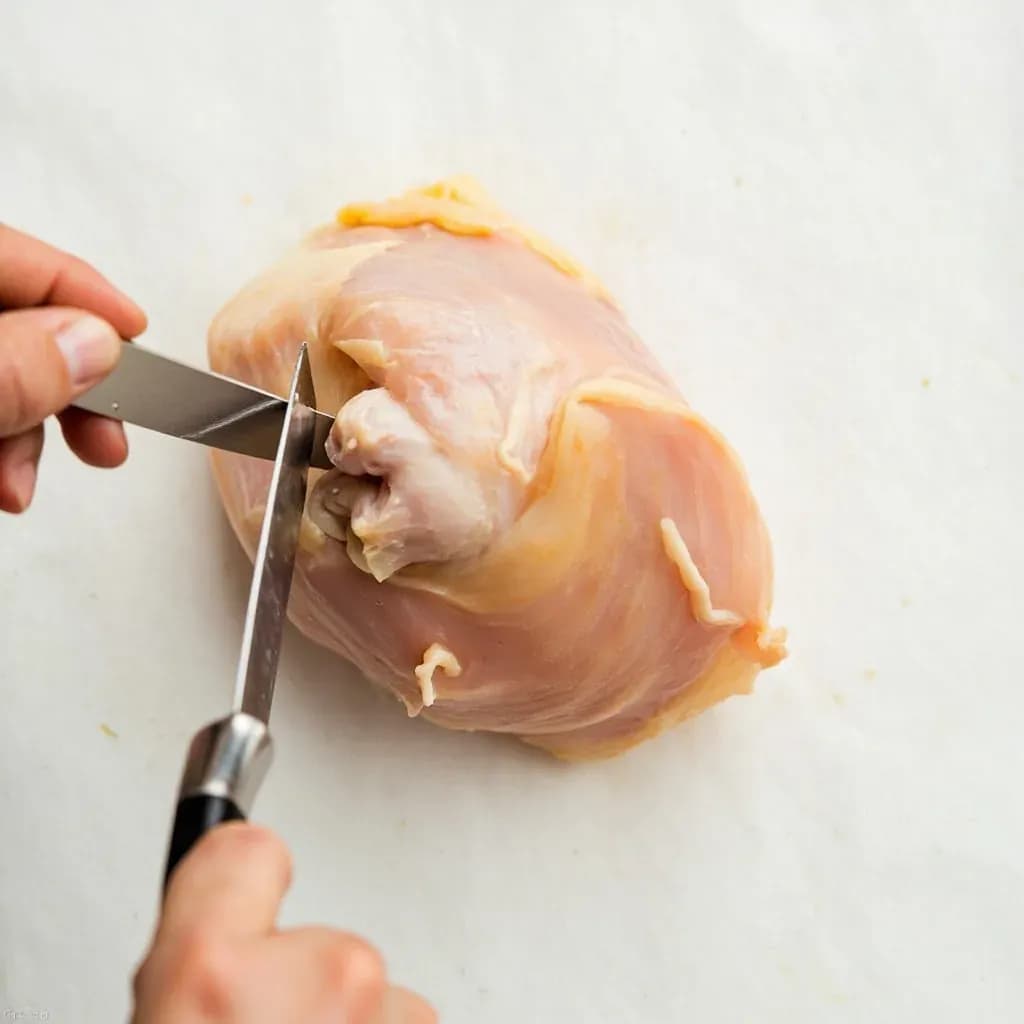
Deboning is the careful removal of bones from a cut of meat, poultry, or fish, often including trimming away silverskin or pulling out fine pin bones with tweezers. It makes food easier to eat, stuff, or roll and gives even cooking. A boning knife's narrow, rigid blade lets you work tight against the bone with minimal waste.
Deboning is the family of butchery techniques used to remove bones from meat, poultry, and fish while keeping the flesh intact and in usable shape. It is less a single procedure than a cluster of related skills — filleting a round fish, lifting a chicken's carcass for stuffing, scraping meat from a rack of lamb to expose clean bone handles, and pulling pin bones from a salmon fillet all qualify — but they share the same underlying principles: a sharp narrow blade kept against bone, a cool firm product, and joints opened by feel rather than sawed through. The payoff is practical as much as visual. Deboned roasts cook more evenly, carve cleanly at the table, and accept stuffing, rolling, or curing in ways bone-in cuts cannot, and they spare diners from navigating around bones at the plate.
The skill rewards repetition more than raw talent. Home cooks who learn four applications — deboning a whole chicken, frenching a rack of lamb, filleting a round fish, and pulling pin bones from salmon — can handle the great majority of recipes that call for boneless product. Knife selection matters more than knife cost at this level: a stiff 6-inch boning knife for red meat and pork, a flexible 6-inch boning or fillet knife for poultry and fish, and a sturdy pair of poultry shears for backbone work. With sharp tools, a slightly chilled protein, and the discipline to keep the blade against bone, even a hesitant cook can lift a chicken in under five minutes and produce a clean salmon fillet in three or four.
- Difficulty
- Hard
Types & varieties
Scraping meat and silverskin from the end of rib or leg bones — rack of lamb, rib roast, crown roast — to expose clean white bone for presentation.
Removing the backbone of poultry with shears or a knife so the bird lays flat for fast, even roasting or grilling.
Stripping the rib bones from one side of a primal — pork belly, spareribs, veal breast — so it lies flat for rolling, stuffing, or portioning.
Working a narrow blade along the femur of a leg of lamb or veal to extract the bone whole, opening the cut for stuffing and re-tying.
Deboning a bird or roast through a small incision while preserving its outer shape — the basis for ballotines, galantines, and stuffed poultry.
Removing the entire skeleton of a bird, usually through the back, so the skin and flesh can be stuffed, rolled, and cooked in one piece.
Running a flexible blade along the spine of a fish to lift off the side flesh, typically in two fillets (sometimes four if the belly strip is removed separately).
Plucking the small, free-floating intramuscular bones from salmon, trout, pike, and similar fish with tweezers or needle-nose pliers.
How to do it
- 1
Prepare the protein and tools
Pat the meat or fish dry and chill it briefly so the flesh is firm and easier to separate from bone. Sharpen a boning knife (stiff for red meat, flexible for poultry and fish), and have poultry shears, kitchen twine, and a damp towel under your cutting board to stop it sliding.
- 2
Map the skeleton before you cut
Identify the major bones and joints you will follow — rib cage, spine, sternum, shoulder and hip joints on a bird; spine, rib cage, and pin bones on fish. Knowing the structure prevents you from cutting into bone or wasting meat.
- 3
Make the opening cuts
For poultry, slice down either side of the backbone with shears or a knife, or open the back along the spine. For a leg or loin, run a shallow cut the full length of the bone to expose it. For fish, cut just behind the pectoral fin and gill plate down to the spine.
- 4
Follow the bone with the blade
Angle the boning knife so it hugs the bone, scraping it clean in long strokes. Use short strokes around curves (shoulder blades, hip joints, rib curves) and long strokes along straight bones (femur, spine).
- 5
Disarticulate the joints
Flex the joint to expose the cartilage, slice through the connective tissue and tendons, and the bone will pop free. This is cleaner than cutting through the ball-and-socket itself. Repeat for wing, leg, and thigh joints on poultry.
- 6
Remove bones in the largest pieces possible
Working the spine and rib cage out in one or two connected pieces preserves the shape of the carcass and leaves more meat intact for stuffing or rolling. Avoid leaving bone fragments in the flesh.
- 7
Trim and refine
Pull or scrape off remaining silverskin, cartilage, and small bone fragments. Check for pin bones in fish by running a finger flat against the flesh — they feel like small ridges. Trim ragged edges so the piece lies flat and even.
- 8
Tie, stuff, or portion as needed
If the cut is destined for stuffing (ballotine, stuffed loin, rolled leg), season, fill, and re-form it now while the shape is still pliable. Tie at 1–1.5 inch intervals with kitchen twine, or portion into steaks and cutlets.
Four skills that cover most home cooking
Most recipes that call for a boneless product are built on a small handful of applications. Learning these four will let you handle the great majority of boning work in a home kitchen.
- Debone a whole chicken (or other poultry): the gateway skill. The same logic — open the back, follow the rib cage, pop the leg and wing joints — applies to turkey, duck, guinea fowl, and cornish hens at smaller scale.
- French a rack of lamb: the showcase presentation skill. Once you can scrape a rib bone clean with the tip of a knife, you can also french a crown roast, a single veal chop, or the shank bone of a ham.
- Fillet a round fish: the volume skill. A 1.5–2 kg salmon, branzino, or snapper yields two clean fillets in a few minutes with a flexible blade, and the same knife motion handles trout, mackerel, and small flatfish.
- Pull pin bones from a salmon or trout fillet: the finishing skill. Run a finger flat against the flesh to feel them, grip each one with needle-nose pliers, and pull gently in the direction it lies.
Common uses
Tips & pitfalls
- Sharpen before you start. A dull boning knife tears meat and slips near joints — the single biggest cause of botched deboning.
- Keep the knife against the bone. The blade follows the skeleton, not the meat; meat is wasted when the knife wanders into the flesh.
- Chill the protein. A short rest in the freezer (15–30 minutes) firms the flesh and fat, so they release cleanly from bone.
- Pop, don't cut, the joints. In poultry, locate the ball-and-socket joints of the wings and legs, slice through the skin and tendons, and the bones disarticulate with a firm push rather than a sawing motion.
- Work from the inside out on birds. Removing the carcass through a back opening (rather than the breast) keeps the skin and breast meat intact for presentation.
- For fish, make long single passes from head to tail, keeping the blade flat against the spine — short sawing strokes leave flesh on the frame.
- Pull pin bones with the grain of the flesh, gently, using needle-nose pliers or dedicated fish tweezers; yanking tears the fillet.
- Save every bone and trim. Roasted bones are the foundation of stock, demi-glace, and pan sauces — deboning day is also stock day.
- Salt after deboning, not before. Salt draws moisture to the surface, which makes a deboned piece slippery and harder to handle, tie, or roll evenly.
- Common mistake: using a chef's knife. A heavy chef's knife is too thick and long to navigate joints and curves; a dedicated boning knife is safer and more accurate.
- Common mistake: cutting toward yourself. Always angle the blade so it moves away from your fingers, and curl the supporting hand's fingertips inward into a 'claw grip' so the knuckles guide the blade.
Good to know
- Also called
- Boning
- Primary tool
- Boning knife with a 5–7 in (13–18 cm) blade
- Stiff vs. flexible
- Stiff blade for red meat and pork; flexible blade for poultry and fish
- Other useful tools
- Poultry shears, needle-nose pliers, fish tweezers, kitchen twine
- Best product temperature
- Slightly chilled, 32–40°F (0–4°C) — firmer flesh separates cleanly from bone
- Difficulty
- Intermediate; speed and yield improve significantly with practice
- Related techniques
- Frenching (exposing bone ends for presentation); spatchcocking (removing the backbone to flatten poultry)
- Yield impact
- Sloppy or skinned-out deboning can leave 10–20% more meat on the bone than careful work
Also called
Boning · Pin-Boning · Silverskin Removal
Dishes that rely on it

Related

Chop
Cut into rough, irregular pieces — the everyday workhorse cut

Dice
Cut into uniform cubes for even cooking and a tidy look

Mince
Cut as fine as possible so flavor melts evenly into the dish

Slice
Cut into even, flat pieces for consistent cooking and presentation

Julienne
Cut into thin matchsticks for fast cooking and elegant garnish

Brunoise
Cut into tiny, precise cubes — the finest dice in the kitchen

Chiffonade
Roll and slice leafy greens into delicate ribbons

Batonnet
Cut into tidy sticks, thicker than julienne — think classic fries