Water & Steam
Skimming Foam / Scum
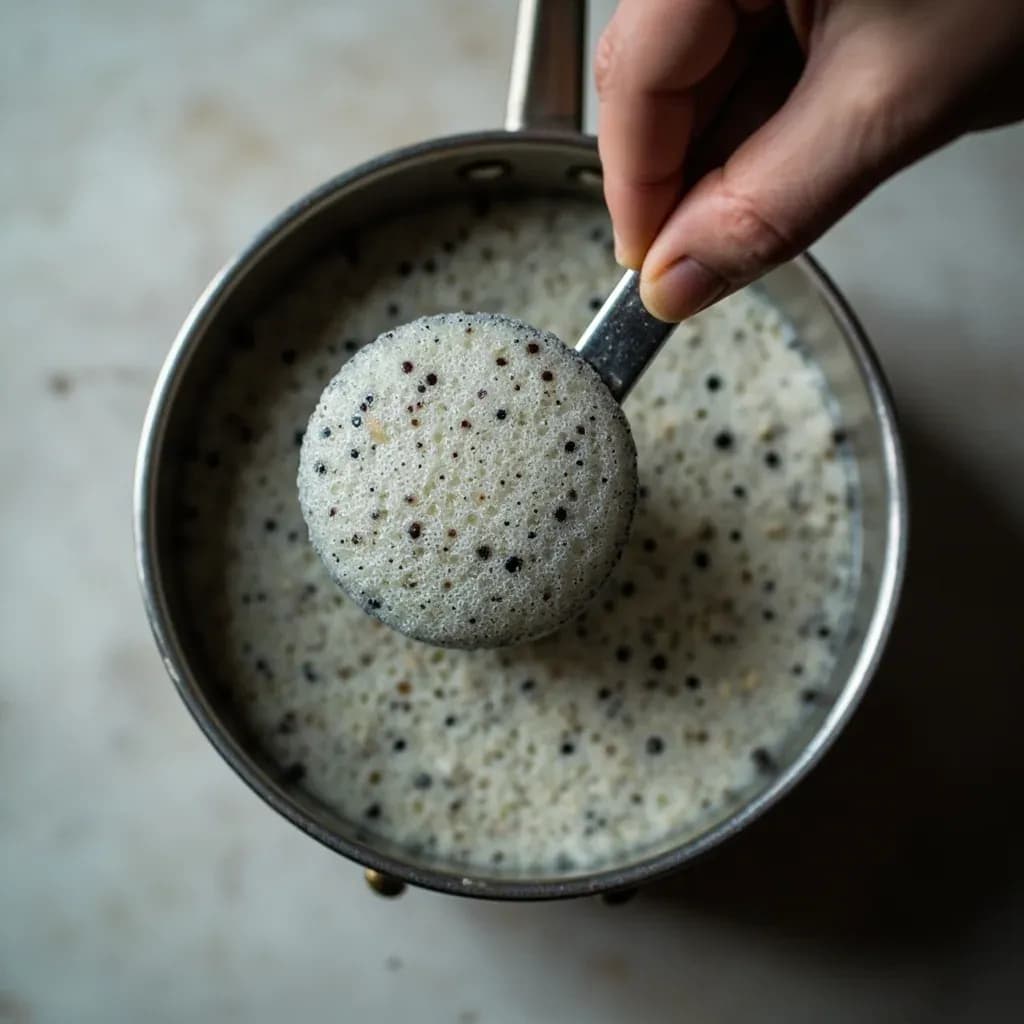
Lifting the grey foam off a simmering stock or broth to keep it clear and clean-tasting.
As stocks, broths, and beans first come to a simmer, coagulated proteins and impurities rise and gather as a grey foam or scum on the surface. Skimming this off with a spoon or ladle in the early stages keeps the finished liquid clear and free of cloudiness and off-flavors. It matters most in the first phase of cooking, after which less scum forms and clear stock can be left to simmer cleanly.
Skimming foam — écumage in French kitchens — is the practice of lifting the grey-white mass of coagulated protein that collects on the surface of a simmering stock, broth, or blanching liquid before it breaks apart and clouds what's below. The foam is mostly albumin and other water-soluble proteins that have denatured with heat, bound up with a little emulsified fat and suspended starch. While it sits intact, you can lift it cleanly; once it disperses, those same proteins turn the liquid milky and contribute the dull, slightly bitter off-notes associated with a poorly made stock.
The technique rests on a handful of habits more than any single tool. A cold-water start gives dissolved proteins time to coagulate into large, buoyant clumps rather than scattering into the liquid. A bare simmer — about 180–195°F (82–90°C), with just an occasional bubble breaking the surface — keeps fat from emulsifying into the stock and keeps foam floating rather than churning back under. And stillness: every stir drags sediment up from the bottom and forces the skimming work to begin again. For most stocks, diligent skimming over the first 30–60 minutes does the heavy lifting; the rest of the simmer needs only occasional touch-ups.
Skimming is the first pass in any serious clarification. For everyday stocks it is often the only one, finished with a cheesecloth strain. For a true consommé, skimming removes the visible foam and an egg-white raft — ground meat, mirepoix, and whites whipped into the cold stock and brought slowly up — traps the suspended particles too fine to lift. Even outside Western technique the move is universal: Chinese soup makers practice 撇浮沫 (piē fú mò) and Japanese cooks lift the akizumi that rises on heating kombu for dashi, all for the same protein-and-clarity reasons. The chemistry is the same in every kitchen.
- Difficulty
- Easy
Types & varieties
Lifting foam off the top with a flat perforated spoon or spider as it appears during simmering — the default method for stocks and broths
Beginning with cold water and skimming repeatedly as the temperature climbs, so proteins coagulate gradually and float rather than dispersing into the liquid
Tipping the pot so foam collects in one spot, then removing it in a single sweep to minimize broth loss — useful for wide, shallow pans
Straining the finished stock through a double layer of damp cheesecloth or muslin to catch fine particles that skimming alone missed
Whipping egg whites with ground meat and mirepoix into a porous 'raft' that traps suspended solids; skimming is the mandatory preliminary step
How to do it
- 1
Start cold and bring up gently
Combine bones, meat, aromatics, and cold water in a stockpot. Heat slowly over medium. Cold water gives dissolved proteins time to coagulate into large, floatable clumps instead of dispersing into the liquid.
- 2
Watch for the first foam
Within 5–15 minutes, a grey-white foam will collect at the edges and across the surface. Begin skimming now — do not wait until the pot is fully hot.
- 3
Hold the pot still
Resist the urge to stir. A still simmer keeps foam on top where you can reach it; stirring drags it back into suspension and pulls sediment up from the bottom.
- 4
Skim with a flat tool
Hold a flat perforated skimmer (écumoire) or fine-mesh spider just below the surface and draw it slowly across, letting the foam drain while the liquid falls back through the holes. Work from the edges inward.
- 5
Discard and repeat
Empty the skimmer into a discard bowl after each pass. Repeat every few minutes during the first hour; new foam keeps surfacing as deeper bones and joints heat through.
- 6
Manage stubborn foam
If foam is thin and refuses to lift cleanly, add a splash of cold water or briefly drop the heat — the temperature drop encourages remaining proteins to coagulate and rise.
- 7
Maintain a bare simmer
Adjust the burner to keep the surface just trembling, with occasional bubbles breaking through. A hard boil emulsifies fat into the stock and undoes all your skimming work.
- 8
Stop skimming once the liquid runs clear
After about 45–60 minutes, foam production drops sharply and the simmering liquid looks clean. From here, occasional spot-skimming is enough.
- 9
Strain as a final step
For a polished stock, line a fine-mesh strainer with a double layer of damp cheesecloth and pour the stock through once it has finished simmering. This catches anything the skimming missed.
- 10
Escalate to raft clarification for consommé
If the goal is crystal-clear consommé, follow skimming with the raft method: combine egg whites, ground lean meat, and finely diced mirepoix, stir into cold stock, then bring slowly to a simmer. The egg-white raft traps the suspended solids that skimming alone cannot reach.
The science behind the foam
The grey foam that climbs the sides of a stockpot is not dirt; it is a chemical event you can predict. As the water warms, soluble proteins — primarily albumin, with smaller amounts of globulin and other blood and tissue proteins — denature and unfold. Their newly exposed hydrophobic regions bond to each other and to any fat droplets in the liquid, forming the loose aggregates we recognize as scum. While those aggregates are large and buoyant they sit on top; once they fragment under agitation or a hard boil, the individual particles become small enough to scatter light and turn the liquid opaque. Skimming works because it interrupts that process at the moment when the aggregates are still liftable.
- Albumin begins coagulating around 140°F (60°C) and finishes by 180°F (82°C)
- Cold water slows the rise through that temperature band, giving proteins time to find each other
- A rolling boil mechanically breaks the aggregates back into tiny particles that stay suspended
- Stirring has the same dispersing effect as a hard boil, just slower
Skimming, degreasing, and raft clarification
Three terms get used loosely for the same pot of liquid, but they target different things and are usually done in sequence. Skimming removes the protein foam that rises during the first hour of simmering. Degreasing removes rendered fat, which can be skimmed hot with a ladle or, more reliably, by chilling the stock until the fat solidifies on top. Raft clarification — the consommé method — uses whipped egg whites (usually with ground lean meat and mirepoix) to form a porous mass that traps suspended solids as the stock is brought slowly to a simmer. The three are complementary: skim first to clear the easy stuff, degrease to keep the finished liquid from feeling greasy, and raft only when you need a crystal-clear result.
Common uses
Tips & pitfalls
- Start with cold water and bring it up slowly; sudden heat locks impurities into the liquid instead of letting them float.
- Never stir a simmering stock — every stir churns up sediment and creates new foam.
- Skim early and often in the first 30 minutes; once foam breaks down and disperses, it is nearly impossible to remove cleanly.
- Use a flat skimmer held nearly parallel to the surface and drawn gently across, rather than plunging a spoon down, which pulls too much liquid with it.
- Keep a small pot of cold water nearby; a tablespoon of cold water added to a simmering stock can drive more stubborn foam to the surface.
- Tilt the pot and rest the lid slightly off-center so foam collects on one side, making removal faster and less wasteful.
- For bone stocks, blanch the bones for 10 minutes, drain, rinse, and start in fresh water — this carries off the worst of the scum before the long simmer even begins.
- Do not fill the pot more than two-thirds full; a fuller pot boils unevenly and traps foam against the rim where it cannot be reached.
Good to know
- Composition of foam
- Mostly albumin and other soluble proteins, with suspended fats and starches
- Best cooking state
- A bare simmer (180–195°F / 82–90°C); a rolling boil emulsifies fat and clouds the liquid
- When foam appears
- Within the first 5–30 minutes of heating, then intermittently as bones release more solids
- Tools commonly used
- Flat perforated skimmer (écumoire), fine-mesh spider, shallow ladle, or a regular spoon
- Effect on clarity
- Removes much of the protein source of cloudiness; a final strain is still recommended for the clearest result
- Effect on flavor
- Reduces bitter, muddy, or 'boiled' off-notes from impurities and excess emulsified fat
- French term
- Écumage (the action); écumoire (the tool)
- Difference from degreasing
- Skimming removes protein foam; degreasing removes liquefied fat — usually done after chilling or with a fat separator
Also called
skimming scum · depouillage · skimming the surface
Dishes that rely on it
Related

Boil
Cook in vigorously bubbling liquid at full rolling heat

Simmer
Hold liquid at a gentle shimmer for tender, unhurried cooking

Poach
Cook gently in barely-trembling liquid for silky, tender results

Steam
Cook in rising vapor to keep color, nutrients, and shape intact

Blanch
Plunge briefly in boiling water, then shock cold to lock color

Braise
Sear, then cook slow in a little liquid until fall-apart tender

Stew
Simmer bite-sized pieces fully submerged into a rich, unified pot

Sous-Vide
Seal and cook in precise warm water for edge-to-edge doneness