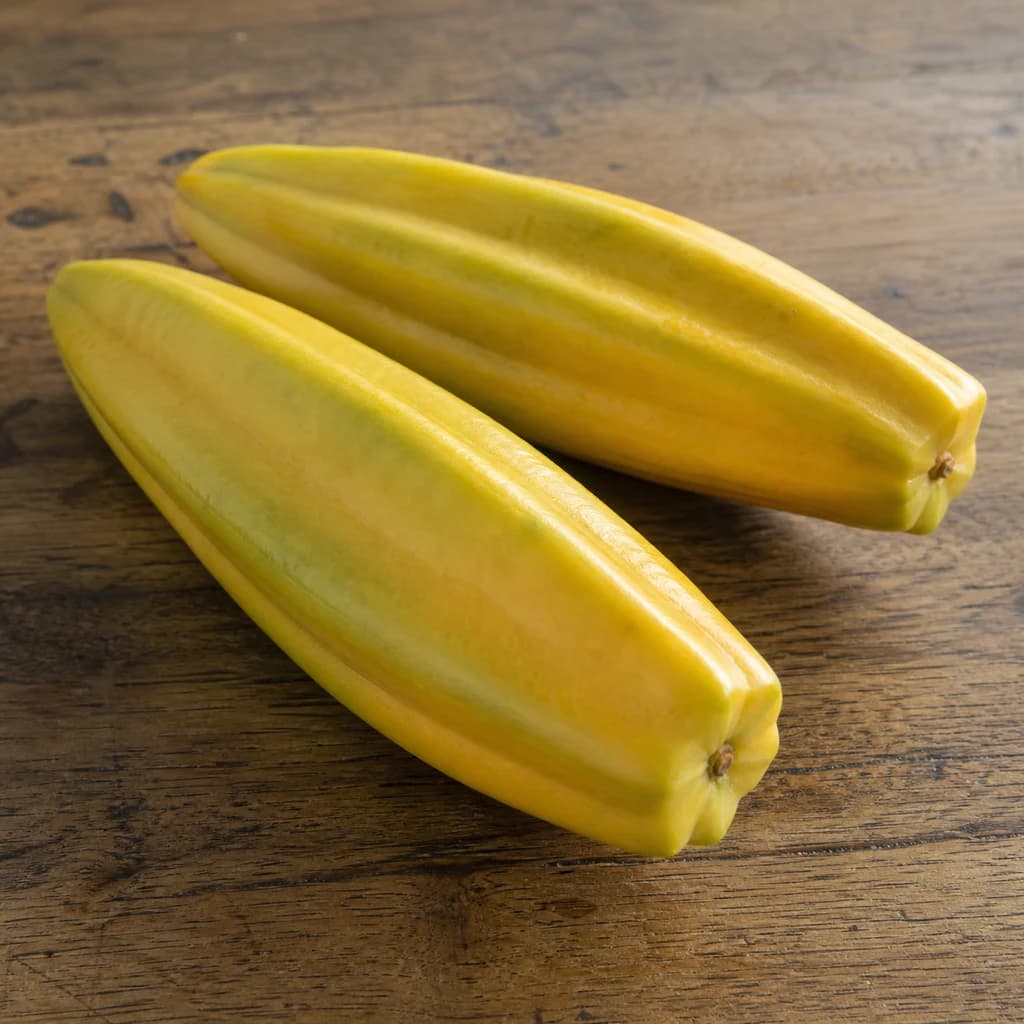
Natural form
Whole babaco fruit showing its distinctive five-sided elongated shape and pale yellow skin.
Teaches readers to recognize the fruit's unique pentagonal cross-section and torpedo-like form in its uncut state.
Produce
Babaco
Seedless five-sided Andean fruit tasting of papaya, pineapple, and strawberry.
Babaco is a seedless, five-sided tropical fruit native to the Andean highlands of Ecuador, related to the papaya. Its juicy, slightly tangy flesh is eaten fresh, juiced, or cooked into preserves, with a flavor blending papaya, pineapple, and strawberry. The whole fruit, including the soft skin, is edible.
Babaco is a natural parthenocarpic hybrid (Vasconcellea × heilbornii) from the high-altitude Andes of Ecuador and Colombia, where it thrives at elevations between 1500 and 2500 meters. Despite belonging to the papaya family, babaco is a distinct fruit entirely—seedless, five-sided in cross-section, and possessing its own tropical complexity. The five-sided symmetry is its most reliable identifying feature and makes it easy to distinguish from any look-alike. Its elongated oval shape, typically 15–30 cm long, yields pale yellow to cream-colored flesh with a melting, juicy texture. The flavor is sweet-tart and multilayered: papaya and pineapple at the base, with strawberry-like floral notes that emerge on the finish. However, this fruit demands respect for its enzymatic nature. Underripe babaco contains proteolytic enzymes similar to papain that cause temporary oral numbness—a warning sign that the fruit is not yet ready. More critically for the kitchen, these same enzymes will prevent gelatin from setting and can over-tenderize meat into mush if left too long in a marinade. Babaco remains a regional specialty with limited global distribution, appearing primarily at farmers' markets and specialty importers during its October-to-March peak season.
- Measured in
- piece
- Storage
- Fridge
Types & varieties
Primary commercial cultivar; the standard five-sided Andean fruit
Larger-fruited selection with same basic characteristics
Understanding Babaco's Enzymes
The proteolytic enzymes in babaco are both an asset and a liability. They make the fruit useful for tenderizing meat, but they create serious problems in certain preparations. Raw babaco will prevent gelatin from setting entirely—the enzymes break down the proteins before the gel can form. Always cook babaco first when using it in aspics, jellies, or any gelatin-based dessert. The same enzymes can over-tenderize meat if the fruit is left in contact for extended periods, turning firm flesh into mush. If you want the tenderizing benefit, limit contact time and then cook the meat immediately.
- Cook babaco before adding to any gelatin-based preparation
- Keep meat contact brief—enzymes work quickly and can over-tenderize
- The temporary mouth numbness from underripe babaco indicates enzyme activity is still high
Selection and Storage
Babaco's short shelf life demands attention. Choose fruit with even yellow-gold skin throughout—no green patches, no soft spots. The flesh should yield slightly at the stem end when ripe. Once ripe, use within 1–2 days for best quality; babaco degrades quickly, becoming mealy and losing its bright tropical character. Refrigerate only when fully ripe, and keep it in the crisper drawer where temperature and humidity are more stable. For longer storage, slice and flash-freeze on a parchment-lined tray, then transfer to airtight bags.
- Even yellow-gold color indicates ripeness
- Use ripe babaco within 1–2 days for peak quality
- Flash-freeze sliced fruit for extended storage
Common uses
Tips & pitfalls
- Select fruit with even yellow-gold skin; avoid any green patches or soft spots
- Ripen at room temperature until fully yellow and slightly yielding at the stem end
- Use immediately when fully ripe—babaco degrades quickly once peak ripeness is reached
- Peel with a vegetable peeler or sharp paring knife, then slice; remove any fibrous core if present
- Strain pureed babaco through a fine-mesh sieve for smooth preparations like sorbet or sauces
- Add a squeeze of citrus juice to stabilize color and flavor when serving raw
- Cook briefly with sugar to make a quick compote that freezes well for later use
- When using in gelatin-based desserts, cook the babaco first to denature the proteolytic enzymes—raw babaco will prevent setting
- Slice and flash-freeze on a parchment-lined tray, then transfer to bags for quick access to pre-prepped fruit
- Do not use in raw meat marinades expecting tenderizing—the enzymes will over-tenderize and create mushy texture if left too long
Nutrition
Energy
180 kJ · per 100 g
Where the calories come from
Protein
0.5g
1% DV
Carbs
10.8g
4% DV
Fat
0.3g
0% DV
Fiber
1.7g
6% DV
Sugars
7.8g
of which
Sodium
8mg
0% DV
Source · USDA FoodData Central · Papayas, raw
View on FDC →In the shops
Matched grocery products
No matched grocery products for Babaco yet.
Good to know
- Scientific Name
- Vasconcellea × heilbornii (pentagonis)
- Family
- Caricaceae (papaya family)
- Origin
- Andes mountains of Ecuador and Colombia, cultivated at 1500–2500m elevation
- Shape
- Pentagonal/five-sided cross-section, elongated oval, 15–30 cm long, 5–10 cm diameter
- Weight
- Typically 500g to 2 kg per fruit
- Flesh Color
- Pale yellow to cream-colored
- Seeds
- Seedless (parthenocarpic hybrid)
- Peak Season
- October to March (winter)
- Shelf Life
- 2–3 days at room temperature when ripe; up to 7 days refrigerated
- Enzymatic Activity
- Contains proteolytic enzymes similar to papain; will tenderize protein and prevent gelatin set if uncooked
Substitutes
- Papaya — Closest substitute; same enzyme profile and melting texture; adjust sweetness as papaya tends to be sweeter
- Pineapple — Provides tropical acidity and texture; lacks the papaya-like flesh consistency; good for juices and cooked applications
- Mango — Offers similar sweetness and tropical fruit character; flesh is firmer; works in salads, desserts, and purees
Pairs with
Also called
Babaco · Mountain Papaya
Appears in these dishes
Related
Tomato
Juicy, sun-sweet fruit for sauces, salads, and slow-cooked depth
Yellow Onion
The aromatic backbone of soups, sofritos, and braises
Garlic
Pungent cloves that perfume nearly every savory dish
Lemon
Bright, acidic citrus that wakes up almost any dish
Potato
Humble, hearty staple — roast, mash, fry, or boil
Carrot
Sweet, crunchy root — raw, roasted, or the base of a sofrito

Cucumber
Cool, crisp, and watery — for salads, pickles, and tzatziki

Lettuce
Crisp leaves for salads, wraps, and a fresh crunch