Produce
Drumstick Pod (Moringa)
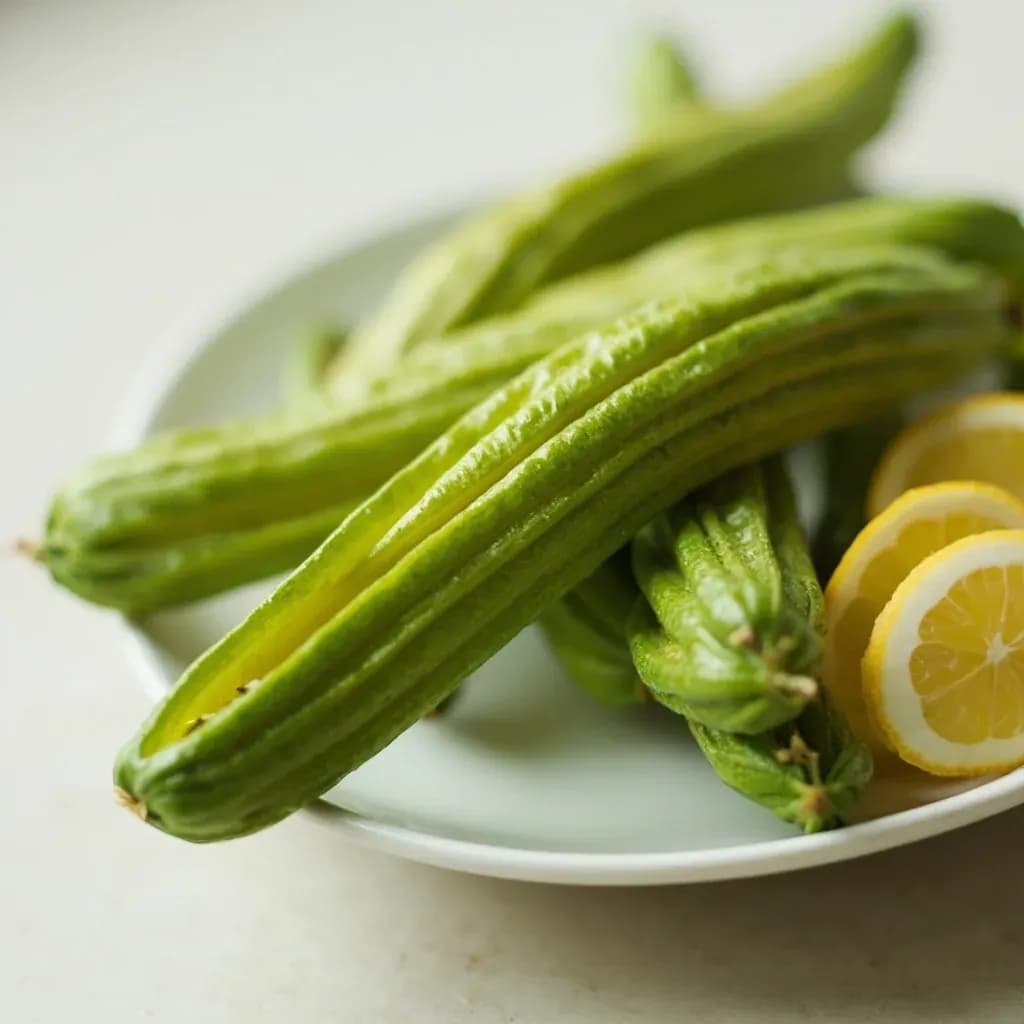
Long, ridged moringa seed pod simmered in South Indian sambar for its tender, asparagus-like pulp.
The drumstick is the long, slender, ridged seed pod of the moringa tree, with a fibrous skin and soft inner pulp that tastes faintly of asparagus and green beans. Cut into batons and simmered, it is a defining vegetable of South Indian sambar and Mauritian curries; the tender flesh is scraped from the inedible woody skin. Both the pod and moringa leaves are valued for their nutrition.
The drumstick pod is the seed pod of Moringa oleifera, a fast-growing tropical tree native to the Himalayan foothills of northern India. The pod grows to 30–90 cm or longer, with a lightly ridged green exterior and a soft, greenish-white pulp surrounding immature white seeds arranged along a central pith. The pulp has a mild, faintly sulfurous flavor when raw that mellows dramatically with cooking, yielding a texture and taste often compared to asparagus or very tender green beans. Nearly every part of the moringa tree is edible — immature leaves and flowers are equally prized in cooking — but the pod is the most widely used in South Asian kitchens. It absorbs the character of its cooking medium, making it adaptable but easily overwhelmed, which is why restraint in seasoning serves it best. The pods travel and store poorly, which has historically confined their use to growing regions, though frozen imports and specialty grocers have expanded access considerably in recent years.
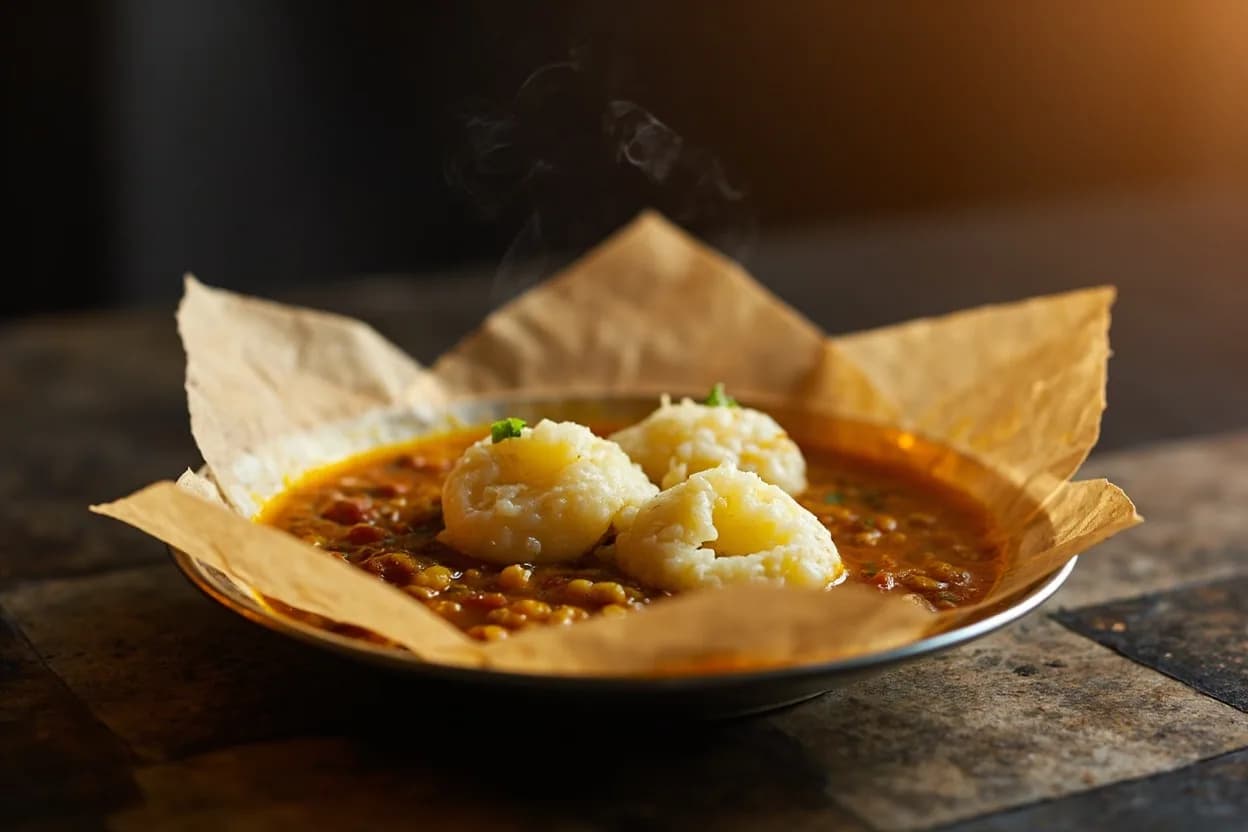
In its native India, drumstick is a signature ingredient in Brahmin-style vegetarian cooking and temple cuisine, particularly in Tamil Nadu, Kerala, and Andhra Pradesh. It appears in sambar — the canonical lentil-vegetable stew — as one of the traditional eight to twelve vegetables, and in kootu, avial, and rasam across the south. The same pods show up in Sri Lanka, the Philippines, East Africa, and the Caribbean wherever moringa thrives, adapted into ginisa, tinola, and West African stews. Outside growing regions, the pods are hard to find fresh and deteriorate rapidly, so sourcing from South Asian, Sri Lankan, or Filipino grocery stores is essential; mainstream Western supermarkets rarely carry them.
The pod's interior structure determines how it is worked with in the kitchen. Three longitudinal ridges run the pod's length, and the pulp clings to these ridges and the surrounding pith. When split and scraped, the yield is roughly 40–50% edible material by weight. The immature seeds inside are edible when young and soft — they taste like small peas — but as the pod matures, the seeds harden and become bitter, functioning only as planting stock. The leaves, by contrast, are significantly more nutritionally dense than the pods, high in vitamin C, calcium, potassium, and iron, and worth seeking out separately.
- Measured in
- piece
- Storage
- Fridge
Types & varieties
High-yielding commercial variety developed in Tamil Nadu; pods are notably longer with more pulp than common varieties
Improved South Indian cultivar with consistent pod quality and reliable flesh yield
Sri Lankan cultivar named for the village of Chavakachcheri; prized for exceptionally tender pods with minimal fiber
West African cultivar adapted to that climate; pods tend to be shorter but well-adapted to regional growing conditions
How to select drumstick pods
Freshness is the single most important quality factor. Choose young, slender pods with a deep, uniform green color and clearly defined ridges running the length. The pod should bend without snapping when held horizontally — this is the test. Thick, woody pods with a dull or yellowish surface are overmature; the pulp will be sparse and the fibers tough. Avoid any pods with brown spots, dry ends, or a visibly shrunken appearance. Because the pods deteriorate rapidly, buy them the day you plan to cook them if possible. If you must hold them, wrap loosely in paper towel, place in a loosely closed bag, and refrigerate for no more than two days.
- Bend test: the pod should flex without breaking — stiffness means maturity and fiber
- Color: deep green throughout; yellowing or dullness indicates age
- Avoid: brown spots, dry or split ends, shriveled surface
How to break and process drumstick pods
The pod's three longitudinal ridges and central pith require a specific technique to extract the pulp efficiently. A heavy knife or cleaver gives you the control needed for the initial split.
- Hold the pod firmly on a stable cutting board
- Using a heavy knife or cleaver, split the pod lengthwise in half or thirds along the ridges
- Use a spoon to scrape the soft pulp away from the ridges and inner pith — the flesh clings tenaciously to the ridges
- Discard the tough outer skin and any hard mature seeds
- Cut the extracted pulp and soft immature seeds into 2-inch pieces for cooking; do not slice into coins or they will disintegrate
- Taste a raw piece: properly fresh pods have a clean, mildly green flavor; bitterness signals age
Common uses
Tips & pitfalls
- Select young, slender pods that bend without snapping — older, thick pods are fibrous and will taste dull and chewy
- Split pods lengthwise with a heavy knife or cleaver, then scrape out the pulp and seeds with a spoon; the pulp clings to the inner ridges and requires deliberate scraping
- Do not overcook — 10–15 minutes of simmering is sufficient; extended cooking turns the pulp mushy and dulls the bright green color
- Add pods late in sambar preparation (last 10–12 minutes) to preserve texture and color; they go in near the end of most wet preparations
- Cut cross-section pieces into 2-inch lengths — do not slice into coins or they will disintegrate entirely during cooking
- When buying frozen or canned drumstick: the texture softens considerably; reduce cooking time and add even later in the process
- Taste a raw piece before cooking — properly fresh pods have a clean, green flavor; bitterness is a reliable indicator of age
- Seeds inside are edible only when young and soft; as the pod matures, seeds become hard and bitter — discard or plant them, do not cook them
Nutrition
Energy
155 kJ · per 100 g
Where the calories come from
Protein
2.1g
4% DV
Carbs
8.5g
3% DV
Fat
0.2g
0% DV
Fiber
3.2g
11% DV
Sodium
42mg
2% DV
Source · USDA FoodData Central · Drumstick pods, raw
View on FDC →In the shops
Matched grocery products
No matched grocery products for Drumstick Pod (Moringa) yet.
Good to know
- Origin
- Indian subcontinent; ancient cultivation in the Himalayan foothills of northern India
- Scientific name
- Moringa oleifera
- Other names
- Malunggay (Filipino), Sajje murungai (Tamil), Murangai (Malayalam), Saragvo (Konkani)
- Typical size
- 30–90 cm long, 1.5–3 cm diameter; pods can exceed 90 cm under ideal growing conditions
- Flavor
- Mild, faintly sulfurous raw; cooked pulp resembles asparagus or tender green beans with a slight earthy quality
- Edible parts
- Pulp surrounding seeds (primary), immature seeds themselves (edible like peas), immature leaves and flowers from the tree
- Peak season
- Spring to early summer in India; year-round in tropical climates (Philippines, Africa, Caribbean)
- Shelf life
- 2–3 days at room temperature; up to 2 days refrigerated; best used very fresh
- Yield
- Pod is split and pulp scraped out; roughly 40–50% edible yield by weight
- Equipment
- Heavy knife or cleaver for splitting pods; spoon for scraping pulp from ridges
Substitutes
- Asparagus — Closest texture and mild flavor; cut into similar lengths and add at the same point in the cooking process
- Green beans — More accessible; cut into 2-inch pieces; will not replicate the specific flavor but holds up similarly in wet preparations
- Okra — Similar mucilaginous quality and ability to thicken stews; different flavor profile but functional in soups and braises
Pairs with
Also called
Brede Mouroum · Moringa Pod · Murungakai
Appears in these dishes
Related
Tomato
Juicy, sun-sweet fruit for sauces, salads, and slow-cooked depth
Yellow Onion
The aromatic backbone of soups, sofritos, and braises
Garlic
Pungent cloves that perfume nearly every savory dish
Lemon
Bright, acidic citrus that wakes up almost any dish
Potato
Humble, hearty staple — roast, mash, fry, or boil
Carrot
Sweet, crunchy root — raw, roasted, or the base of a sofrito
Cucumber
Cool, crisp, and watery — for salads, pickles, and tzatziki

Lettuce
Crisp leaves for salads, wraps, and a fresh crunch