Natural form
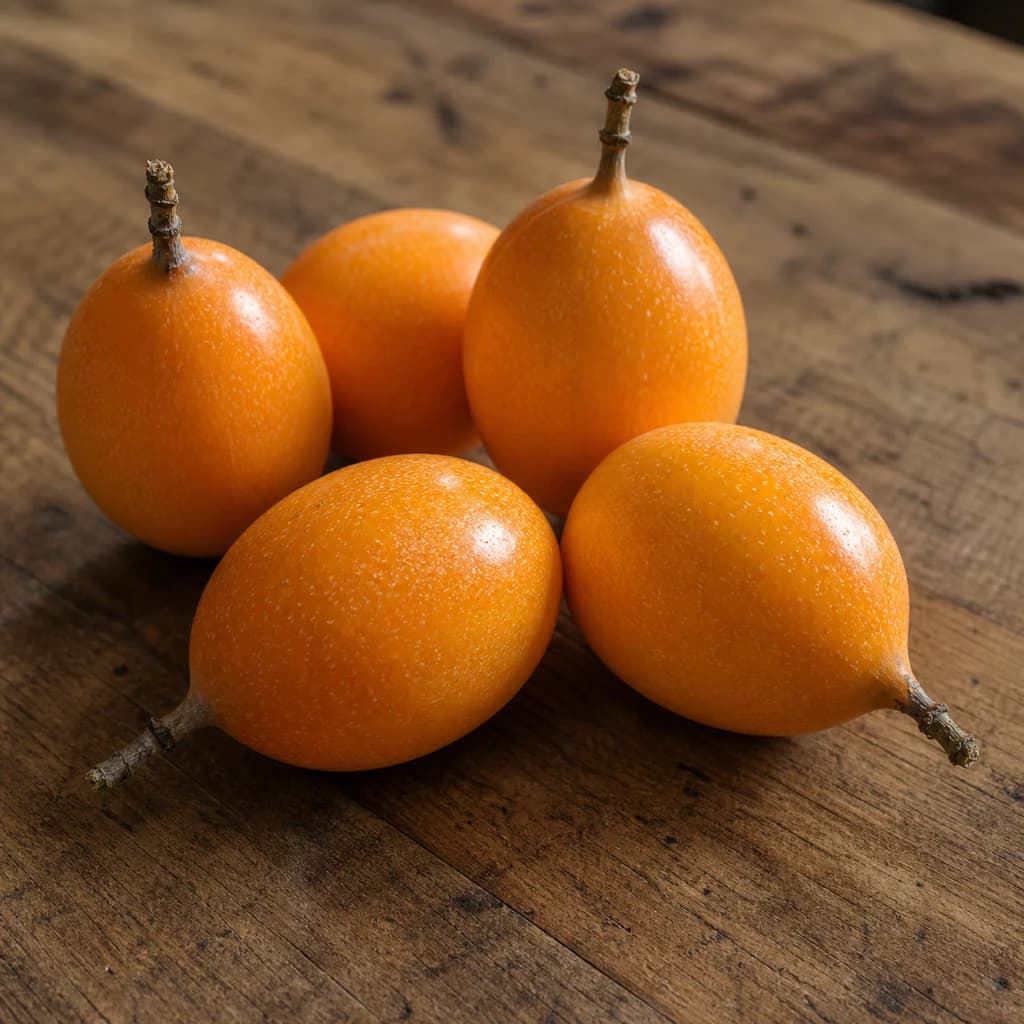
Whole granadilla fruits showing their smooth, bright orange shell and stem.
Establishes the fruit's distinctive oval shape, vivid orange color, and smooth skin so readers can identify it at a market.
Produce
Granadilla
Sweet orange-skinned passionfruit relative with crunchy seeds and aromatic gelatinous pulp.
Granadilla is a passionfruit relative with a smooth orange shell enclosing a slippery, gray-jelly pulp studded with edible crunchy black seeds. Native to the Andes, it is far sweeter and less acidic than common passionfruit, eaten fresh by scooping the pulp straight from the shell or spooning over desserts and into juices. It is a popular breakfast and snack fruit in Colombia, Peru, and Ecuador.
Granadilla (Passiflora ligularis) is a smooth-shelled relative of the more familiar purple passionfruit, native to the high-altitude Andes from Colombia to Bolivia. Its round to oval fruit, 5–8 cm in diameter, ripens to a leathery orange-yellow shell that encases translucent gelatinous pulp threaded with edible black seeds. Unlike its tart purple cousin, granadilla is noticeably sweeter, registering 14–18° Brix at peak ripeness, with a floral honeyed character that carries subtle grape and melon notes. The pulp and seeds are both edible; the shell is discarded. Granadilla is climacteric, meaning it continues to ripen after harvest, and benefits from a brief rest at room temperature before serving. In Andean markets it is often sold under its Quechua name, curuba, and appears in everything from fresh fruit cups to traditional beverages. While widely cultivated throughout South America, it remains relatively obscure outside specialty import retailers, making it a fruit well worth seeking out for its distinctive sweetness and pleasing texture.
- Measured in
- piece
- Storage
- Fridge
Types & varieties
The canonical granadilla; pale orange shell, clear pulp, mildest and sweetest flavor of the group
Elongated yellow fruit; more tart than true granadilla; common in Colombia and Ecuador
Distinct species; wrinkled purple-brown shell when ripe; significantly more acidic; often mislabeled as granadilla in Brazil
Selecting and Ripeness
Granadilla is one of the few fruits where a slight shell wrinkle is a positive sign rather than a flaw. A smooth, unblemished shell can indicate the fruit is still underripe and lacking in sweetness. The most reliable test is weight: select fruits that feel heavy for their size, indicating abundant gelatinous pulp inside.
- Choose heavy fruits with brightly colored, unblemished shells
- A slight wrinkle is acceptable and even desirable — it signals full ripeness
- Avoid fruits with soft spots, mold, or shells that feel hollow when shaken
Opening and Serving
The smooth, leathery shell of granadilla is deceptive — it twists apart more easily than it appears. There are two reliable methods for opening.
- Twist method: Score the equator of the shell with a thumbnail or knife, then twist firmly until the two halves separate
- Scoop method: Slice off the top third of the fruit, then scoop the pulp directly with a spoon
- Serve the pulp fresh, seeds and all — the seeds provide pleasant crunch
- If a smooth texture is required, press the pulp through a fine sieve to remove seeds
Common uses
Tips & pitfalls
- Select fruits that are heavy for their size with unblemished, brightly colored shells — weight is a better indicator than shell smoothness
- A slight wrinkle on the shell signals full ripeness; avoid this advice for other fruits, but it holds true for granadilla
- Refrigerate uncut fruit to extend shelf life up to four weeks, but bring to room temperature before serving for fullest aromatic expression
- To open: score the shell with a knife and twist apart, or slice off the top third and scoop with a spoon
- The black seeds are edible and contribute pleasant crunch — strain them out only when a silky sauce or puree is your goal
- Pulp oxidizes quickly once exposed to air; use within two to three hours, or toss with a squeeze of lemon to slow discoloration
- Do not attempt to juice granadilla in a centrifugal juicer — the seeds clog the mechanism and the pulp's gelatinous texture makes it better suited to blending or straining
- Common mistake: assuming smooth-shell granadilla is always ripe. If the fruit feels light, it lacks pulp and will be disappointingly bland
Nutrition
Nutrition
No USDA FoodData Central match for Granadilla yet. We surface a per-100 g profile once a generic whole-food entry is matched and verified.
In the shops
Matched grocery products
No matched grocery products for Granadilla yet.
Good to know
- Scientific name
- Passiflora ligularis
- Family
- Passifloraceae (passionflower family)
- Origin
- Andean regions of South America (Colombia, Peru, Bolivia, Ecuador)
- Peak season
- Late summer through winter in temperate climates
- Physical description
- Round to oval, 5–8 cm diameter; smooth orange-yellow shell; clear gelatinous pulp with black seeds
- Flavor profile
- Sweet, floral, mildly tropical; honeyed with subtle grape and melon notes; less acidic than purple passionfruit
- pH
- 3.5–4.0 (moderately acidic)
- Shelf life
- 2–3 weeks at room temperature; up to 4 weeks refrigerated
Substitutes
- Purple Passionfruit — More acidic and intensely flavored; use roughly half the quantity and expect a tangier result
- Mango — Offers comparable tropical sweetness and body in purees; lacks the floral notes and seeds but is reliable in desserts
- Litchi — Similar floral sweetness and jelly-like texture; excellent substitute in desserts and beverages
Also called
Sweet Granadilla · Grenadia
Related
Tomato
Juicy, sun-sweet fruit for sauces, salads, and slow-cooked depth
Yellow Onion
The aromatic backbone of soups, sofritos, and braises
Garlic
Pungent cloves that perfume nearly every savory dish
Lemon
Bright, acidic citrus that wakes up almost any dish
Potato
Humble, hearty staple — roast, mash, fry, or boil
Carrot
Sweet, crunchy root — raw, roasted, or the base of a sofrito
Cucumber
Cool, crisp, and watery — for salads, pickles, and tzatziki

Lettuce
Crisp leaves for salads, wraps, and a fresh crunch