Produce
Lychee
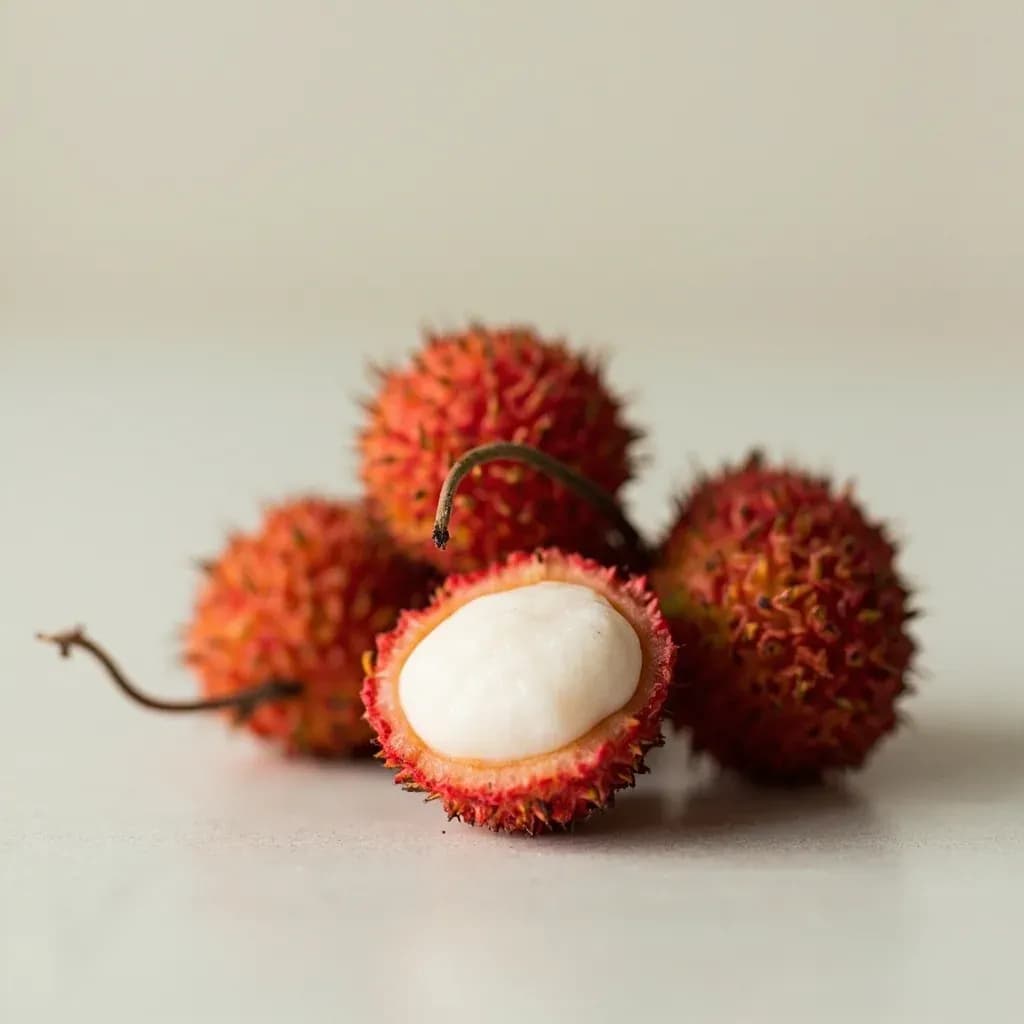
Sweet, floral tropical fruit with rosy bumpy skin and translucent flesh.
Lychee is a small tropical fruit with a rough, rosy-red shell that peels away to reveal translucent, fragrant white flesh around a single seed. Sweet and floral, it is eaten fresh, added to fruit salads and drinks, and used in desserts and cocktails across Asia. It is at its best very fresh, as the flavor fades quickly after picking.
Lychee (Litchi chinensis) is a tropical fruit of exceptional character: its bumpy, papery skin ranges from pink to deep rose, while the translucent flesh beneath is juicy, firm, and intensely sweet with a distinctive floral aroma often described as rose-like. Native to the Guangdong and Fujian provinces of China, where it has been cultivated for over two thousand years, lychee belongs to the Sapindaceae family and is a close relative of the longan and rambutan. The fruit grows in clusters on evergreen trees and is characterized by a single inedible seed at its center—some premium varieties are nearly seedless. In Western kitchens, lychee was largely unknown until the late twentieth century, despite Marco Polo's accounts of the fruit in thirteenth-century China. It gained mainstream popularity in the 1990s through tiki cocktail culture and tropical dessert trends, but in Cantonese, Thai, and Indian cuisines it has long been a fixture of both savory and sweet preparations.
Fresh lychee has a short shelf life—two to three days at room temperature—and its quality deteriorates quickly once purchased. Refrigeration extends this to two to three weeks if stored properly, but the fruit's delicate floral notes fade with time. Lychee's mildly acidic pH (4.5–5.5) makes it versatile for both sweet and savory applications, and its firm texture holds up better than many tropical fruits when poached or grilled. The edible portion represents only 60–65% of the whole fruit once skin and seed are removed, so purchasing by weight requires accounting for this significant waste. When selecting fresh lychee, look for bright, unblemished skin with a subtle floral fragrance—the fruit should feel heavy and firm, indicating good juice content.
Nutritionally, lychee is notable for its exceptional vitamin C content—119% of the daily value per 100 grams—along with copper, potassium, iron, and moderate B vitamins. Despite its sweetness, it contains only 66 calories per 100 grams, making it a relatively light fruit option. Lychee is available in several forms beyond fresh: frozen (peeled and pitted), canned in syrup, dried (sometimes called lychee nuts), as juice or nectar, and preserved in liqueur. Each form behaves differently in the kitchen, and understanding these differences is key to using lychee successfully across a range of dishes.
- Measured in
- g
- Storage
- Fridge
Types & varieties
Considered the highest-quality Chinese variety; large, heart-shaped fruit with nearly seedless flesh and exceptional sweetness
Named for the dark foliage of the tree; premium export variety with rich, honeyed flavor and good flesh-to-seed ratio
Dominant commercial variety in Florida and Hawaii; large fruit with sweet, spicy flesh and prominent seed; late-season
Common in South Africa, Florida, and commercial production; excellent flavor, smaller seed; mid-season
Widely grown in California and Hawaii; early-season, very sweet with mild acidity; tendency toward small seed
Grown in China and exported widely; compact, intensely sweet flesh
Smaller fruit, early-season; firm flesh, less aromatic than premium types; good for canning
Very large fruit with thick flesh; primarily a garden variety rather than commercial crop
Understanding Lychee Quality
The gap between a mediocre lychee and an exceptional one is enormous. Most commercial lychees in Western supermarkets are picked underripe to survive transit, which means they lack the full floral intensity of tree-ripened fruit. When possible, seek out lychees from specialty Asian grocers or farmers' markets where the supply chain is shorter. The fragrance is your best indicator—fully ripe lychee smells unmistakably floral, almost perfumed. If you encounter lychee with a slight brownish tinge to the skin, do not automatically reject it; this can simply indicate ripeness rather than spoilage, particularly in varieties like Mauritius. However, avoid fruit that feels lightweight (a sign of desiccation), has sticky surfaces (fermentation has begun), or emits an off or fermented odor.
- Bright pinkish-red skin with slight browning at the stem end is acceptable; avoid dull, shriveled, or sticky fruit
- The fruit should feel heavy for its size—light weight indicates moisture loss and poor juice content
- A faint floral fragrance confirms ripeness; completely odorless lychees are underripe and will lack sweetness
- Skin that clings tightly to the flesh indicates underripe fruit; properly ripe lychee releases easily from the flesh
Working with Fresh Lychee
Peeling fresh lychee requires a simple technique. The skin adheres firmly at the stem end, so begin by pinching and twisting at that point to create an opening. You can then work your fingers under the skin and pull it away in one piece. Alternatively, score the skin around the equator with a thumbnail and peel as you would an egg. For applications where the flesh must be pristine—garnishes for fine desserts, or whole fruit for cocktails—chilling the lychees for 30 minutes before peeling makes the skin contract slightly and release more cleanly. Once peeled, always remove the dark seed, which is astringent and unpleasant. Some varieties like No Mai Tsz have such small seeds they are nearly seedless, but never assume this without checking. The flesh discolors quickly once exposed to air, so work quickly or keep peeled fruit refrigerated in a sealed container until needed.
- Pinch and twist at the stem end to start peeling; the skin comes away more easily from that point
- Score around the equator if the skin clings stubbornly; peel after a brief chill for cleaner results
- Remove the seed from every piece—the astringency will ruin a dish
- Work quickly with peeled flesh; it oxidizes and loses floral notes within minutes
Common uses
Tips & pitfalls
- Select fruit that is firm, plump, and bright pinkish-red; avoid dull, brownish, or shriveled specimens
- Fresh lychees should have a faint floral fragrance—odorless fruit may be underripe
- To peel: pinch and twist at the stem end, or score the skin with a thumbnail and peel back
- The seed is astringent and should always be removed; some varieties are nearly seedless
- If flesh clings stubbornly to the skin, score around the equator and peel after a brief chill
- Eat or cook with fresh lychees within 2–3 days of purchase for best texture and flavor
- Refrigerate unpeeled lychees in a loosely closed bag to maintain moisture without promoting mold
- To freeze: peel, pit, and spread on a sheet pan in a single layer before transferring to a bag (prevents clumping)
- Canned lychees are softer and often less aromatic—drain and pat dry if using in pastries or cocktails
- When cooking with lychee (poaching, sautéing), limit heat and time: brief cooking preserves the delicate floral character
- Dried lychee (known as lychee nuts) are chewy, caramel-like, and best rehydrated or used in braises
- If buying from an Asian grocery, ask for the harvest date—quality varies more than in specialty markets
Nutrition
Energy
276 kJ · per 100 g
Where the calories come from
Protein
0.8g
2% DV
Carbs
16.5g
6% DV
Fat
0.4g
1% DV
Fiber
1.3g
5% DV
Sugars
15.2g
of which
Sodium
1mg
0% DV
Source · USDA FoodData Central · Litchis, raw
View on FDC →In the shops
Matched grocery products
No matched grocery products for Lychee yet.
Good to know
- Scientific name
- Litchi chinensis (Sapindaceae family)
- Origin
- Guangdong and Fujian provinces, China; cultivated for over 2,000 years
- Peak season
- May through August (Northern Hemisphere)
- Primary growing regions
- China, India, Thailand, Vietnam, South Africa, Australia, Mexico, Hawaii, South Florida, California
- Calories
- 66 kcal per 100 g fresh fruit
- Key nutrients
- Vitamin C (119% DV per 100g), copper, potassium, iron, moderate B vitamins
- Edible portion yield
- Approximately 60–65% (skin and seed discarded)
- Shelf life (fresh)
- 2–3 days at room temperature; up to 2–3 weeks refrigerated in a loosely closed bag
Substitutes
- Longan — Closely related; milder, less floral flavor but similar texture; 1:1 substitute in both sweet and savory applications
- Rambutan — Similar tropical profile; slightly firmer texture, neutral sweetness; good in salads and garnishes
- Red grapes — Partial substitute for texture and mild sweetness in salads and desserts; lacks the floral notes
- Canned lychees — Acceptable for cooked preparations, desserts, and cocktails when fresh are unavailable; texture is softer
Pairs with
Also called
Letchis · Litchi
Related

Tomato
Juicy, sun-sweet fruit for sauces, salads, and slow-cooked depth

Yellow Onion
The aromatic backbone of soups, sofritos, and braises

Garlic
Pungent cloves that perfume nearly every savory dish

Lemon
Bright, acidic citrus that wakes up almost any dish

Potato
Humble, hearty staple — roast, mash, fry, or boil

Carrot
Sweet, crunchy root — raw, roasted, or the base of a sofrito

Cucumber
Cool, crisp, and watery — for salads, pickles, and tzatziki

Lettuce
Crisp leaves for salads, wraps, and a fresh crunch