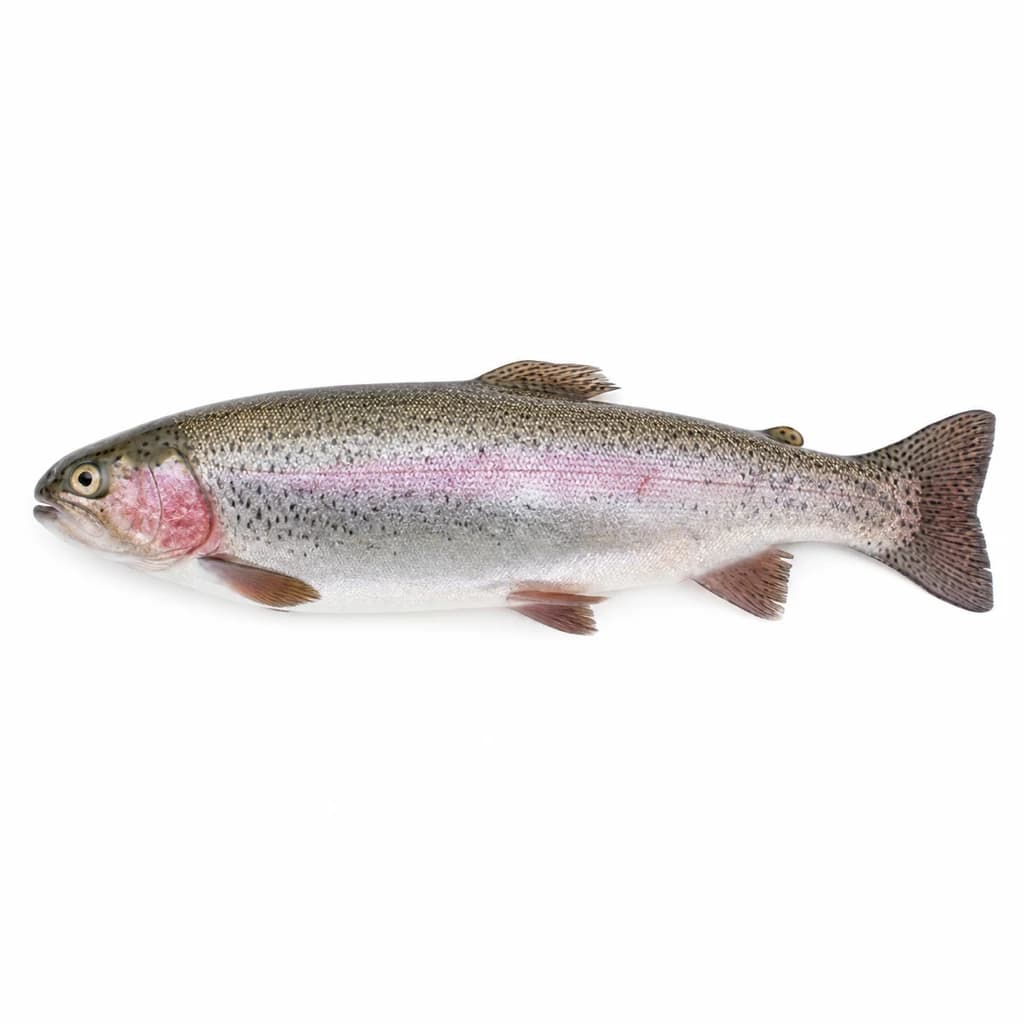
Natural form
Whole fresh rainbow trout showing iridescent skin, pink lateral stripe, and speckled pattern.
Establishes the fish's unmistakable exterior markings, body shape, and scale coloration for identification.
Proteins
Rainbow Trout (Kirjolohi)
Freshwater fish with delicate pink-orange flesh and mild, slightly nutty flavor; pan-fried or baked.
Rainbow trout is a freshwater fish with tender, mildly nutty flesh ranging from pale pink to orange. It is commonly pan-fried, baked, grilled, or smoked, often served whole or as fillets. Widely farmed, it is a Nordic staple known in Finnish as kirjolohi.
Rainbow trout (Oncorhynchus mykiss) belongs to the same genus as Pacific salmon, a kinship that explains its distinctive pink-orange flesh—a hue derived from dietary astaxanthin, whether from wild crustaceans or supplemented farm feed. The farmed variety—dominant in most markets and known in Finland as kirjolohi—originates primarily from Denmark, Italy, France, and Chile, where efficient aquaculture makes it one of the more sustainable finfish options when sourced from certified operations. Its flavor sits in a careful middle ground: milder and less gamey than brook or brown trout, with a sweet undertone and faint nutty quality that makes it broadly appealing yet easy to overwhelm with heavy seasoning.
The flesh is fine-grained and tender when cooked, flaky without being dry—provided you do not overcook it. A 1-inch fillet reaches medium doneness in roughly 8 minutes total over medium-high heat. The skin, incidentally, is entirely edible and crisps beautifully in a hot pan, a technique many home cooks discard unnecessarily. One structural concern: rainbow trout carries pin bones running from just behind the head cavity to the tail along the ribcage edges. These must be removed with tweezers before cooking; pre-portioned fillets from retail cases frequently have them still embedded.
Farmed and wild trout behave differently in the pan. Farmed specimens carry more internal fat, which insulates the flesh and tolerates slightly longer cooking or gentler heat. Wild trout, leaner and more delicate, overcook quickly and respond best to high heat with abundant fat, finishing the cook at reduced temperature to avoid a dry, tight texture. Both benefit from room temperature before hitting the pan and aggressive seasoning applied moments before cooking rather than earlier.
- Measured in
- g
- Storage
- Fridge
Allergens
Types & varieties
Anadromous (sea-run) form of rainbow trout; firmer flesh, deeper orange color, more pronounced flavor. Cook slightly faster than standard rainbow trout fillets of equivalent thickness.
Darker flesh, stronger nutty flavor, lower fat content. Sourced from rivers and lakes in the Pacific Northwest and Rocky Mountains. Overcooks easily—monitor closely.
Milder flavor, lighter flesh color, higher fat content. The dominant commercial variety. Tolerates more forgiving cooking times and lower heat than wild specimens.
Landlocked populations; similar to wild river trout in flavor profile but often reach larger sizes. Adjust cooking time to match fish weight.
Pin Boning Trout Fillets
Pin bones are a structural fact of rainbow trout and must be removed before cooking. They run along the ribcage edges from just behind the head cavity to the tail. Use needle-nose tweezers—not a knife alone. Grip each bone close to the flesh and pull straight out toward the tail end at a slight backward angle; twisting tears the flesh. Work from the thickest end toward the tail. If you encounter a bone that breaks, use your fingertips to locate and extract any remaining fragment. A properly pin-boned fillet will have a smooth, clean surface with no resistance when drawn across your fingertip.
- Work with skin-on fillets for better grip and control during removal
- Needle-nose tweezers are the right tool for the smaller posterior bones; pliers work better for larger anterior bones near the head end
- Run your fingertips firmly across the flesh both directions to locate all bones before pulling
- A properly pin-boned fillet should have a smooth, unblemished surface with no residue when drawn across your fingertip
Wild vs. Farmed: Adjusting Your Approach
The fat content difference between wild and farmed rainbow trout is the single most important factor governing how you cook it. Farmed trout carry substantially more internal fat—visible as subtle marbling in raw fillets—which acts as built-in basting and insulates the flesh. This means farmed trout tolerates gentler heat, longer cook times, and lower oven temperatures without drying out. A farmed fillet can comfortably go into a 375°F oven or a medium-low pan. Wild trout, by contrast, has little margin for error. Cook wild specimens over high heat with abundant butter or oil, reducing to medium only if the fillet is thick. The flesh opacity test—watching for opaque flesh advancing from the edges toward the center—is more reliable than any time guideline, since thickness varies. Buying whole and filleting yourself is the best way to know which you have, because farmed and wild fillets look and feel noticeably different at the counter.
- Farmed trout: visible marbling, lighter flesh, higher fat—tolerates forgiving cook times
- Wild trout: darker flesh, lean, minimal marbling—requires high heat and close attention
- Wild trout cooks faster at the same thickness; adjust your timing accordingly
- When in doubt about provenance, cook on the wild-trout parameters (faster, hotter) to avoid overcooking the farmed fish
Flavor Affinities
Rainbow trout has a gentle, approachable flavor that partners well with assertive accompaniments without being dominated by them. Brown butter is the foundational pairing—the toasted, nutty notes of beurre noisette amplify the trout's own inherent nuttiness, making it the default choice for meunière, pan sauce, and compound butter applications. Acid is equally important: lemon zest and juice in equal measure cut through the richness and brightness the fat, while capers add a briny, saline edge that wakes up the palate between bites. Fresh herbs play supporting roles—dill for Scandinavian preparations like gravlax or baked presentations, chives and chive blossoms for their mild onion character that never overwhelms the delicate flesh. Toasted almonds folded into brown butter add crunch and echo the nutty flavor note already present. For smoked trout preparations, cool and clean accompaniments like raw cucumber or potato salad refresh the palate. Sorrel, with its tart, lemony leaves, is underused but exceptional—it wilts into butter as a side dish or dresses a salad alongside smoked trout with remarkable harmony.
- Brown butter + lemon + capers: the classic meunière trifecta, reliable across all cooking methods
- Dill, chives, sorrel: fresh herbs for baked, poached, or smoked preparations
- Toasted almonds: textural contrast that reinforces the fish's nutty quality
- Cucumber and sorrel: acidic, cooling elements that cut through richness, especially with smoked trout
- Dry white wine (Sauvignon Blanc, Pinot Grigio, Grüner Veltliner) for deglazing pan sauces
Common uses
Tips & pitfalls
- Purchase whole and fillet yourself when possible—pre-portioned retail fillets frequently have embedded pin bones that should have been removed
- Score the flesh along the lateral line before cooking to prevent the fillet from curling during heat exposure
- Bring fish to room temperature for 20 minutes before cooking to ensure even heat penetration throughout the fillet
- The skin crisps beautifully in a hot pan and is entirely edible—do not peel it off before cooking
- A 1-inch thick fillet needs approximately 4 minutes per side over medium-high heat, but use the flesh opacity test rather than relying on time alone
- Farmed trout's higher fat content makes it more forgiving; wild trout is lean and overcooks quickly—err toward higher heat and shorter time
- Season aggressively at the last moment before cooking—salt draws moisture and will steam the fish instead of developing a sear
- Common mistake: maintaining high heat throughout. Begin high for the skin side to render and crisp it, then reduce to medium for the second side to cook the flesh evenly without burning the exterior
- Store fresh trout on crushed ice in a bowl—no direct contact with water, and never in sealed plastic where CO₂ off-gassing creates off-flavors
Nutrition
Energy
590 kJ · per 100 g
Where the calories come from
Protein
19.9g
40% DV
Carbs
0g
0% DV
Fat
6.2g
8% DV
Fiber
0g
0% DV
Sugars
0g
of which
Sodium
51mg
2% DV
Source · USDA FoodData Central · approx. Fish, trout, rainbow, farmed, raw
View on FDC →In the shops
Matched grocery products
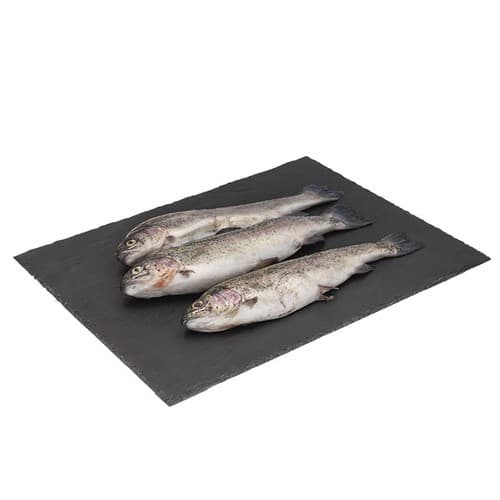 €2.50
€2.50Rainbow Trout
ud · Bonpreu
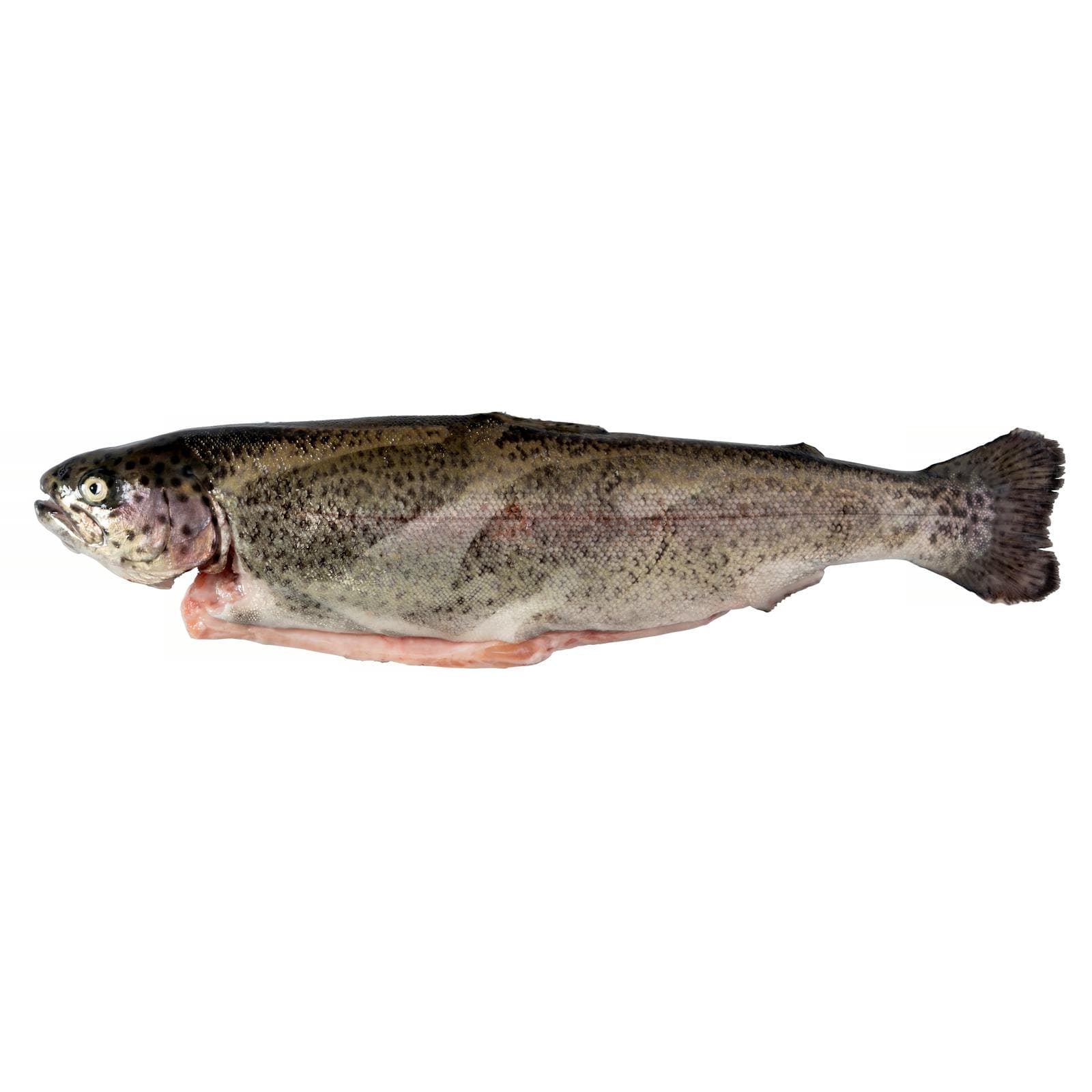 €3.94
€3.94Rainbow Trout Finless
440 g · Mercadona
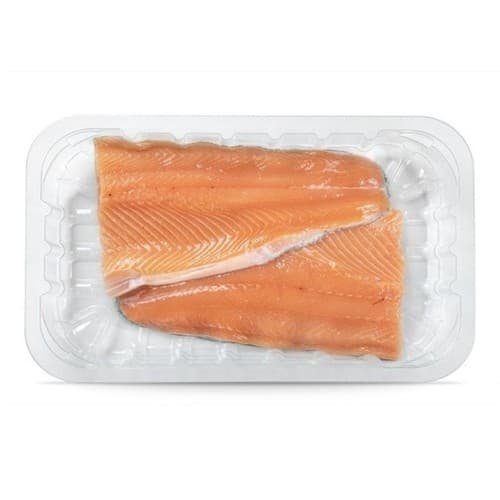 €5.99
€5.99Rainbow Trout Fillet
kg · Bonpreu
 €3.50
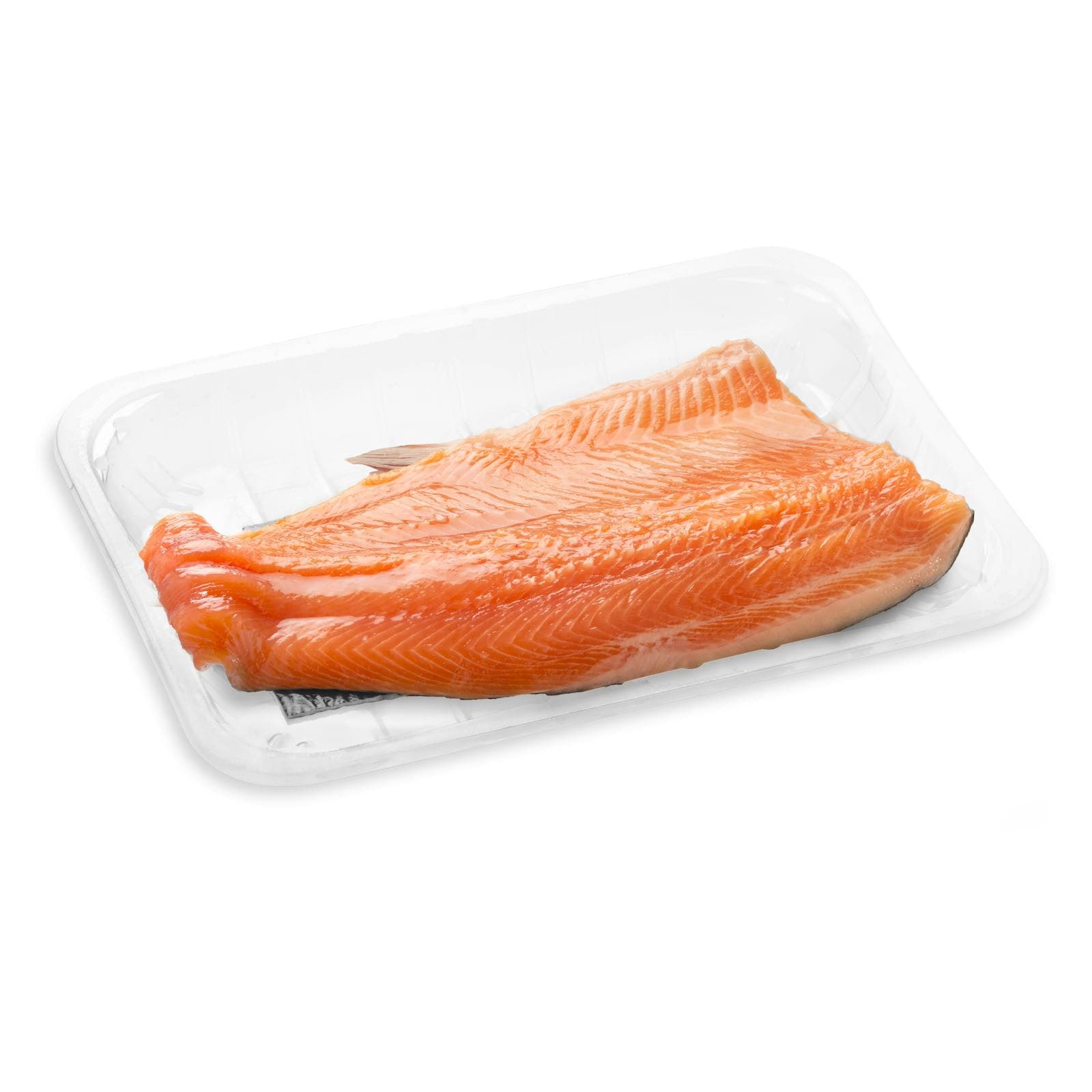
€3.50Rainbow Trout Fillets
226 g · Mercadona
 €5.49
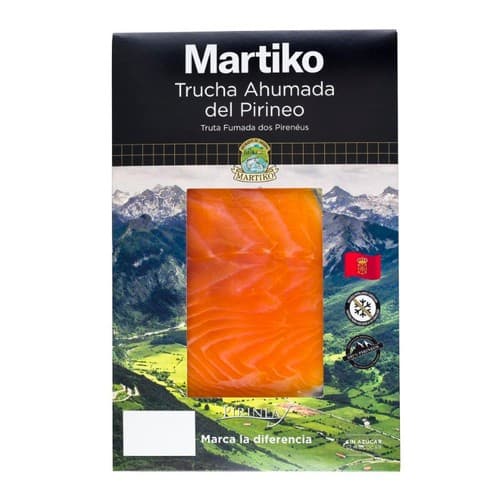
€5.49MARTIKO Smoked Rainbow Trout from the Pyrenees
MARTIKO · kg · Bonpreu
Good to know
- Scientific Name
- Oncorhynchus mykiss
- Origin
- Cold freshwater rivers of North America and Pacific Northwest; now farmed worldwide, with major production in Denmark, Italy, France, and Chile
- Season
- Year-round; peak quality spring through early autumn for both wild and farmed
- Average Size
- 1–3 lbs (450g–1.4kg) whole fish; fillets typically 6–10 oz (170–280g)
- Flesh Color
- Pink to coral-orange, with a subtle darker lateral line running the length of the fillet
- Flavor Profile
- Mild and delicate; sweet undertone with a faint nutty quality; less gamey than other trout species
- Texture
- Fine-grained, tender, and flaky when cooked; moist if not overdone
- Yield
- Approximately 45–50% from whole fish to skin-on fillet; pin bones must be removed from all fillets
- Shelf Life
- 1–2 days refrigerated on ice; up to 3 months frozen at 0°F (-18°C)
- Price Point
- Moderate; farmed varieties are consistently affordable; wild-caught commands a premium
Substitutes
- Brook Trout — Slightly sweeter and more delicate; use 1:1 ratio but monitor cooking time as brook trout cooks faster than rainbow trout
- Arctic Char — Comparable fat content and mildness; flesh is slightly firmer; excellent 1:1 substitute in all preparations
- Steelhead — Direct substitute with a more pronounced trout flavor; reduce cooking time slightly if fillet is thinner than the original
- Atlantic Salmon — Richer flavor and higher fat content; reduce cooking temperature to avoid drying out the milder trout flesh
- Large Pan-Dressed Trout (any species) — For whole fish preparations, interchangeable with care to match cooking times to fish weight and fat content
Pairs with
Also called
Kirjolohi
Related

Egg
The kitchen's everything ingredient — bind, leaven, enrich, or fry

Chicken Breast
Lean, quick-cooking white meat for everyday dinners

Ground Beef
Versatile minced beef for burgers, ragù, tacos, and meatballs

Pork Loin
Lean, tender roasting cut that stays juicy with care

Salmon
Rich, rosy fish that roasts, grills, or cures beautifully

Egg White
Pure protein that whips to airy peaks for meringue and more

Egg Yolk
Rich, golden yolk for custards, mayonnaise, and pasta

Quail Egg
Tiny, speckled eggs for garnishing and elegant bites